1921
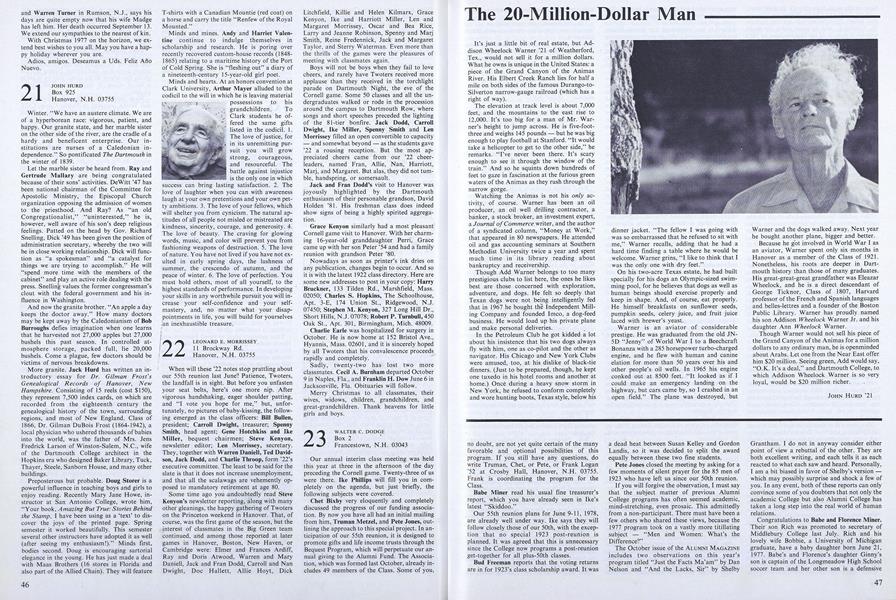
Winter. “We have an austere climate. We are of a hyperborean race: vigorous, patient, and happy. Our granite state, and her marble sister on the other side of the river, are the cradle of a hardy and beneficent enterprise. Our institutions are nurses of a Caledonian independence." So pontificated The Dartmouth in the winter of 1839.
Let the marble sister be heard from. Ray and Gertrude Mallary are being congratulated because of their sons’ activities. DeWitt ’47 has been national chairman of the Committee for Apostolic Ministry, the Episcopal Church organization opposing the admission of women to the priesthood. And Ray? As “an old Congregationalist,” “uninterested,” he is, however, well aware of his son’s deep religious feelings. Patted on the head by Gov. Richard Snelling, Dick ’49 has been given the position of administration secretary, whereby the two will be in close working relationship. Dick will func- tion as “a spokesman” and “a catalyst for things we are trying to accomplish.” He will “spend more time with the members of the cabinet” and play an active role dealing with the press. Snelling values the former congressman’s clout with the federal government and his in- fluence in Washington.
And now the granite brother. “An apple a day keeps the doctor away.” How many doctors may be kept away by the Caledonianism of BobBurroughs defies imagination when one learns that he harvested not 27,000 apples but 27,000 bushels this past season. In controlled at- mosphere storage, packed full, lie 20,000 bushels. Come a plague, few doctors should be victims of nervous breakdowns.
More granite. Jack Hurd has written an in- troductory essay for Dr. Gilman Frost’sGenealogical Records of Hanover, NewHampshire. Consisting of 15 reels (cost $150), they represent 7,500 index cards, on which are recorded from the eighteenth century the genealogical history of the town, surrounding regions, and most of New England. Class of 1866, Dr. Gilman Dußois Frost (1864-1942), a local physician who ushered thousands of babies into the world, was the father of Mrs. Jens Fredrick Larson of Winston-Salem, N.C., wife of the Dartmouth College architect in the Hopkins era who designed Baker Library, Tuck, Thayer, Steele, Sanborn House, and many other buildings.
Preposterous but probable. Doug Storer is a powerful influence in teaching boys and girls to enjoy reading. Recently Mary Jane Howe, in- structor at San Antonio College, wrote him, “Your book, Amazing But True: Stories Behindthe Stamp, I have been using as a ‘text’ to dis- cover the joys of the printed page. Spring semester it worked beautifully. This semester several other instructors have adopted it as well (after seeing my enthusiasm!).” Minds first, bodies second. Doug is encouraging sartorial elegance in the young. He has just made a deal with Maas Brothers (16 stores in Florida and also part of the Allied Chain). They will feature T-shirts with a Canadian Mountie (red coat) on a horse and carry the title “Renfew of the Royal Mounted.”
Minds and mines. Andy and Harriet Valen-tine continue to indulge themselves in scholarship and research. He is poring over recently recovered custom-house records (1848- 1865) relating to a maritime history of the Port of Cold Spring. She is “fleshing out” a diary of a nineteenth-century 15-year-old girl poet.
Minds and hearts. At an honors convention at Clark University, Arthur Mayer alluded to the codicil to the will in which he is leaving material possessions to his grandchildren. To Clark students he of- fered the same gifts listed in the codicil, 1. The love of justice, for in its unremitting pur- suit you will grow strong, courageous, and resourceful. The battle against injustice is the only one in which success can bring lasting satisfaction. 2. The love of laughter when you can with awareness laugh at your own pretentions and your own pet- ty ambitions. 3. The love of your fellows, which will shelter you from cynicism. The natural ap- titudes of all people not misled or mistreated are kindness, sincerity, courage, and generosity. 4. The love of beauty. The craving for glowing words, music, and color will prevent you from fashioning weapons of destruction. 5. The love of nature. You have not lived if you have not ex- ulted in early spring days, the lushness of summer, the crescendo of autumn, and the peace of winter. 6. The love of perfection. You must hold others, most of all yourself, to the highest standards of performance. In developing your skills in any worthwhile pursuit you will in- crease your self-confidence and your self- mastery, and, no matter what your disap- pointments in life, you will build for yourselves an inexhaustible treasure.
Box 925 Hanover, N.H. 03755
More From This Issue
-
 Feature
A Story: His Grandmother and Vincent
December | January 1977 -
 Feature
The Well-Tempered Synclavier
December | January 1977 -
 Feature
Reflections on an $8-million post office The Hopkins Revolution
December | January 1977 -
 Article
Resident Rotiferologist
December | January 1977 -
 Class Notes
1971
December | January 1977 -
 Sports
The Coach Departs
December | January 1977