1950
Spring came early. In late March the forsythia bloomed to grace Easter. But the North Country remains cruel, tantalizing, taking what it gives, reverting from promise to threat. The dogwood blossoms blended with the swirl of April snows.
Remember those lazy days. The warming sun teased. Books lay forsaken for an afternoon. Tanning was the order of the day, until. The inevitable always intervened, perhaps after two days, three at most. Then the wind swung into the north, the black clouds crossed the river, and the rain chilled. The promise vanished.
But April always stretched into May the evenings lengthened with the greening grass the elms filled out and cast those mystic shadows as the songs at hums spread over the campus in the glowing twilight before cool nights drifted into mornings sparkling with freshets of dew as time stood still for wetdown and ceremony until June came and the dream ended for three years when exams were over and then forever with graduation except for the stolen return trips as spring evolves except for lingering memories.
Spring in the North Country lacks flowers; their time is June, late June. It lacks the slow unfolding of a gentler pace. It comes, reluctantly at first, then with a rush; there is the promise, then the fulfillment, suddenly, when least expected. The time was special in the springtime of our lives.
The man-in-the-news New York Timesstyle has been a New Jersey judge, one ascribed to have an acerbic pen. Having drawn more than his share of big ones from randomly assigned cases, he has won a reputation "for the length, thoroughness, elegance, and, in particular, pungency of his opinions, which belie his generally courteous courtroom demeanor." His targets include the IRS, the Federal Department of Health and Human Services, and the Small Business Administration; the foibles of one are freely translated into the transgressions of another with such observations as "government at its heartless, rigid, and Orwellian bureaucratic worst." Recently, in overturning the triple murder conviction of ex-boxer Rubin "Hurricane" Carter and John Artis, citing grave constitutional errors by prosecutors, he wrote, "The need to combat crime should never be utilized to justify an erosion of our fundamental guarantees. Indeed, the growing volume of criminal cases should make us more vigilant; the greater the quantity, the greater the risk to the quality of justice." The pen belongs to Marjorie's husband and Senator Bill Bradley's friend, Federal District Judge Lee Sarokin. He presides well.
Once upon a time no one believed the prediction that the next stop for GerrySarno was New York. It was. Now the Perini Corporation is relocating Gerry and Ginny to Boston, where he will be vice president of business development for the realigned Construction Group. Gerry will be where the action is for heavy construction and for Perini. He still has to explain his association with The Moles, which sounds more like an assignation with the CIA than something to do with engineering. The only question now is whether the next stop will be Hanover or Revere.
When he gave up the presidency of Bellevue Community College in Washington, perhaps a little reluctantly, TomO'Connell simply shifted into high gear. His recorded activities include teaching Spanish at the college, writing provocative columns for the Journal-American, encouraging the maturing theatrical work of his wife, Anne, and depicting characters on stage. His recent roles include Oscar in The Odd Couple and Sancho Panza in Manof La Mancha. In one of his columns Tom relates the varied as well as "one concentrated experience with a variety of judges, which stands me in good stead," playing a judge who must decide the fate of a quadraplegic in an original play, WhoseLife Is It, Anyway? Tom may have had only a bit part in TV's "Hot Pursuits," but Anne had a key role opposite Ellen Burstyn in the movie Twice in a Lifetime.
Tidbits here and there: it's impossible to write about Tom and theater without recalling Al Tarr, Bill Mulligan, BobOliver, Charlie Hamilton, and, as King Lear, Ken Clark. Bob Wilkinson served as president of the association of Dartmouth alumni. In reviewing Frank Gilroy's movie The Gig, the Los Angeles Times noted, "We need more character in American movies right now, and that's exactly what The Gig has to offer." The original locale for Frank's movie, recalls Tom Ruggles, was Zuk's in Pompton Lakes, N.J., a long jump from the Catskills. And thoughts of music stirs memories of the Glee Club and the (original) Injunaires Don Daniels, Charlie Gardner, and BillEmbree.
Memories flood in reunion years. Names and faces parade through events and places. Once started, there is no end. No end, except for the finite limits of a column.
Final words: there is an end. For years you have .read some bit of the essence of Dartmouth its seasons, its moods, its changes, its constancy from my perspective. It's time you had another perspective. It's time to end.
Parting is a sorrow, but part we must. Writing for you has been a pleasure these many years. I hope you enjoyed my perspective, for serving you has been grand.
Final, final words; so long; cheers; peace. The end.
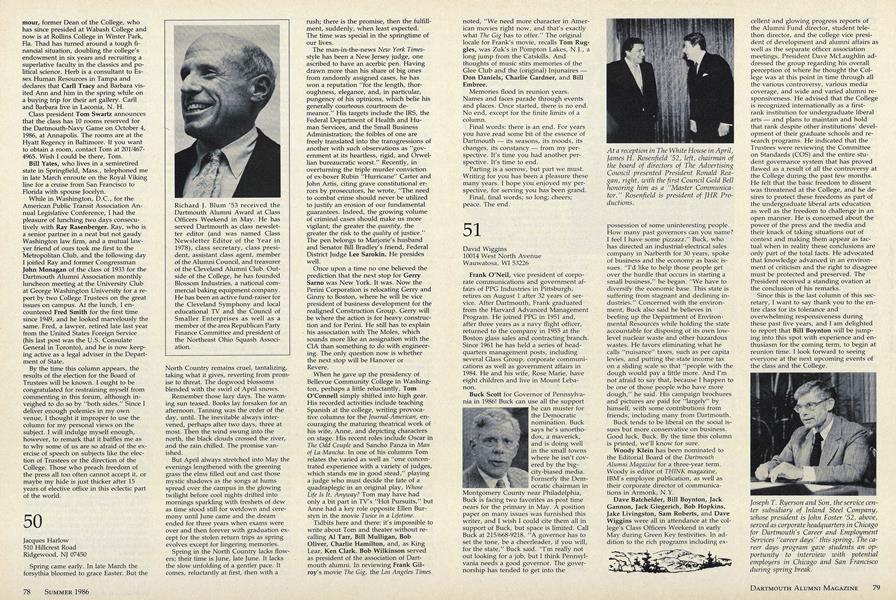
Richard J. Blum '53 received the Dartmouth Alumni Award at Class Officers Weekend in May. He has served Dartmouth as class newsletter editor (and was named Class Newsletter Editor of the Year in 1978), class secretary, class president, assistant class agent, member of the Alumni Council, and treasurer of the Cleveland Alumni Club. Outside of the College, he has founded Blossom Industries, a national commercial baking equipment company. He has been an active fund-raiser for the Cleveland Symphony and local educational TV and the Council of Smaller Enterprises as well as a member of the area Republican Party Finance Committee and president of the Northeast Ohio Squash Association.
510 Hillcrest Road Ridgewood, NJ 07450