1951
This month's column is one which every class secretary dreads: 500 words to write but very little with which to work. However, as Franz Kafka once stated, "The end of the world will not come on the last day, but the day after that." Apparently, then, I have time to do what I canT
We hear that John Higley has recently changed banking jobs after 20 years with the Mechanics Bank of Worcester, Mass., becoming executive vice president and chief operating officer of the Granite Savings Bank and Trust in Burlington, Vt. John, who majored in history, earned his M.B.A. at Boston University.
I have promised more of that December letter from Al Crehan, now retired both from the USAF and from business, and living in Chester, N.Y.: "I am a student of current events and politics, read The NewYork Times with my teeth gritted, read the Wall Street Journal editorials for a little sanity, average a book a week (nonfiction), and turn off the TV after the MacNeil/Lehrer Report." I'll bet that Al's sentiments are shared by many of us who would also agree with Norman Douglas's statement that "You can tell the ideals of a nation by its advertisements," and with Alexander Pope's "Amusement is the happiness of those that cannot think."
I just came across an article about Hanover in the February '88 issue of Yankee which relates to our views of the town and the College. One of the article's main points is that Hanover is no longer utterly dominated by Dartmouth. Life really was simpler during my father's time , there (1913-17), and apparently that condition continued through our time there. In the late fifties, however, the College had to share its hegemony with the Hitchcock Medical Center; and in the early sixties the hightech influx began with the coming of the Cold Regions Research Lab. At that point residents other than students, professors and their families, doctors and their families, and locals became important to the community. Soon, another kind of resident appeared: the retiree —D-grads and others. Today these several kinds of residents do not simply accede to the wishes of the College, as they once did 25 years ago when an entire town street disappeared with the building of the Hopkins Center. And yet, as this article points out, the usual town/gown antagonisms do not seem to exist in Hanover because each of the town's constituencies (of which, remember, the College is but one) is involved in the decision-making process of making the town an ideal place in which to live. Apparently the only negatives voiced are from those in surrounding communities who feel put upon because they have the shopping malls, etc., that Hanover does not want. Indeed, even the Dartmouth-Hitchcock Medical Center is about to be shifted just across the town's south border into West Lebanon. Outwardly, Hanover may look almost the same as it did when we arrived in 1947 because its residents hope to preserve its special quality, but it is that special quality which continues to attract people. We know the power of that attraction. Now so do many others. Thus, change seems inevitable, both for Hanover and for Dartmouth.
Take care, be good to yourselves, and keep in touch.
178 Madison Avenue, Holyoke, MA 10140
More From This Issue
-
 Cover Story
Putting Heaven in Perspective
October 1988 -
 Feature
The Zen of Football
October 1988 -
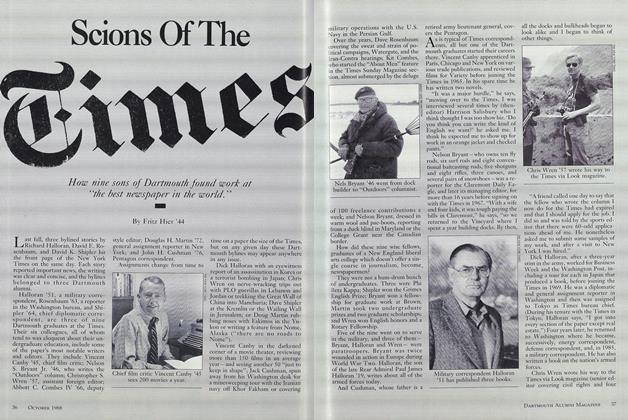 Feature
Scions Of The Times
October 1988 -
 Feature
Checking into the Inn and Out of an Era
October 1988 -
 Feature
Is the Indian Symbol a Right or an Opportunity?
October 1988 -
 Article
Funded Research Rises
October 1988