1965
Among the diverse occupations of the class of '65, one job stands out as perhaps the most difficult. While the rest of us deal with the pleasant problems of the living, two of our classmates work in a profession that reaches out to the needs surrounding death.
Dave Perinchief says, "You can call us anything you want, but don't use the word 'undertaker.' It brings to mind a ghoulish character that is far from the truth in our business. Our primary job is to help the survivors—many times our friends—deal with their grief and suffering." Dave, known to our class as an outstanding defensive back on the football team, is president of Perinchief Chapels, a Mt. Holly, N.J., funeral home started by Dave's great-great-greatgrandfather over 150 years ago. The major dilemma Dave faces as a funeral director is that success requires involvement in the community and, as a by-product, extensive friendships; the personal feelings that develop in this process make the performance of his job in a time of need that much more difficult. One of the ways he copes with such emotions is through a family that understands the strain involved. Dave praises his British-born wife, Maureen, whom he met on a blind date while she was a charter airline stewardess. The Perinchief family also includes a daughter, Alison, presently a goalkeeper on the Rutgers soccer team, and twins, Patrick and Kerri, both active in high school athletics. Dave points out that smalltown funeral directors lead a "fishbowl existence" similar to that of the clergy. He says, "If I really want to let down and have fun, I almost have to wait for the next reunion in Hanover."
Tom Sampson, like Dave, was a history major and member of the Tabard. His early plans were to attend graduate business school and eventually make a career within a large corporation. While meeting his ROTC commitment, first as a PX officer at Valley Forge Army Hospital and then as a First Infantry Division platoon leader in Vietnam, Tom changed his mind. "The military experience made me skeptical of large organizations that like to shuffle paper. I decided I was moore suited for my family's funeral home in Brockton, Mass." After more than 20 years, Tom believes his decision was a good one, but says the business pressures have been stronger than expected. When he first went to work, Brockton had 12 funeral homes divided along, ethnic and religious lines. Now, as a means of. spreading the cost of expensive equipment, these firms have consolidated into seven ownership units with more mergers likely. As for the personal side of his job, Tom says planning for family events such as vacations and school activities is nearly impossible; his wife, Linda, whom he met while she was attending Green Mountain College, and their four children have learned to cope with his unpredictable schedule. Tom explains that a funeral director must serve as a counselor, administrator, planner, and organizer. All of these efforts involve an immense amount of detail work that has to be tied together with absolute precision. He says, "People don't think much about the role Dave and I play, but it is a necessary and important part of our communities."
We have to agree with you, Tom. Many of us may even go so far as to disagree with Dave. As we reflect on the word "undertaker," it is clear that the word was originally chosen to describe someone taking on responsibilities others cannot handle. It is good to know the class of '65 includes such persons among our numbers.
3610 Oriole Drive, Columbus, IN 47203'
More From This Issue
-
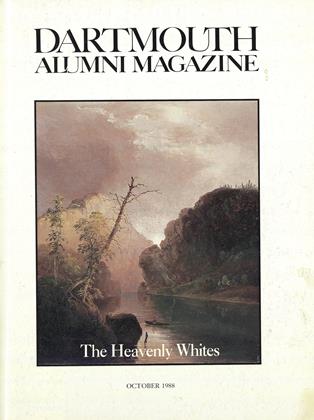
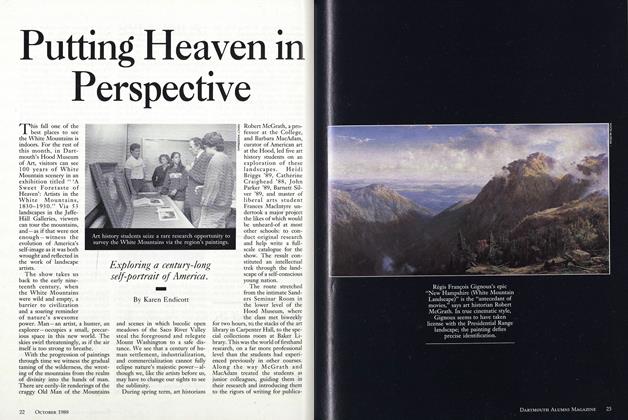 Cover Story
Putting Heaven in Perspective
October 1988 -
 Feature
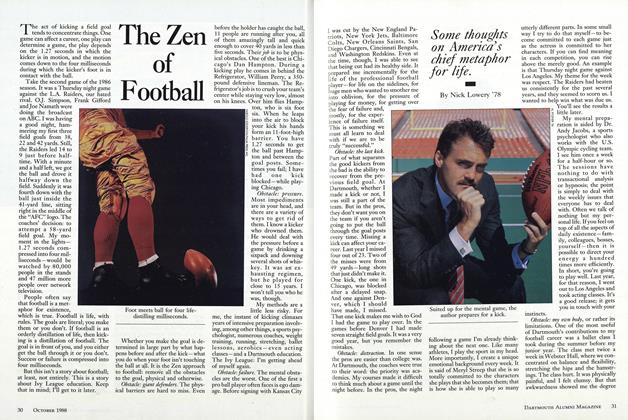
The Zen of Football
October 1988 -
 Feature
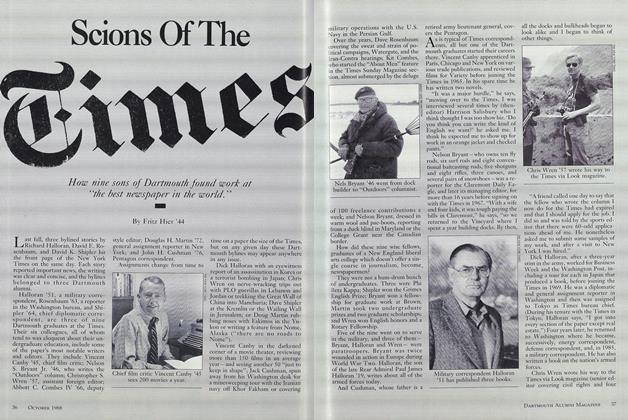
Scions Of The Times
October 1988 -
 Feature
Checking into the Inn and Out of an Era
October 1988 -
 Feature
Is the Indian Symbol a Right or an Opportunity?
October 1988 -
 Article
Funded Research Rises
October 1988