LETTERS
Pink Stinks
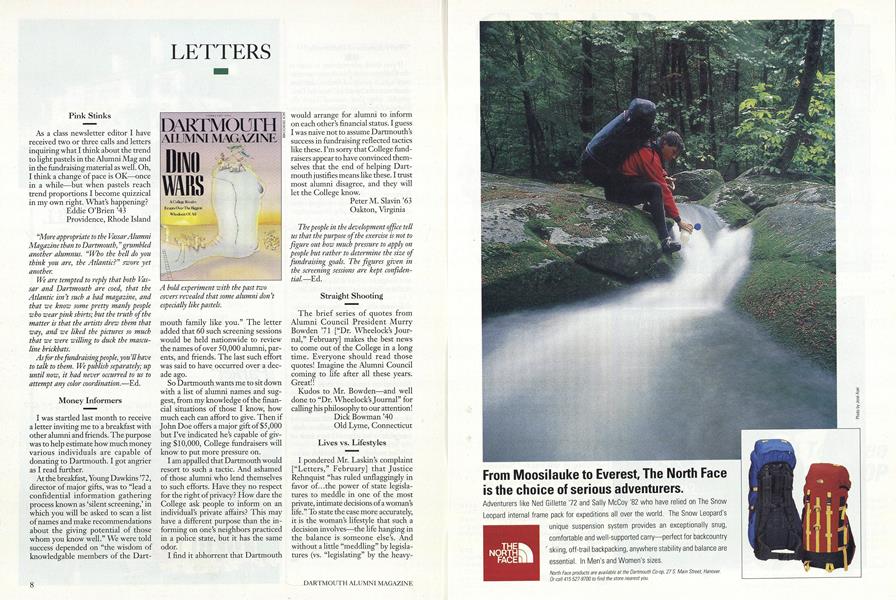
As a class newsletter editor I have received two or three calls and letters inquiring what I think about the trend to light pastels in the Alumni Mag and in the fundraising material as well. Oh, I think a change of pace is OK—once in a while—but when pastels reach trend proportions I become quizzical in my own right. What's happening?
Providence, Rhode Island
"More appropriate to the Vassar AlumniMagazine than to Dartmouth,"grumbledanother alumnus. "Who the hell do youthink you are, the Atlantic?" swore yetanother.
We are tempted to reply that both Vassar and Dartmouth are coed, that theAtlantic isn't such a bad magazine, andthat we know some pretty manly peoplewho wear pink shirts; but the truth of thematter is that the artists drew them thatway, and we liked the pictures so muchthat we were willing to duck the masculine brickbats.
As for the fundraising people, you'll haveto talk to them. We publish separately; upuntil now, it had never occurred to us toattempt any color coordination.—Ed.
Money Informers
I was startled last month to receive a letter inviting me to a breakfast with other alumni and friends. The purpose was to help estimate how much money various individuals are capable of donating to Dartmouth. I got angrier as I read further.
At the breakfast, Young Dawkins '72, director of major gifts, was to "lead a confidential information gathering process known as 'silent screening,' in which you will be asked to scan a list of names and make recommendations about the giving potential of those whom you know well." We were told success depended on "the wisdom of knowledgable members of the Dratmouth family like you." The letter added that 60 such screening sessions would be held nationwide to review the names of over 50,000 alumni, parents, and friends. The last such effort was said to have occurred over a decade ago.
So Dartmouth wants me to sit down with a list of alumni names and suggest, from my knowledge of the financial situations of those I know, how much each can afford to give. Then if John Doe offers a major gift of $5,000 but I've indicated he's capable of giving $10,000, College fundraisers will know to put more pressure on.
I am appalled that Dartmouth would resort to such a tactic. And ashamed of those alumni who lend themselves to such efforts. Have they no respect for the right of privacy? How dare the College ask people to inform on an individual's private affairs? This may have a different purpose than the informing on one's neighbors practiced in a police state, but it has the same odor.
I find it abhorrent that Dartmouth would arrange for alumni to inform on each other's financial status. I guess I was naive not to assume Dartmouth's success in fundraising reflected tactics like these. I'm sorry that College fundraisers appear to have convinced themselves that the end of helping Dartmouth justifies means like these. I trust most alumni disagree, and they will let the College know.
Oakton, Virginia
The people in the development office tellus that the purpose of the exercise is not tofigure out how much pressure to apply onpeople but rather to determine the size offundraising goals. The figures given inthe screening sessions are kept confidential.—Ed.
Straight Shooting
The brief series of quotes from Alumni Council President Murry Bowden '71 ["Dr. Wheelock's Journal," February] makes the best news to come out of the College in a long time. Everyone should read those quotes! Imagine the Alumni Council coming to life after all these years. Great!!
Kudos to Mr. Bowden—and well done to "Dr. Wheelock's Journal" for calling his philosophy to our attention!
Old Lyme, Connecticut
Lives vs. Lifestyles
I pondered Mr. Laskin's complaint ["Letters," February] that Justice Rehnquist "has ruled unflaggingly in favor of...the power of state legislatures to meddle in one of the most private, intimate decisions of a woman's life." To state the case more accurately, it is the woman's lifestyle that such a decision involves—the life hanging in the balance is someone else's. And without a little "meddling" by legislatures (vs. "legislating" by the heavy handed Roe court) handed Roe court) a lot of little lives are left defenseless in the face of such "intimate decisions." To quote another Dartmouth alum, "a person's a person, no matter how small" (Dr. Seuss, Horton Hears a Who).
Dover, New Hampshire
Pay Dirt
There's an old saw about "figures don't lie but..." that I thought of when I read about Dartmouth faculty salaries on page five of the Winter issue ["Dr. Wheelock's Journal"].
Duke (apparently the top payer) pays 3.2 percent higher than Dartmouth. Stanford (apparently also a top payer and which beats us consistently in attracting students) less than one percent more.
In industry we feel that plus or minus five percent in average salaries in competing companies is great (note plus or minus), and now I'm supposed to feel Dartmouth is "falling behind" because Stanford pays less than one percent more?
Somethings wrong but I'm not sure what. Can you clarify the situation?
Paris, France
You read the figures correctly. It wouldbe hard to claim that the College is "falling behind," but then, we didn't claim that.What happens in the future is somethingelse again. Faculty salaries at Dartmouthhave risen dramatically in the past several years, and they have just kept pacewith the competition.—Ed.
First Carnival
I was somewhat amused by the first sentence of the article "Northern Lights" in the February issue: "The fireworks are a new twist to the na tion's oldest winter carnival, which has evolved since 1910—when DOC founder Fred Harris '11 organized sporting events on the golf course." Throse of us who attended Vermont Academy are aware that the sentence is incorrect. According to VermontAcademy: A History of Survival and Suecess, the Assistant Principal James P. Taylor organized the first winter carnival on Lincoln's birthday in 1909. "Ayear later," the book says, "Vermont Academy assisted Dartmouth in starting its first Winter Carnival."
Reading, Massachusetts
Quizzers Quizzed
By chance, I came across a familiar quotation by Daniel Webster on the same day I encountered the quiz on Dartmouth traditions in the Alumni Magazine [February], According to John F. Kennedy in Profiles in Courage, stern Chief Justice Marshall was said to have been visibly moved by Webster's famous defense in the Dartmouth College case-"It is, sir, as I have said, a small college—and yet there are those who love it."
If this quotation had been included in your quiz as a Dartmouth tradition, I know it would not be answered by "B"—New (less than 20 years old) or by "D"—Never existed in the first place. I had to wonder, would your choice as the correct answer have been "A"—Old (more than 20 but still alive) or "C"—Failed (no longer exists)?
Punta Gorda, Florida
The small-college tradition has lived onthrough the addition of graduate schoolsenhanced research, the rise of an international reputation, and Dartmouth's public designation as a "asmall liberal-artsuniversity." Alumni have never been reticent about reminding officials of that tradition. That may be one reason why theCollege continues to place such stress onundergraduate education. And it is whywe would choose "A." —Ed.
Class Acts
institution. We join you and many, many others in sending our congratulations to Dick Page. Seldom has there been a more popular candidate than Dick and we look forward to his leadership in concert with the three '53 present Trustees, Bob Douglass, Bob Henderson, and Andy Sigler. Like yourself, I have great respect for the class of '54 ["Letters," February]. Without its having raised $3.9 million, my class would probably never have raised $5.2 million and won more John H. Davis Trophies (seven) than any other class in the history of the
Hanover, New Hampshire
Spirit in the Dark
I was delighted with the Alumni Magazine's Winter issue focus on idealism and student volunteerism.
Whenever I or our students speak with alumni about the work Dartmouth volunteers are doing in the community and beyond, the conversation always turns to "why don't the alumni hear about this? All we hear in the press is negative things about Dartmouth students." It is both gratifying and a relief to see that the word is getting out, finally, and that alumni will know that there are really some very special students at Dartmouth, who have plenty of energy and desire to reach beyond themselves in service to others.
As you know, in addition to the local efforts, every year 40 or so fellowships are awarded to undergraduates to perform leave-term, direct community-service projects anywhere in the world.
Many of those experiences are exciting and reflect the best of the Dartmouth spirit at work in the world far from the shelter of our ivy halls. Everyone who cares about the College and the extended education we provide would benefit from hearing a few of these stories.
Associate Dean William Jewett Tucker Foundation
Help Wanted
As a new at-large member of the Alumni Council, I invite ideas, suggestions, or comments regarding the College.
District of Columbia Court of Appeals 500 Indiana Avenue, NW Washington, DC 20001
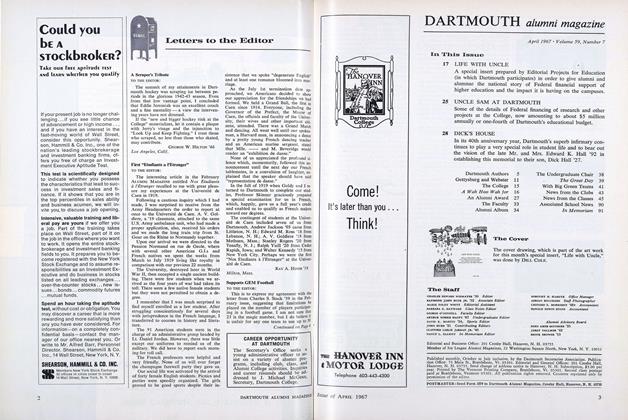
A bold experiment with the past twocovers revealed that some alumni don'tespecially like pastels.

More From This Issue
-
 Cover Story
It Pays The Rent
April 1990 -
 Feature
Taking God's Word For It
April 1990 -
 Article
A Few Of Dartmouth's Adventure Pros
April 1990 -
 Article
On chemistry, Cuba, and other radical elments on the campus.
April 1990 -
 Article
The Satanic Verses: Why Were Muslims So Offended?
April 1990 -
 Article
A SENSE OF PLACE
April 1990