Is the New Millennium the Beginning of the End?
Human qualms and dreams surge every thousand years.
Human qualms and dreams surge every thousand years.
Human qualms and dreams surge every thousand years
YOU MAY NOT KNOW IT, but chances are you've been suffering from PMT: Pre-Millennial Tension. Christened by the media in the mid-1990s, Pre-Millennial Tension has left a clear mark on the final years of the 20th century. From deadly cults whose members committed mass suicide to hysteria about worldwide computer crashes, from Pope John Paul IPs call to celebrate the "Great jubilee" to expectations that Christ will soon return, the ap proach of the year 2000 has filled people with anxiety and excitement.
Perhaps no one has been more energized by the approach of the millennium than religious groupseven Christians, who now know that Christ was not born in 1 A.D. yet still see religious significance in the calendar. Catholics, for instance, have been building to the dawn of 2000 for the last three years by devoting a year of reflection to each member of the Trinity. Worshipers at the world's largest church, the 700,000- member Yoido Full Gospel Church in Seoul, South Korea, believe Christ will return and the world will end soon after the year 2000. At night the city's skyline glows with red neon crosses, signals to guide Christ down from the clouds.
But even if most religions don't preach that a new world will begin in the first seconds of the new millennium, many believe the end is near. Last summer, religion professor Frank Whaling reckoned the time was ripe to find out why.
In his class "The Millennium and World Religions," Whaling, a visiting professor from the University of Edinburgh in Scotland, looked closely at millenarian groups—religions or sects that believe the world as we know it will end. The term millenarian originally referred to Christians who believe that one day Christ will triumph over Satan, toss the devil into a bottomless pit and reign over the Earth in peace for 1,000 years. Now the term is used more broadly. "The background of these millenarian movements is suffering," Whaling says. "Virtually every millenarian group tends to think things are getting worse. And something needs to happen to lift us out of this presentmess."
Although they're not all millenarian, followers of the world's major religions—and some minor ones—have at least one similarity: They await what Whaling calls "The One Who is to Come." Hindus wait for Kalkin, an avatar of the god Vishnu. Jews look for the Messiah. Christians anticipate the return of Christ. Buddhists wait for Maitreya, and Muslims, for the Mahdi.
The modern notion of the end of the world is believed to have started with Zoroaster, a prophet from Central Asia who lived around 1,100 B.C. He told his followers about the coming battle between good and evil, in which everyone would be judged. The wicked would die, and the virtuous would live forever. He had a precise vision of the new world order: All young people, he prophesied, would live forever as 15-year-olds; adults would always be 40. The Persian Empire adopted his ideas as its official religion. Many years later, similar ideas made their way into the Old Testament. When the Book of Daniel was written, around 168 B.C., the Jews were in despair. The Greeks were occupying jerusalem and martyring jews for their faith. Worshiping on the Sabbath was forbidden and a statue of the pagan god Baal had been installed in the Temple. So the visions in Daniel, which described the only fall-scale apocalypse in the Jewish Bible, were welcome hope for a better life. The book foretold a series of evil empires, a wicked king destroyed in battle and finally, the dawn of the Kingdom of God, where the righteous would live forever.
The largest messianic movement in Jewish history centered on Sabbatai Tsvi, a Turkish Jew who traveled to jerusalem in 1665 and was proclaimed by a prophetic rabbi to be the Messiah. Millions of Jews accepted him as the Messiah. But when he returned to Ottoman Turkey, he was ordered under the threat of death to convert to Islam. He converted, dashing the hopes of most of his followers. Three centuries later, another messianic movement sprang up, this time in New York. Some Hasidicjews believed their leader, Rabbi Menachem Schneerson, was the Messiah. Schneerson, born in Russia, spoke ten languages, reportedly needed just an hour of sleep a night and lived in Crown Heights, Brooklyn. When he died in 1994 at 93, some of his 200,000 followers expected him to be resurrected. Many still expect him to return as the Messiah.
Christians look to the Book of Revelation for a detailed, if confusing, vision of the apocalypse. A number of today's born again Christians, possibly the fastest-growing religious group in the world, fervently believe it is their mission to save souls before Christ returns. "The time is urgent and the end is near, so Christians have to get on with the job of preaching the Gospel," Whaling says of them. In another variation on the Christian theme, the Rev. Sun Myung Moon, the leader of the Unification Church, announced his implicit messiahship in 1992. Followers believe they will be purified of sin if they follow Moon and his wife.
Some recent millenarian movements have turned deadly. In 1994, for example, 58 members of the Order of the Solar Temple, which preached a coming environmental holocaust, committed suicide (some apparently were murdered) in Canada and Europe. The following year, clouds of deadly gas drifted through the Tokyo subway at rush hour, killing 12 people and injuring 5,500, the handiwork of the Aumshinri-Kyo cult, whose members believed nuclear war was imminent. In 1997, 39 members of Heaven's Gate ate a deadly last supper of vodka and sedatives, believing they would bypass the suffering of this world by reaching a better place in the heavens.
Whaling has closely researched one recent millenarian group, the Brahma Kumaris, an Indian sect that grew from Hinduism. The group, which now has 400,000 members, began in 193 6 when a 60-year-old diamond merchant began having visions about the end of the world. "It's very unusual," Whaling says. "He had done nothing out of the ordinary before then. He was a business leader and a saintly man." The Brahma Kumaris, unique because they are led mainly by women, believe the world will end with a nuclear holocaust within 20 years. "Some of them regard everything in the news Kennedy falls into the ocean and dies, there's trouble in the Middle East, Northern Ireland is still lingering on—as grist for the mill," Whaling notes. "Everything is getting worse and the world is going down. Things are coming to an end and something's got to happen to sort out the mess." Other Hindus wait for Vishnu's avatar, Kalkin, to save them. "At the end of the world in its present form, Vishnu will appear as a human being in the form of Kalkin to bring the world to an end and reward the virtuous," Whaling says.
Whaling personally views the millennium as a chance to think about more secular issues—the state of the environment and our human and spiritual future. "My own vision is that the year 2000 is nothing special in its own right," he says. "But insofar as it is a rigid date in round terms, it's a time for sober and mature reflection about where we are and where we're going."
KATHLEEN BURGE is a writer living inNorwich, Vermont.
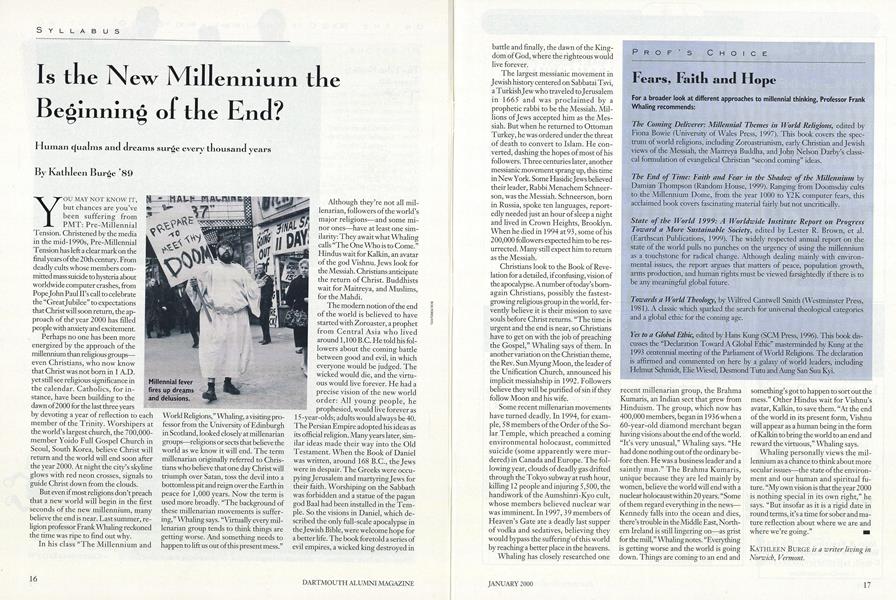
Millennial fever fires up dreams and delusions.