The Great Debate
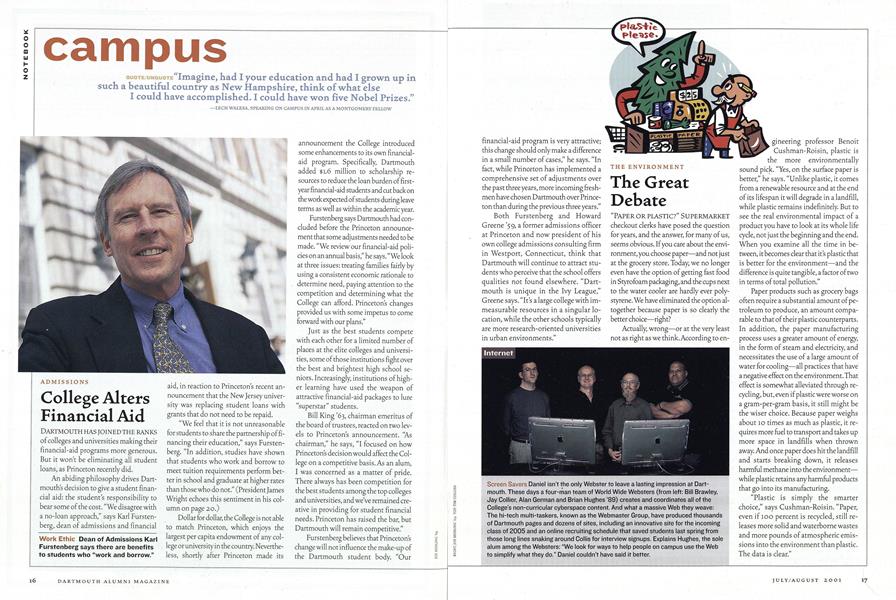
"PAPER OR PLASTIC?" SUPERMARKET checkout clerks have posed the question for years, and the answer, for many of us, seems obvious. If you care about the environment, you choose paper—and not just at the grocery store. Today, we no longer even have the option of getting fast food in Styrofoam packaging, and the cups next to the water cooler are hardly ever polystyrene. We have eliminated the option altogether because paper is so clearly the better choice—right?
Actually, wrong—or at the very least not as right as we think. According to engineering professor Benoit Cushman-Roisin, plastic is the more environmentally sound pick. "Yes, on the surface paper is better," he says. "Unlike plastic, it comes from a renewable resource and at the end of its lifespan it will degrade in a landfill, while plastic remains indefinitely. But to see the real environmental impact of a product you have to look at its whole life cycle, not just the beginning and the end. When you examine all the time in between, it becomes clear that it's plastic that is better for the environment—and the difference is quite tangible, a factor of two in terms of total pollution."
Paper products such as grocery bags often require a substantial amount of petroleum to produce, an amount comparable to that of their plastic counterparts. In addition, the paper manufacturing process uses a greater amount of energy, in the form of steam and electricity, and necessitates the use of a large amount of water for cooling—all practices that have a negative effect on the environment. That effect is somewhat alleviated through recycling, but, even if plastic were worse on a gram-per-gram basis, it still might be the wiser choice. Because paper weighs about 10 times as much as plastic, it requires more fuel to transport and takes up more space in landfills when thrown away. And once paper does hit the landfill and starts breaking down, it releases harmful methane into the environmentwhile plastic retains any harmful products that go into its manufacturing.
"Plastic is simply the smarter choice," says Cushman-Roisin. "Paper, even if 100 percent is recycled, still releases more solid and waterborne wastes and more pounds of atmospheric emissions into the environment than plastic. The data is clear."