Coming Undone
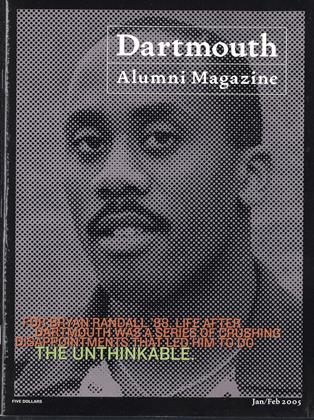
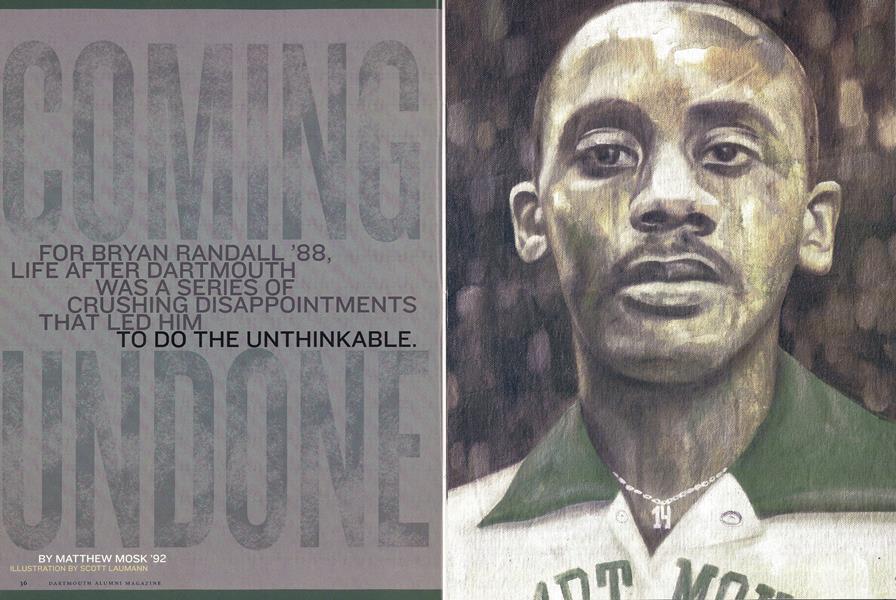
For Bryan Randall ’88, life after Dartmouth was a series of crushing disappointments that led him to do the unthinkable.
For Bryan Randall ’88, life after Dartmouth was a series of crushing disappointments that led him to do the unthinkable.
FOR BRYAN RANDALL '88, LIFE AFTER DARTMOUTH WAS A SERIES OF CRUSHING DISAPPOINTMENTS THAT LED HIM TO DO THE UNTHINKABLE.
THERE IS NO SOUND TO GO WITH THE IMAGES.
The camera frame wobbles, and the picture quality is so grainy it's hard to make out the faces of the boys in green. But after a few moments, the tape of the March 5,1988,Ya1e-Dartmouth basketball game comes into sharper focus. There is Dartmouth's 7-foot center, Walter Palmer '90, loping up the court, his long arms swinging in broad arcs. There is Jim Barton '89, floating a smooth jumper up over the outstretched arms of two Yale defenders, and down through the net with a snap. And there, orchestrating play as he calmly works the ball up the court, is No. 14, Bryan Randall. The young man gliding coolly across the floor is the one everyone called "Ice."
The game tape is 16 years old now, properly of the Yale athletic department. If the Dartmouth coaches kept their own film of the 1988 season finale—probably one of the most thrilling games in Ivy basketball history—you can almost forgive them for losing it. A win would have given the Big Green not only the Ivy title but also an automatic berth in the NCAA tournament. Of course that was a dream for the players—and not only because they wanted that for themselves. They wanted it for Ice. Randall had joined a 1984 Dartmouth squad that won only five games his freshman year. Slowly, he helped it become a winner, earning his nickname with calm leadership and clutch baskets. By the winter of his senior year it looked as if the team finally had jelled. The players went to New Haven one win from the title.
The game evolved as a classic duel, with dozens of lead changes and momentum rising and crashing with every three-pointer. Near the end of the tape a fatigued Randall can be seen standing at the baseline, punching the air in disgust as he fouls out with six minutes to play. From a seat on the bench he watches the drama of the final minutes of his basketball career unfold: As Barton sinks a miraculous jumper to bring Dartmouth within one. As the Big Green defense shuts down Yale with 14 seconds to play. As coach Paul Cormier assumes his nervous crouch on the sideline. As Randall's protege, freshman James Blackwell '91, dives for a loose ball and gets swatted by Yale's point guard. As Blackwell steps to the foul line with two seconds on the clock, Yale leading 79-78. As he casts the ball into the air and clangs it off the front of the rim. As time runs out.
Most Dartmouth athletes step off the court after their final game feeling a sense of fulfillment. Many have gone on to find great success in the business world, to find personal satisfaction in their families. But that's not the story of Bryan Christopher Randall. He would graduate without the prospect of a pro career. And while there was no way anyone could know it back in March of 1988, the day Randall walked off the court in New Haven and climbed aboard a bus for the silent ride back to Hanover was the first of a 16-year journey that would eventually unravel tragically, at the edge of a drab retention pond in central Florida called Lake Destiny.
BORN THE SECOND OF TWO BOYS in Rochester, New York, Bryan Randall had basketball coursing through his arteries. His father, Bill, had excelled in the sport at a local community college and nurtured Bryan's passion with blacktop instruction that continued even after he and Bryan's mother divorced in 1973 and she moved the boys to an Amherst, New York, duplex. Bryan played varsity ball during all four years at Sweet Home High School in Bufalo and, in 1984, took the team to the New York State Class A championships. The final game seemed to foreshadow limitless potential. With the Panthers down by one point and just seven seconds remaining, Randall drove the length of the floor and was poised to take the winning shot when he spotted an open teammate and unfurled a pinpoint pass, making the pivotal assist that won them the title.
The combination of flash and unselfish play made him the high school player of the year in Buffalo. As recruiters came calling, he began to harbor thoughts of an NBA career. But his mother, Beverly Randall, insisted that academics take top priority and enrolled the nimble 6-footer at Dartmouth. Coach Paul Cormier recalls meeting Bryan when he arrived in Hanover his freshman year and finding a young man who was painfully out of his element. "Off the court, he was almost an introvert. It was like he was intimidated by the surroundings," says the former coach. But when Randall picked up a ball, it was just the opposite, according to Cormier: "He was unbelievable. He had total command, almost from the first day."
Dartmouth was well below the caliber of basketball programs that had tried to recruit Randall. Even within the Ivy League, the school was hardly a basketball powerhouse. While Penn and Princeton had just spent the prior three decades amassing 25 titles between them, Dartmouth hadn't struck Ivy League pay dirt in decades, last winning the championship in 1959. In 1984 the College had hired Cormier, a young protege of Villanova coach Rollie Massimino, to rebuild the team from scratch. From the start he struggled with the realities of commanding a squad so long on intellect but so short on talent. That first season Cormier walked off the court after a 36 point loss to the University of South Florida and seemed unable to summon the will to break down films and prepare for the next night's game against La Salle and its three NBA draft-bound players. It was the first time in his life he didn't go out onto the court believing there was at least a chance he could win. "I just knew there was no way," Cormier told The Boston Globe later. "I found myself preparing not to win but to keep from being embarrassed." The Green lost 20 games that year. And yet by the season's end, the coaching staff had a strange sense of optimism. If they were assembling a team with a future, they now had the foundation. The kid from Buffalo had just become the 1984 Ivy League Rookie of the Year. "We may have had a dismal season," assistant coach Dave Faucher remembers, "but the good news was that he surfaced."
The coaches' ambitions were well placed. Randall started scoring nearly 20 points a game during his sophomore year. In his junior year Dartmouth had its first winning season (15-11) in more than a decade. In one game against Brown, "Randall completely controlled the tempo of the game with his passing and quick ball movement, " TheD reported. His "awe-inspiring passes ignited the crowd." Faucher says there was something about his play that "infused an energy, an enthusiasm" into the whole team. "He'd just get down the floor in a hurry. He'd come wide, and the whole team would fly down the floor, and he could just feel the people. Everyone in the crowd would be up on their feet wondering, 'What's he going to do now?' The whole arena would be chanting, 'Ice, Ice, Ice.' "
The excitement followed Randall off the court, too. As his game started to shine—and the wins stacked up—he hit his stride on campus. Teammate Robbie Summers '90 remembers hearing stories about Randall being shy, but that's not what he saw. 'Around campus everyone knew him," Summers says. "He was incredibly popular. People he didn't know would come up to him and be like 'lce this' and 'Ice that.' " Randall took a room in the Choates, the low-slung cluster of cinderblock dorms derided for their ugly design, and turned it into the social center of the basketball team's universe. He "borrowed" furniture from the dorm's common rooms and set up a bar that would be the meeting place where players would down fuzzy navels before hitting frat row on Friday nights. "That became our fraternity-he called it The Ball Squad," Summers says. "We had cheerleaders who would come and do chants. We had our own little secret handshake. We would drink our fuzzy navels. It was a blast. Bryan was the center of it, and he brought us all in."
On the trips to games Randall was the one who took over the back row of the bus, Bruce Hornsby and Human man League blasting from his tape player. But if the team lost, he was to be avoided. "Basketball meant everything to him," says Summers. "He came from a highly successful high school basketball program. He had received other offers to play for college programs. So for him to come to Dartmouth and not win, it was a major problem for him. It really hurt. No one dared go back there and sit in those seats after games. He would always have his radio going. And if the team lost, you didn't say a thing to him. You knew to just let him listen to his music, and when he was ready to talk, then he would talk."
Part of Randall's obsession with winning was his drive to play professional ball. Most Ivy League players don't come to school with dreams of the NBA. The sport was merely a ticket to a great education or a way to get onto a European team for a couple years after college, just for kicks. "Nine out of 10 pretty much know they'll never play ball beyond college," Cormier says. "But if there was one kid at Dartmouth who thought he might be an NBA player, it was Bryan." Cormier says the two discussed Randall's ambitions and worked on the tools he'd need to have a chance. But in the end, as good as Randall was at handling the ball, as strong as he was on defense, he didn't have a great shot. He wasn't a scorer. "He just basically wasn't good enough," Cormier had concluded.
UNTIL YOU READ THE EPITAPH Bryan Randall wrote for himself in the fall of 2003, it isn't immediately obvious that the end of his college basketball career, and of his NBA dreams, would propel him toward tragedy. The first decade after college seemed to head him in the direction more common to his teammates: success in business, a fulfilling family, a comfortable home, and occasional trips back to Hanover to play ball on an alumni squad, giving the young guns an occasional scare as he fed assists to his old teammates.
Randall still flirted with the idea of staying in basketball. He considered playing in the Continental Basketball Association, a minor league of journeymen ballplayers that struggles to make pay roll and has become less and less relevant as the junior colleges and overseas leagues have emerged. Then, after taking a job at AT&T in 1990, he tried to form the Metropolitan Basketball Association, a corporate basketball league in which large companies sponsored teams of employees in each city, culminating in a national championship tournament. The idea had some legs—he was able to convince a number of companies to sign on, he rented space to play and even purchased radio time to broadcast the games. But insurance costs and the logistics of finding officials forced him, ultimately, to sell the idea to another entrepreneur.
Money was a problem in his personal life, too. He fell in love with an AT&T colleague, Lisa Byrd, and the two married in 1994. Two years later they had filed jointly for bankruptcy. After the couple had two children, and with a third on the way, the bank foreclosed on their $147,000 condo in the D.C. suburbs in 1998. When Lisa became pregnant with their fourth child in 2000, Randall left AT&T and moved his family to the Orlando area to take a job with Intermedia Communications, a subsidiary of World Com. His daughter Yana's birth was followed quickly by the company's bankruptcy and the evaporation of Randall's new job. "In my mind, that's where things started really going south," says Eugene Sims '89, the Dartmouth teammate who remained closest to Randall. "Even af- ter moving to Florida he had a good paying job. He had a level of authority. He was the top dog at the call center. But once he lost that position and he couldn't get anything else, that's when he really started getting into trouble."
With his work life in tatters, Bryan Randall sought salvation in the one place he'd be least likely to find it: basketball. He took a job at an Orlando Magic sales office. Then he applied to the University of Central Florida to get a master's degree in sports business. He pulled out of both when he determined neither would help him keep his family afloat. At the same time, as court records from Florida indicate, Randall's marriage to Lisa was coming apart. According to the Orlando Sentinel, the records revealed that Bryan had been recording Lisas phone calls and discovered she was having an affair. In August of 2003 Lisa asked the court for a restraining order, saying Bryan had become verbally abusive and had threatened to provide her friends with a newsletter describing her sexual proclivities. It was late at night on August 15,2003, that Sims got a phone call from Randall, who was on his cell phone, parked out in front of his and Lisas house.
"Lisa had called the police on him, and they came and put him out," Sims said. "He called me while the police were still there. He was sitting in his car. He had just loaded it up with all his stuff, and he was upset to the point of tears. I could hear that he was crying. That wasn't him. I knew that. I knew he was distraught." Sims says there was nothing about the call that signaled Randall would do something crazy. But Sims can't seem to shake a memory of seeing the Michael Douglas movie Falling Down with his friend and teammate a decade earlier. In the film, Douglas' character sees his marriage unravel and his career bottom out, and he goes on a sort of crazed crime spree across Los Angeles. "Who knows, subconsciosly, how much that might have had something to do with it?" Sims says now. "He may not have even remembered going to see that movie. But to me, it's eerie."
Deborah Leporowski, a Florida psychologist who specializes in cases where custody disputes go awry but was not involved in the Randall case, says being thrown out of his own house by police would have been a moment of total humiliation. "What we know is that the family was entering a very, very dangerous period," she says. "Bryan had been through something very humiliating and damaging to his ego. This is a man who had had a persona, a certain kind of public identity that, underneath, was very fragile." Already he had been dressed down before a judge in court as his wife's lawyer made the case for a restraining order. He'd been ordered not to have contact with his family. He had lost his job. "Everybody handles that kind of stress differently," says Leporowski, "but if he's getting humiliated from all angles and being told he's not needed any more, what's he got left?"
ON SEPTEMBER 16, 2003 , Dave Faucher was out stalking the Indiana cornfields in search of talent when his cell phone rang. Faucher, then Dartmouth's head coach since 1991, was on the last stop of his annual fall recruiting trip. To say now that he navigated the two-lane roads of central Indiana with a sense of impending dread sounds like something he's cooked up, but he swears it's so. Three years earlier Faucher was on this same trip when an assistant called and broke the news that the coach's sister had died in a bike accident. Two years prior, in 2001, he was flying to Los Angeles and never made it because the nation came under attack. His plane was diverted to Boise, Idaho, where he was stuck for a week. So when a call came unexpectedly that September day, Faucher hesitated longer than normal before picking it up. Kathy Slattery, the College's sports information director, had news that would consume him in the coming days and linger with him for far longer. Bryan Randall, the one they called "Ice," a shy young guard who grew into the unequivocal star of the first team Faucher helped to coach at Dartmouth, was dead.
The only thing worse than the news itself was how he died, Faucher says. Somehow, one of the most unselfish players in the history of Dartmouth basketball, who for more than a decade held the record for career assists, would instead make his lasting mark on this earth committing one of the most flagrantly self-indulgent acts that anyone could fathom. One of the most charming men to cross the Green, once hounded for autographs by adoring elementary schoolchildren, would leave this earth at 37, erasing that legacy in one incomprehensible binge of self pity.
Four days earlier, Faucher was told, Randall had spiraled out of control. With his marriage in a shambles, his work life a mess, the former basketball standout took a room at the Candlewood Suites motel in central Florida and hung a framed poster of himself wearing Dartmouth No. 14 on the wall. Police reports show he prepared a shopping list and went to Wal-Mart to buy sandwiches, drinks, snacks and sleeping pills. That evening he met Lisa at a Burger King and picked up his four children, whom he hadn't seen in a month. In the predawn hours the following morning, police say, he put a knife to the throat of his youngest child, 2-year-old Yana, but could not carry through with taking (continued on page 93) her life. Instead, newspaper accounts say, he drove Yana and his son Regal, 4, to a re- tention pond near Lake Destiny and threw them in. An hour later a fisherman found Regal floating on his back, clinging to life. Divers were called to recover Yanas limp body. She had drowned in eight feet of water. By then Randall had returned to the motel, gathered his two oldest boys in his gold SUV, lined them up on the drivers side and darted out in front of a tractor trailer within view of the office where Lisa worked. The impact killed him and took the life of his oldest son, Bryan Jr.; Julian, 6, survived the crash as Regal did the attempted drowning-but both faced long weeks of recovery.
Faucher tried to digest the news but could not. His phone started ringing with calls from Randall's stunned teammates. None of them could understand it. "If this was just that he died young, he died tragi- cally, we could all mourn and handle that and tell stories and there is a breath of fresh air to what he was and what he did and we could have fond memories," Faucher says. "But that's not what happened here. What everyone wants to know, you can't answer. Everyone wants to know what put that man over that edge. Why? Why? Why?"
According to the Orlando papers, police found a suicide note clutched in Randall's hand at the accident scene. "I've lived my life fully," he wrote. "Played basketball as long as I could. Started a business. Got married. Had 4 kids. Experienced my wife cheating and the resulting destruction of my family."
The words rang hollow to Randall's teammates. In March 2004, six months after his death, they were together in Hanover for Faucher's final game as a Dartmouth coach. Just about all the guys who were on the floor 16 years earlier at Yale crowded into the gym. Barton and Blackwell were there. Rob Summers was there. After the game the old timers crowded into a room in the back of the gym for a reception to toast the coach. But most people, Faucher says, could not help but think about Ice.
"There was nothing formal. No memorial or even mention, really," Faucher says. "But he was a presence there. He was on every one's mind." For hours they reconnected.
Greg Frame '94, who joined the Dartmouth basketball program after Randall had graduated but who had gotten to know Randall and his teammates at alumni games, says the gathering was "cathartic." They didn't spend time talking about Bryan. Thatwas too complicated. People were grieving. But also they were livid with him for murdering his children. Frame was one of several who wondered if Randalls Dartmouth teammates could have done more to prevent the tragedy had they been in closer touch, if perhaps they could have spotted a warning sign. Absent a memorial service, which seemed inappropriate under the circumstances, Frame proposed to the alumni players that they make an effort to stay in touch. "When you lose a member of the family you can either go your separate ways or you can come together," he says. "Since the moment this happened, we came together." From his law office in Maine, Frame creat- ed an e-mail list and urged his teammates to write in. To a remarkable degree, he says, they have been doing just that.
In part, Frame says, they have used the connection to talk candidly about Randall's final hours. The most common sentiment is an echo of Cormier's remarks to a newspaper reporter last fall: "I can't believe the Bryan Randall story ends this way." Summers says he couldn't shake that feeling when he arrived at Leede Arena for Faucher's last game. Seeing the brothers of The Ball Squad again, he was stuck with one memory he could not escape: crying for Bryan that day the team lost to Yale. "I knew then how much he had been a part of the turnaround of the Dartmouth program," Summers says. "I re-member that after that game he was hurt, and we were all hurt for him." At the reunion game something about the smell of the locker room and the sound of his teammates' voices swept that same feeling back over him in a rush. "There we were back together, all these guys who were part of the early success of Dartmouth basketball," says Summers. 'And I realized the guy who was the key was Bryan. And he wasn't there."
Summers says he stepped out of the arena in the silence that blankets Hanover long after dark, strolled across the Green and wept for Ice all over again. a
With typical intensity, Randall dribbles past a Cornell defender in 1987. Even off the bus, as on the beach in Hawaii that year, he was often a man apart (far right, below).
End of the Road A teddy bear marksthe spot where2-year-old YanaRandall died shortlybefore the crashthat killed her fatherand brother.
OFF THE COURT IT WAS LIKE THE SURROUND HE WAS INTIMIDATED BYINGS. -PAUL CORMIER, RANDALLS DARTMOUTH BASKETBALL
ONE OF THE MOST CHARMING MEN TO CROSS THEARTH AT 37, ERASING THAT LEGACYINCOMPREHENSIBLE BINGE GREEN WOULD LEAVE THISIN ONE E OF SELF PITY.
MATTHEW MOSK is a Washington Post statehouse reporter in Annapolis, Maryland. As acontributing editor he has previously profiledNathaniel Fick '99 and Rand Beers '64 for DAM.