The Contenders
Once again the College has a strong lineup of athletes with their sights set on Sochi.
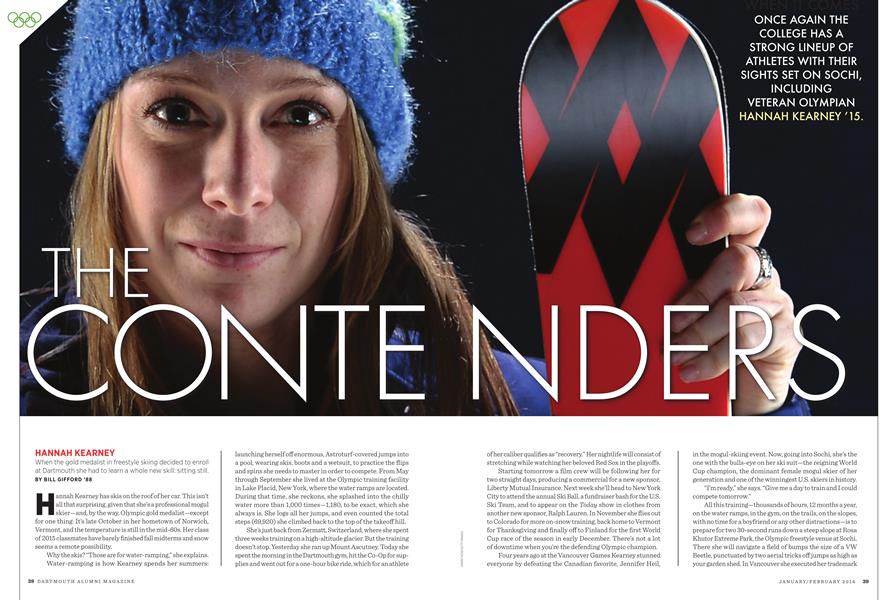
Once again the College has a strong lineup of athletes with their sights set on Sochi.
Hannah Kearney When the gold medalist in freestyle skiing decided to enroll at Dartmouth she had to learn a whole new skill: sitting still.
Hannah Kearney has skis on the roof of her car. This isn’t all that surprising, given that she’s a professional mogul skier—and, by the way, Olympic gold medalist—except for one thing: It’s late October in her hometown of Norwich, Vermont, and the temperature is still in the mid-60s. Her class of 2015 classmates have barely finished fall midterms and snow seems a remote possibility.
Why the skis? “Those are for water-ramping,” she explains. Water-ramping is how Kearney spends her summers: launching herself off enormous, Astroturf-covered jumps into a pool, wearing skis, boots and a wetsuit, to practice the flips and spins she needs to master in order to compete. From May through September she lived at the Olympic training facility in Lake Placid, New York, where the water ramps are located. During that time, she reckons, she splashed into the chilly water more than 1,000 times—1,180, to be exact, which she always is. She logs all her jumps, and even counted the total steps (69,920) she climbed back to the top of the takeoff hill.
She’s just back from Zermatt, Switzerland, where she spent three weeks training on a high-altitude glacier. But the training doesn’t stop. Yesterday she ran up Mount Ascutney. Today she spent the morning in the Dartmouth gym, hit the Co-Op for supplies and went out for a one-hour bike ride, which for an athlete of her caliber qualifies as “recovery.” Her nightlife will consist of stretching while watching her beloved Red Sox in the playoffs.
Starting tomorrow a film crew will be following her for two straight days, producing a commercial for a new sponsor, Liberty Mutual Insurance. Next week she’ll head to New York City to attend the annual Ski Ball, a fundraiser bash for the U.S. Ski Team, and to appear on the Today show in clothes from another new sponsor, Ralph Lauren. In November she flies out to Colorado for more on-snow training, back home to Vermont for Thanksgiving and finally off to Finland for the first World Cup race of the season in early December. There’s not a lot of downtime when you’re the defending Olympic champion.
Four years ago at the Vancouver Games Kearney stunned everyone by defeating the Canadian favorite, Jennifer Heil, in the mogul-skiing event. Now, going into Sochi, she’s the one with the bulls-eye on her ski suit—the reigning World Cup champion, the dominant female mogul skier of her generation and one of the winningest U.S. skiers in history.
“I’m ready,” she says. “Give me a day to train and I could compete tomorrow.”
All this training—thousands of hours, 12 months a year, on the water ramps, in the gym, on the trails, on the slopes, with no time for a boyfriend or any other distractions—is to prepare for two 30-second runs down a steep slope at Rosa Khutor Extreme Park, the Olympic freestyle venue at Sochi. There she will navigate a field of bumps the size of a VW Beetle, punctuated by two aerial tricks off jumps as high as your garden shed. In Vancouver she executed her trademark back layout, followed by a flawless 360-degree spin. Judges take into account her acrobatics, speed and, most importantly, the quality of her turns, which she honed on icy New England slopes, starting at the Dartmouth Skiway.
“I don’t even remember learning to ski,” she says. Her parents do: They put her on skis when she was 2. A few years later her mom, Jill, the recreation director for Norwich, enrolled her in the Ford Sayre freestyle program at the Skiway. There Hannah learned to love rugged terrain. “When you’re a kid the bumps at the side of the trail are the fun part of skiing,” she says. “They just seemed inherently more interesting.”
At 9 she entered her first mogul-skiing competition, at Waterville Valley, New Hampshire, and “didn’t even place,” she says. By 15 she had won a junior world title. At 16 she made the U.S. Ski Team and began juggling an international competition schedule with homework for Hanover High School. At 19 she was standing in the start house for her first Olympics, in Torino in 2006. And she blew it.
She was supposed to be in contention for a medal: She had won the World Championships the year before and had bagged a World Cup win that season. But the pressure proved too much for her. She failed to advance out of the qualifying round. There were tears, followed by a resolution that it would never happen again. “I wasn’t ‘just happy to be there,’” she says now. “I let everybody down.”
“Anything she did she did with real intensity, and she always wanted to win—whether it was puttputt golf or Monopoly or any sport,” says her mother. “She was born with an extraordinary amount of competitive spirit.”
After Torino Kearney trained harder—and then blew out a knee in 2007, causing her to miss the rest of that season. After ACL surgery at Dartmouth-Hitchcock Medical Center she came roaring back. Now she was winning World Cups regularly, battling with the older Heil up until their showdown in Vancouver. When she came home to Norwich with gold, the town threw a parade for her. The governor came. Dan & Whit’s General Store hung up a victory banner.
“I think we all floated around for three or four months, sort of on this cloud of heaven,” says her mom. “Then she was like, ‘Okay, what am I gonna do now?’”
Her answer was to keep skiing, of course. But she also entered Dartmouth, the first 24-year-old, gold-medal-winning freshman in the history of the College. Her younger brother, Denny, now a professional hockey player in France, had already graduated from Yale, so it was time to start catching up to him. Dartmouth was the only place she applied: It was the school down the road, so she could live at home in the house her father built and that she shares with Denny when he’s home from hockey season. “I said if I get in, it’s a sign I should go to school,” she says. Bingo: She was accepted to the class of 2015 and showed up on campus in March of 2011.
After several years of traveling the world she found that student life was at least as challenging as training to be a world-class athlete. Maybe more so. She was out of place, for one thing—a female freshman five years older than her classmates, living six miles from campus with no dorm parties or freshman-trip bonding experiences to share. Instead of spending hours in the gym or on the hill, she was spending her days and late evenings in the library or at her desk at home, practicing an unfamiliar skill: sitting still and studying. “It was terrible, to be honest,” she says. “I was really unhappy.”
It wasn’t the lack of a social life that bothered her. She was out of shape when it came to schoolwork. So she approached it the way she did her training: borderline-obsessively. “I’m the person who’s doing, like, 17 drafts of a paper,” she says. “In my mind I’m like, if I just let it go with the schoolwork, it might carry over to my next workout. If you’re satisfied, you’re never gonna get better.”
The hard work paid off with her first A on a paper in “Environmental Justice,” a freshman seminar, where she argued in favor (obviously) of building ski areas on National Forest land. But there always seemed to be more work than hours in the day. “I’m also the idiot who read every single word of everything that was assigned,” she laughs. “It turns out people don’t do that! But I was paying for every single cent of it myself, so I might as well.”
Because Kearney was an older, “independent” student, she was expected to pay full fare. The College determined that she could afford to spend up to 75 percent of her IRA, which she had carefully nurtured since the age of 16, on tuition. Nevertheless, she decided it was worth coming back for a second term in the spring of 2012. This time, things seemed to go better: She found that her favorite course was “Introduction to Biological Anthropology,” taught by professor Seth Dobson. “It was evolution, it was physiology, it was human society, and all that’s interesting to me,” she says. She still hasn’t made up her mind, major-wise, “but I can probably rule out the English-literature-y sorts of things.”
After Sochi, Kearney says she’ll ski for one more year, at which point she’ll be 28—getting oldish for a mogul skier—and then retire. She hopes to then become an oldish college sophomore with two gold medals. She’s already spent hours paging through the Dartmouth course catalogue, which sits on a shelf above her desk. “I’m like, wow, how do you choose?” she says. “It’s all interesting to me. There are a lot of dog-eared pages in that thing.”
ONCE AGAIN THE COLLEGE HAS A STRONG LINEUP OF ATHLETES WITH THEIR SIGHTS SET ON SOCHI, INCLUDING VETERAN OLYMPIAN HannaH Kearney ’15.
BILL GIFFORD has written for Outside, Wired and Men’s Health. He is working on a book about the future of medicine.

More From This Issue
-
 Feature
Man in the Middle
January | February 2014 -
 Cover Story
SOCHI HOPEFULS
January | February 2014 -
 Feature
The Rambler
January | February 2014 -
 Cover Story
GILLIAN APPS '06
January | February 2014 -
 Cover Story
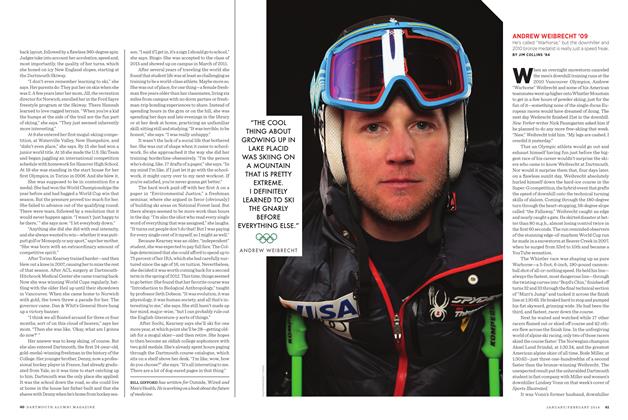
ANDREW WEIBRECHT '09
January | February 2014 -
 OUTSIDE
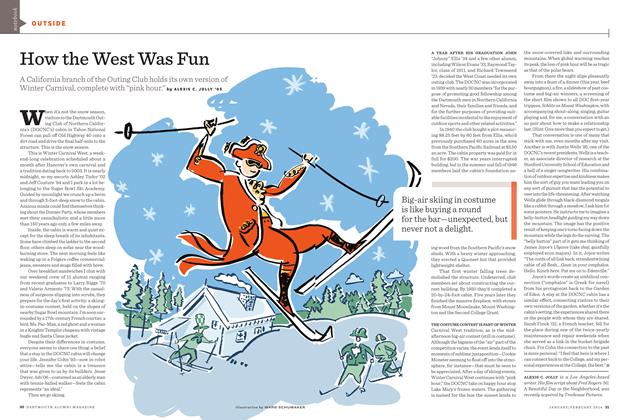
How the West Was Fun
January | February 2014
BILL GIFFORD ’88

Features
-
 Feature
Seventeen Alumni Given Awards
October 1951 -
 Cover Story
Murray Hitzman '76
March 1993 -
 Feature
Early X-rays, Missing Skulls and Frozen Pizza
DECEMBER 1997 -
 Feature
Twelve Hours and Their Aftermath: The Student Seizure of Parkhurst Hall
JUNE 1969 -
Cover Story
ANDREW WEIBRECHT '09
JANUARY | FEBRUARY 2014 -
 Feature
"Spoiled Children" of Hanover: A Letter from Charles Doe, 1849
MARCH 1959


