WILLIAM HOWARD TAFT
By Herbert S. Duffy, '20. Minton, Balch & Company, 1930, 345 pages.
This life of William Howard Taft, by Herbert S. Duffy of the Class of 1920, is rather more complete and is less marked by the spirit of salesmanship than a campaign biography. On the other hand it is less thorough and contains fewer documents than the usual "life and letters" such as Hirst's "Life and Letters of Thomas Jefferson."
In the foreword Mr. Duffy says, "In the preparation of this biography, access was had to the private papers of William Howard Taft, located in the Manuscript Division of the Library of Congress, Washington, D. C. This book, however, is not in any way to be considered or construed as an official life of Mr. Taft." It is a pity that the time is not ripe for Mr. Duffy to have printed a great many of the documents which he must have seen in the Taft collection. This is a source of information in which any biographer or historian would find great relish.
A brief chapter of nine pages carries the account of Taft's youth through Yale College and to the beginning of his career as a young lawyer in Cincinnati. There then follow three chapters giving some account, necessarily a brief one, of his early experience as a lawyer, as Solicitor-General of the United States and in connection with some disputes with the labor element in Ohio.
The next group of chapters, thirteen in all, constitute the core of the book. They are devoted almost entirely to those events which led to the American acquisition of the Philippine Islands and to Taft's connection with those possessions. In these chapters are to be found a somewhat vivid account of Taft's functions in the establishment of the American regime and particularly his interest in the erection of a civil government. There are a few indications of the controversy and ill feeling which arose when the Taft commission slowly replaced the military government of the Philippines.
Perhaps it is too early to set forth this controversy in all its details, but that the controversy was a real one, and that its detail would be of interest to all colonial administrators, is indubitable. Many of Governor Taft's confidential letters to friends in America indicated the difficulty which the civil administrator meets in replacing military control with the more orderly processes of civil government.
It is in this connection, perhaps, that Taft's geniality, willingness to cooperate, and abounding stores of tact appear to most advantage. There is also in these chapters an attractive picture of Taft in relation to the natives of the Islands.
Chapters 21 to 29 concern mainly the career of Taft just previous to the presidency, during that period and during the election of 1912. These chapters do not add much to what is already known about the events which rocked American politics between 1910 and 1912. This reviewer is coming to the opinion that some day, when all the available manuscript material has been digested, it will appear that the Taft presidency deserves a much higher reputation than it has hitherto had, and that much more credit will be given to Mr. Taft in connection with the campaign of 1912 than has yet been given him. Whatever material Mr. Duffy may have discovered in these connections, he has refrained from setting forth. This is undoubtedly wise, but here again the biographer and historian would welcome any information that can be made public.
The remaining chapters, three in number, relate to the later years of Taft's life, with especial reference to his tenure on the Supreme Court. The account of Taft as Chief Justice is so brief as to be somewhat sketchy, but a thorough-going account of these years would doubtless demand a volume larger than the number of pages which Mr. Duffy had at his disposal.
The format of the book is attractive; the illustrations, while not numerous, are excellent and the book contains a satisfactory index.
Charles R. Lingley
-
 Books
BooksThe Life of Thomas Brackett Reed
-
 Article
THE SPIRIT AND MECHANISM OF THE ADVISOR SYSTEM
April 1916 -
 Article
SALMON P. CHASE, UNDERGRADUATE AND PEDAGOGUE
October 1919 -
 Books
BooksMemories of Many Men in Many Lands
June, 1923 -
 Article
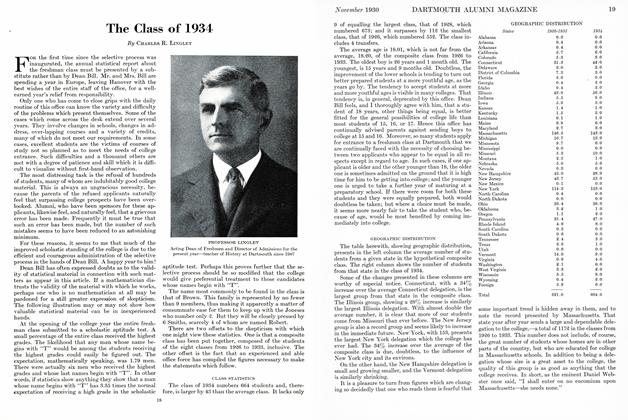
The Class of 1934
November, 1930 -
 Article
Some Misapprehensions in Regard to the Selective Process
February, 1931