Class of 1896 Reunion
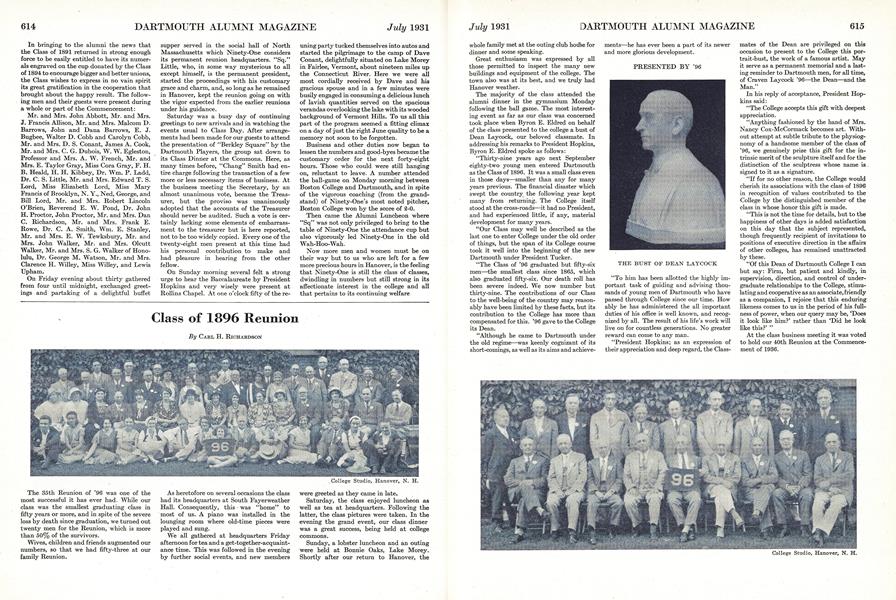
The 85th Reunion of '96 was one of the most successful it has ever had. While our class was the smallest graduating class in fifty years or more, and in spite of the severe loss by death since graduation, we turned out twenty men for the Reunion, which is more than 50% of the survivors.
Wives, children and friends augmented our numbers, so that we had fifty-three at our family Reunion.
As heretofore on several occasions the class had its headquarters at South Fayerweather Hall. Consequently, this • was "home" to most of us. A piano was installed in the lounging room where old-time pieces were played and sung.
We all gathered at headquarters Friday afternoon for tea and a get-together-acquaintance time. This was followed in the evening by further social events, and new members were greeted as they came in late.
Saturday, the class enjoyed luncheon as well as tea at headquarters. Following the latter, the class pictures were taken. In the evening the grand event, our class dinner was a great success, being held at college commons.
Sunday, a lobster luncheon and an outing were held at Bonnie Oaks, Lake Morey. Shortly after our return to Hanover, the whole family met at the outing club hoifse for dinner and some speaking.
Great enthusiasm was expressed by all those permitted to inspect the many new buildings and equipment of the college. The town also was at its best, and we truly had Hanover weather.
The majority of the class attended the alumni dinner in the gymnasium Monday following the ball game. The most interesting event as far as our class was concerned took place when Byron E. Eldred on behalf of the class presented to the college a bust of Dean Laycock, our beloved classmate. In addressing his remarks to President Hopkins, Byron E. Eldred spoke as follows:
"Thirty-nine years ago next September eighty-two young men entered Dartmouth as the Class of 1896. It was a small class even in those days—smaller than any for many years previous. The financial disaster which swept the country the following year kept many from returning. The College itself stood at the cross-roads—it had no President, and had experienced little, if any, material development for many years.
"Our Class may well be described as the last one to enter College under the old order of things, but the span of its College course took it well into the beginning of the new Dartmouth under President Tucker.
"The Class of '96 graduated but fifty-six men—the smallest class since 1865, which also graduated fifty-six. Our death roll has been severe indeed. We now number but thirty-nine. The contributions of our Class to the well-being of the country may reasonably have been limited by these facts, but its contribution to the College has more than compensated for this. '96 gave to the College its Dean.
"Although he came to Dartmouth under the old regime—was keenly cognizant of its short-comings, as well as its aims and achievemates ments—he has ever been a part of its newer and more glorious development.
PRESENTED BY '96
"To him has been allotted the highly important task of guiding and advising thousands of young men of Dartmouth who have passed through College since our time. How ably he has administered the all important duties of his office is well known, and recognized by all. The result of his life's work will live on for countless generations. No greater reward can come to any man.
"President Hopkins; as an expression of their appreciation and deep regard, the Class-Blue of the Dean are privileged on this occasion to present to the College this portrait-bust, the work of a famous artist. May it serve as a permanent memorial and a lasting reminder to Dartmouth men, for all time, of Craven Laycock '96—the Dean—and the Man."
In his reply of acceptance, President Hopkins said:
"The College accepts this gift with deepest appreciation.
"Anything fashioned by the hand of Mrs. Nancy Cox-McCormack becomes art. Without attempt at subtle tribute to the physiognomy of a handsome member of the class of '96, we genuinely prize this gift for the intrinsic merit of the sculpture itself and for the distinction of the sculptress whose name is signed to it as a signature.
"If for no other reason, the College would cherish its associations with the class of 1896 in recognition of values contributed to the College by the distinguished member of the class in whose honor this gift is made.
"This is not the time for details, but to the happiness of other days is added satisfaction on this day that the subject represented, though frequently recipient of invitations to positions of executive direction in the affairs of other colleges, has remained unattracted by these.
"Of this Dean of Dartmouth College I can but say: Firm, but patient and kindly, in supervision, direction, and control of undergraduate relationships to the College, stimulating and cooperative as an associate, friendly as a companion, I rejoice that this enduring likeness comes to us in the period of his fullness of power, when our query may be, 'Does it look like him?' rather than 'Did he look like this?' "
At the class business meeting it was voted to hold our 40th Reunion at the Commencement of 1936.
THE BUST OF DEAN LAYCOCK
More From This Issue
-
 Article
Attributes of Vision: The Baccalaureate Address
July 1931 -
 Article
LOCAL ASSOCIATIONS
July 1931 -
 Class Notes
1926 in the Hills: The Glorious Fifth
July 1931 -
 Class Notes
1921 Tenth Reunion
July 1931 -
 Article
Characterizations of Honorary Degree Recipients
July 1931 -
 Class Notes
Reunion of the Class of '76
July 1931