1895
I am presently intending to drive into the deep South to join Frank Austin, Joel Harley,"Sliver" Rice, at als, who have been spending the winter in Winter Park, Fla., along with other Dartmouth men.
If I have the hardihood to drive to St. Petersburg, I shall do just that and shall hope to be present at the projected alumni dinner there on April 9, according to the following letter from Williard G. Aborn '93:
"We had an Alumni meeting here in St. Petersburg, February 22 and quite a number present; I should guess about 60, at the Lakewood Country Club.
"Secretaries of '84—'85—'86—'88 and '93 pressent. Another meeting April 9 when it is expected that President Dickey will be there.
"The Baketels took us out to the Club which is a little ways out of the City. We did not drive down this year and so are dependent on friends for anything out of the city.
"The Baketels have a lovely home at Bahama Shores in the southerly part of the city.
"Weather has settled and we are having temperatures of 65° during the nights and going up to 80° at noons."
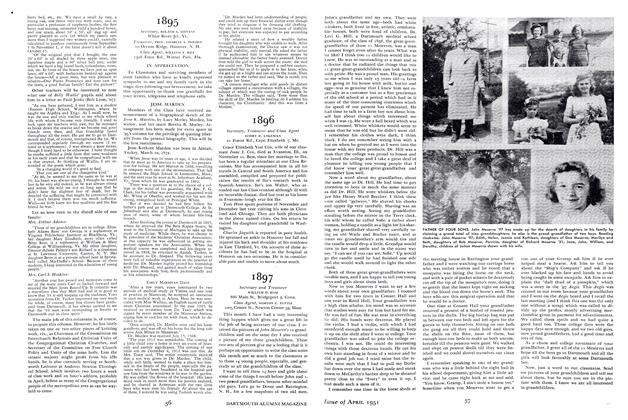
With his letter, Secretary Aborn inclosed a clipping from the St. Petersburg Times wherein our classmate, Dr. H. Sheridan Baketel, and Mrs. Baketel are pictured at lunch at the Bahama Shores Hotel, with his guests, Forrest Tucker and his fiancee, Miss Marilyn Johnson. Mr. Tucker is cited in the picture as taking time off from the movie set of TradeWinds, being filmed at Homassa Springs. The recent Tucker films, made for Republic Pictures, include The Sands of Iwo Jima, RockIsland Trail and California Passage.
To return now to the life of Dr. Jesse K.Mar den.
THE NEW HOSPITAL
"The medical work in Marsovan under his lead- ership grew apace. The Station Treasurer, Mr. Dana K. Getchell, would say with significant emphasis, 'The hospital account has grown to 4 figures—to 5 figures.' It seemed that the time was ripe for a new hospital building. The winters of 1909, 'lO, and 'll saw plans maturing, with an English architect on the ground to draw up the blueprints. Ground was broken in June, 1911. Material for the building began to arrive. Great oak logs from beyond Chorum were brought on ox-carts. From these, frames for windows and doors were made on the ground. The roofing for the building came from Canada, shingles of a preparation of asbestos, a beautiful gray in color. The iron girders came from Belgium. These were brought in skillfully arranged groups, bound together and carried by camels and horses up the hills and across the plains and rivers 70 miles, from the port of Samsoun. The heating system came from Germany, installed by German skill, adapting the furnaces to the local coal which was mined east of Kavza.
"In August, 1914, when the hospital buildings were nearly ready for occupancy, World War I broke out. The College buildings were commandeered by the government. Dr. Marden and Dr. White, President of Anatolia College, went to the Marsovan _ officials and offered the new hospital buildings if they would leave the College halls and homes untouched. This was done. A Turkish regiment took over the hospital, and soon the fresh rooms were occupied by Turkish soldiers. In September, Ambassador Morgenthau in Constantinople successfully manipulated the order for their with- drawal. There followed a great and hurried clean-up, and before the end of the month the wards were ready for occupancy. The day for moving from the old hospital to the new was at hand—no small task. Dr. White, in fine cooperation, gave one day for the young men of the College to remove the patients to the new wards.
"Never can I forget the first night. There were lights in all the windows where patients were in their beds. Our own home was above the pharmacy and out-patient department, across the driveway from the hospital. My husband stood at the window of our dining room looking across to the main building with its lighted windows. He knew who lay in those wards, the men's ward on the second floor and the women's and children's on the third floor. His attitude as he stood there showed deep inner satisfaction, not pride, for that was foreign to him, but deep, unexpressed gratitude. The hospital was built, was actually occupied; it was a going concern. And our boy, William Morely Marden, was sleeping in his cradle bed, between those of his father and mother.
"Yes, the dream had come true, the culmination of years of work and planning that there might be better opportunity to care for suffering humanity. It was the best and largest hospital in Asia Minor east of Constantinople at that time. It comprised three units, the main building, the kitchen and laundry at the back, and near the main entrance the out-patient department and pharmacy, with a suite of rooms on the second floor.
"But war clouds came nearer and nearer. Turkey declared war on the side of Germany in the autumn of 1914. The following spring and summer the fiendish plans for the deportation of the Armenians from all over Turkey to Der Zor in the far southeast were carried out. Most of the College and Hospital personnel were Armenian.
"In all of the difficult problems and critical situations, Dr. Marden, Pr. White and Mr. Gretchell were in close consultation. They sought by every means they knew to get the deportation order rescinded or at least ameliorated for the American Compound.
"Officials agreed to permit the pharmacist, a certain number of nurses, two cooks and other helpers to stay: but most of the key professors and teachers of College and Girls' School were taken.
"Ox-carts were driven onto the Compound, and Armenian families were ordered to load on what they could and be ready to be off within an hour or so. No one knew what was in store for them; utterly defenseless, they were at the mercy of the rude oxdrivers and the soldiers. Heart-rending were the good-byes as Americans and friends watched the sad caravan file out of the Compound. No one of them ever came back, and only confused, uncertain reports were received as to their fate.
"Different was the story of the deportation from the Girls' School. Two days after the ox-carts took away the professors with the College and Hospital group, spring carriages appeared at the doors of the School with the order for the girls to go. Miss Willard, the Principal, arranged the groups for the carriages, each carriage having a teacher or older girl in charge. By superb faith, persistence, and good-will. Miss Willard with her close friend Miss Frances Gage, the former Principal, obtained permission to follow the carriages at a distance of two hours. Forty-eight of the 61 who left the American Compound were taken to Sivas, where Miss Willard and Miss Gage applied to the Vali for permission to take them back. He granted the permission and took pains to make sure that they were in no way molested on the.return journey. This was the only such incident in all those days of horror. The story is told in detail in the Life of Charlotte R. Willard, by Ernest Pye.
'The Hospital and schools continued to carry on through the autumn and winter, though with greatly reduced numbers."
Secretary, White River Jet., Vt.
Treasurer, 10 Occum Ridge, Hanover, N. H.
Class Agent, 8 Zamora St., Jamaica Plain 30, Mass.