1905
According to my latest report from our faithful Tub Besse, Bill Knibbs is making a satisfactory recovery from the severe operation that he underwent early this fall. We all wish you the best of health, Bill.
Thanks to Shirley Cunningham, who appears to be renewing his youth in the invigorating air and sunshine of New Mexico, I have some news of Jim Mulally. The proud grandfather of 12 young hopefuls, Jim is still very active as Assistant General Counsel of the Great Northern Railway in St. Paul. Two of his sons are lawyers in Jim's home town. Of these, Edward was recently appointed to the Bench. Congratulations, Jim, on your fine family.
We are saddened to learn of the loss recently of our classmate Bob Clark by cerebral hemorrhage. Those of us who attended the class reunion last summer will recall very pleasantly Bob's friendliness and obvious delight in being with us. Our deep sympathy goes to his wife Margaret in her sad bereavement.
We are looking forward eagerly to the '05 —'06 dinner in New York at the Dartmouth Club December 12. We hope for a good representation from our class.
Who's Who In '05
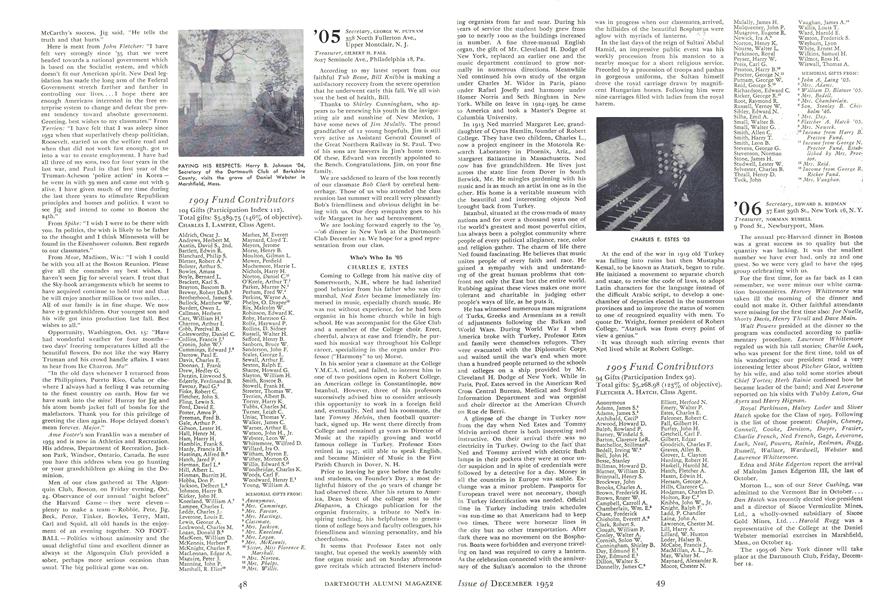
CHARLES E. ESTES
Coming to College from his native city of Somersworth, N.H., where he had inherited good behavior from his father who was city marshal, Ned Estes became immediately immersed in music, especially church music. He was not without experience, for he had been organist in his home church while in high school. He was accompanist for the Glee Club and a member of the College choir. Erect, cheerful, always at ease and friendly, he pursued his musical way throughout his College career, specializing in the organ under Professor ("Harmony" to us) Morse.
In his senior year a classmate at the College Y.M.C.A. tried, and failed, to interest him in one of two positions open in Robert College, an American college in Constantinople, now Istanbul. However, three of his professors successively advised him to consider seriously this opportunity to work in a foreign field and, eventually, Ned and his roommate, the late Tommy Melvin, then football quarterback, signed up. He went there directly from College and remained 42 years as Director of Music at the rapidly growing and world famous college in Turkey. Professor Estes retired in 1947, still able to speak English, and became Minister of Music in the First Parish Church in Dover, N. H.
Prior to leaving he gave before the facultv ancl students, on Founder's Day, a most delightful history of the 40 years of change he had observed there. After his return to America, Dean Scott of the college sent to the Diapason, a Chicago publication for the organist fraternity, a tribute to Ned's inspiring teaching, his helpfulness to generations of college boys and faculty colleagues, his friendliness and winning personality, and his cheerfulness.
It seems that Professor Estes not only taught, but opened the weekly assembly with fine organ music and on Sunday afternoons gave recitals which attracted listeners including organists from far and near. During his years of service the student body grew from 300 to nearly 1000 as the buildings increased in number. A fine three-manual English organ, the gift of Mr. Cleveland H. Dodge of New York, replaced an earlier one and the music department continued to grow normally in numerous directions. Meanwhile Ned continued his own study of the organ under Charles M. Widor in Paris, piano under Rafael Joseffy and harmony under Homer Norris and Seth Bingham in New York. While on leave in 1924-1925 he came to America and took a Master's Degree at Columbia University.
In 1915 Ned married Margaret Lee, granddaughter of Cyrus Hamlin, founder of Robert College. They have two children, Charles L., now a project engineer in the Motorola Research Laboratory in Phoenix, Ariz., and Margaret Ballantine in Massachusetts. Ned now has five grandchildren. He lives just across the state line from Dover in South Berwick, Me. He mingles gardening with his music and is as much an artist in one as in the other. His home is a veritable museum with the beautiful and interesting objects Ned brought back from Turkey.
Istanbul, situated at the cross-roads of many nations and for over a thousand years one of the world's greatest and most powerful cities, has always been a polyglot community where people of every political allegiance, race, color and religion gather. The charm of life there Ned found fascinating. He believes that music unites people of every faith and race. He gained a sympathy with and understanding of the great human problems that confront not only the East but the entire world. Rubbing against these views makes one more tolerant and charitable in judging other people's ways of life, as he puts it.
He has witnessed numerous mass migrations of Turks, Greeks and Armenians as a result of adjustments following the Balkan and World Wars. During World War I when America broke with Turkey, Professor Estes and family were themselves refugees. They were evacuated with the Diplomatic Corps, and waited until the war's end when more than a hundred people returned to the schools and colleges on a ship provided by Mr. Cleveland H. Dodge of New York. While in Paris, Prof. Estes served in the American Red Cross Central Bureau, Medical and Surgical Information Department and was organist and choir director at the American Church on Rue de Berri.
A glimpse of the change in Turkey now from the day when Ned Estes and Tommy Melvin arrived there is both interesting and instructive. On their arrival there .was no electricity in Turkey. Owing to the fact that Ned and Tommy arrived with electric flash lamps in their pockets they were at once under suspicion and in spite of credentials were followed by a detective for a day. Money in all the countries in Europe was stable. Exchange was a minor problem. Passports for European travel were not necessary, though in Turkey identification was needed. Official time in Turkey including train schedules was sun-time so that Americans had to keep two times. There were horsecar lines in the city but no other transportation. After dark there was no movement on the Bosphorus. Boats were forbidden and everyone traveling on land was required to carry a lantern. As the celebration connected with the anniversary of the Sultan's accession to the throne was in progress when our classmates, arrived, the hillsides of the beautiful Bosphorus were aglow with myriads of lanterns. '
In the last days of the reign of Sultan Abdul Hamid, an impressive public event was his weekly procession from his mansion to a nearby mosque for a short religious service. Preceded by a procession of troops and pashas in gorgeous uniforms, the Sultan himself drove the royal carriage drawn by magnificent Hungarian horses. Following him were nine carriages filled with ladies from the royal harem.
At the end of the war in 1919 old Turkey was falling into ruins but then Mustapha Kemal, to be known as Ataturk, began to rule. He initiated a movement to separate church and state, to revise the code of laws, to adopt Latin characters for the language instead of the difficult Arabic script, to develop a onechamber of deputies elected in the numerous provinces and to improve the status of women to one of recognized equality with men. To quote Dr. Wright, former president of Robert College, "Ataturk was from every point of view a genius."
It was through such stirring events that Ned lived while at Robert College.
1905 Fund Contributors
94 Gifts (Participation Index 92). Total gifts: $5,268.98 (123% of objective). FLETCHER A. HATCH, Class Agent.
Anonymous Adams, James S.1 Adams, James S.2 Archibald, Cecil3 Atwood, Howard D. Balph, Rowland P. Barney, Winfield S. Barton, Clarence LeR. Batchellor, Stillman3 Bedell, Irving W.4 Bell, John H. Besse, Stanley Billman, Howard D. Blatner, William D. Brintnall, Henry S. Brockway, John Brooks, Charles A. Brown, Frederick H. Brown, Roger W. Campbell, Carroll A. Chamberlain, Wm. E.8 Chase, Frederick Chisholm, Everett A.e Clark, Robert S. Clough, William P. Conley, Walter A. Cornish, Solon W. Cunningham, Shirley B. Day, Edmund E.T Day, Edmund E.1 Dillon, Walter S. Donnelly, James C.8 Elliott, Herford N. Emery, Walter P. Estes, Charles E. Falconer, Robert C. Fall, Gilbert H. Furfey, John H. Getchell, Carl F. Gilbert, Edgar Goodrich, Charles F. Graves, Allen B. Grover, L. Clayton Harding, Robert H. Haskell, Harold M. Hatch, Fletcher A. Hazen, Edwin H. Hersam, George A. Hills, Clarence C. Hodgman, Charles D. Holton, Ray C.3 Knibbs, John W., Jr. Knight, Ralph F. Ladd, P. Chandler Laing, John A. Lawrence, Chester M. Lill, Harry A. Lillard, W. Huston Loder, Halsey B. McCabe, Francis J. MacMillan, A. L., Jr. May, Walter M. Maynard, Alexander R. Moore, Chester N. Mulally, James H. Mulqueeney, John P. Musgrove, Eugene R. Newick, Ira A.9 Norton, Henry K. Nourse, Walter L. Parkinson, Royal Peyser, Harry W. Preis, Carl G. Preston, Harry B.10 Proctor, George N.u Putnam, George W. Reid, George S.12 Richardson, Edward C. Ricker, George R.13 Root, Raymond R. Russell, Verney W. Sibley, EdwardJM. ( Silha, Emil A. t. Small, Walter B. Small, Walter G. Smith, Allen C. Smith, Harry T. Smith, Leon B. Stevens, George G. Stevenson, Norman Stone, James H. Studwell, Lester W. Sylvester, Charles B. Thrall, Henry D. Tuck, John Vaughan, James A.14 Wallis, Louis T. Ward, Harold E. Weston, Frederick S. Weyburn, Lyon White, Ernest M. Wilkins, Samuel H. Wilmot, Ross H. Wiswall, Thomas A. MEMORIAL GIFTS FROM:1 John A. Laing '05.2 Mrs. Adams.3 William D. Blatner '05.4 Mrs. Bedell.5 Mrs. Chamberlain.6 Son, Stanley B. Chisbolm '46.7 Mrs. Day.8 Fletcher A. Hatch '05.9 Mrs. Netvick. 10 Income from Harry B.Preston Fund.11 Income from George N.Proctor Fund. Established by Mrs. Proctor.12 Mrs. Reid.13 Income from George R.Richer Fund.14 Mrs. Vaughan.
CHARLES E. ESTES '05
Secretary, 358 North Fullerton Ave., Upper Montclair, N. J. Treasurer, 8027 Seminole Ave., Philadelphia 18, Pa.