1904
"It is always nice to hear from you, and your recent letter pepped me up quite a bit. I can visualize where you live and recall your family whom Anna and I met. I'll bet that the austere setting of winter just gives another kind of beauty to Canaan. Snow is mostly beside the roads and in some fields, but knowing New England as we do, this report may be out of date in a few minutes. Yet it is Monday and Anna has hung out the washing.
"I am glad if I can be of service to the Class and committee at the Fiftieth. I shall welcome any suggestions or ideas about the Memorial Service. The dates, I note, are from June 11-13. One time is as good as another about my coming, but it is far more impressive to be around when the College is grinding out one more batch of coming world-shakers. Thanks for your estimate of the number who may return to Hanover, with a guess at the members of their families. It is helpful. I am most grateful for the Class Directory, which I keep consulting at odd moments."
Jack Dailey '53, Hopkins Scholar, Mike's son, returned to College after the holiday recess, but disappeared during the January 9 weekend. The facts as they are known appear in two paragraphs at the bottom of Page 13 of the February MAGAZINE. Before filing these March notes, the Medical School office had nothing more helpful to add. Mrs. Dailey is constantly in touch with the Medical School.
Bissell Hall was a gloomy spot for a group of willing, eager boys fresh from a hundred widely scattered prep schools to begin indoctrination in Dartmouth athletics in the fall of 1900. However, we did find MEN there from the classes of 1901 -02-03 who were winning honor on college fields for themselves and making good records for Dartmouth. These men were in the business of building life-long friendships when John Bowler arrived in 1901 to help Dartmouth men play better and work better year after year. His energy and ability provided the increased physical equipment to contain the growth of the College. Now, Ducky Drake, Secretary of 1914, a pioneer in many good things, springs a simple plan for the classes who knew and loved Doc Bowler to provide a memorial where his life work was happily spent. It is a real privilege for us in 1904 to support the Drake idea. See "Bowler Memorial" Page 26, January MAGAZINE.
At a directors meeting of the Massachusetts Business Development Corporation, February 3. George B. Wells resigned as president and Carl F. Woods was elected to succeed him. Wells, who has given much time without compensation to the organization of the corporation, is returning to manage his private business interests. Woods, a prominent industrial engineer, is chairman of the board of Swank Inc., a trustee of the Winchester Savings Bank, and director of many companies, including the Arkwright Mutual Fire Insurance Co., the Felters Co., and Angier Corpoation. Woods is also contributing his services to the Development Corporation. Source, Boston Globe, February 4.
We have on hand a modest supply of the July '49 MAGAZINE, which will be sent to applying class members till the supply is exhausted. It covers reunions from '89's 60th through '39's 10th, featuring '99 in the 50-year role. With Ned Robinson in person as runner-up at our 45th.
John F. Sanderson (yes—that's Jack) operates a guest house at 220 S. Lawsona Blvd., Orlando, Fla.
Ira O. Willard planned to be in Miami for Christmas, remaining till April 1 - address, 5884 S.W. 2nd Terrace, Miami 44, Fla. "I intend to be at Hanover next June at all costs," Ira.
Bernie Boyle now gets his mail at Box 956 New Port Richey - make this change please, in your new directory.
The morning mail on February 10 brought a much enjoyed letter from Harry Morse, handler of footballs and fondler of pianos. Living now in Santa Barbara instead of "on the ranch," he allows that he would like to see all of the group who were classmates at the turn of the century. Perhaps he will persuade Hat Hardy to come with him. Put a few briars in his pants to create dissatisfaction with his surroundings - tell him we must have the news in time to exchange pianos for accordions.
Ralph Sexton retired January 1 from the managership of the Boston office of the Sylvania Division of the American Viscose Corporation, second largest manufacturer of cellophane, which was first made in America by Dupont in 1925. When cellophane was introduced here from France in 1920, Ralph was one of a half dozen in the U. S. to sell this product. Ralph was then associated with a New York firm no longer in existence. In 1929 Sylvania Industrial Corporation erected a plant for the manufacture of cellophane in Fredericksburg, Va., and Mr. Sexton became manager of the Boston office. He continued as manager when American Viscose took over Sylvania in 1946. The family home is at 18 Mason St., Winchester, Mass., where they have lived since 1920. Son John lives in Rangely and Richard is now on Navy duty at Portsmouth Naval Hospital in Virginia. A reserve officer, he was in private practice in Providence when called to duty. He plans to return to Providence when he is separated from the Navy.
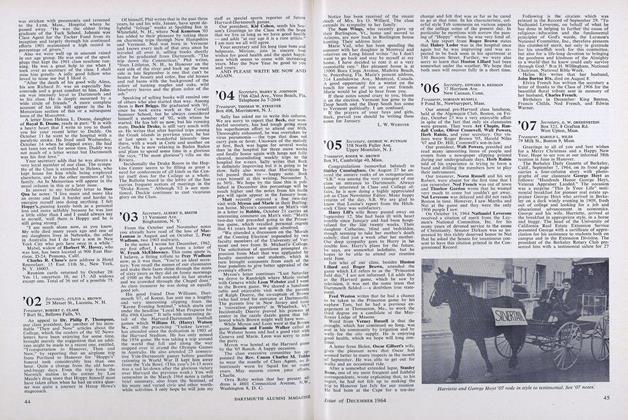
An undated (Postmark blurred) but enticing card of the Old Fort, Montego Bay, Jamaica, brings a greeting from Hayward, "Temperature 80° - water 78° - Some contrast to New England. Hope to see Pen andRosy in Florida in February." When you see Rosy and Pen, tell them about your baseball experiences in 1904 and get a pass for the games till weather changes here.
Secretary, Canaan, N.H.
Treasurer, Morristown, N.J.
Bequest Chairman,
A boost from Canon Charlie Tubbs: