1900
The sincere sympathy of the class goes out to Ben Prescott in the loss of his wife. Early in January, after a long illness, Ruby C. Prescott passed away in a Nashua hospital. It is always hard to lose our loved ones. This, I think, is especially true in Ben's case as he and his wife had lived together for 48 years in a close-knit partnership of mutual interest and affection.
Perhaps at this juncture the words of the great Poet-Laureate of England have meaning for us all:
"Strong Son of God, immortal Love,
Whom we that have not seen thy face, By faith, and faith alone, embrace, Believing where we cannot prove!"
Lynda Redington tells me that John Redington's son, John Skinner Redington, and his wife have bought a new home at 6008 Clinton St., Boise, Idaho. John is happy in his work as senior draftsman with the Idaho Power Co.
Mrs. Gertrude Balkham, widow of Gilbert Balkham, flew to California last June to attend the wedding of her grandson. She reports not only a lovely wedding but also the opportunity for a wonderful visit with her oldest son, Steve. At Christmas time she again went up the ramp of an airliner and flew to New York where she spent the holidays, I am sure joyously, with her son Gil and his wife on Long Island.
And speaking of Long Island reminds me that your secretary and his wife journeyed to Freeport, L. I., on Dec. 23 and stayed until Jan. 8. We ate well, slept well, watched TV, engaged in miscellaneous activities, and saw two of the current musical comedies in New York. What more could one ask of a holiday?
While on the subject of Christmas this further note is pertinent. Charles Proctor and his wife spent five delightful days with their son John and his family in Weymouth, Mass. Christmas dinner was - I am not quite sure the word hilarious is proper or exact - celebrated with thirteen members of the family present. Charles also had the good fortune of a visit with his sister whom he had not seen for a number of years.
A note from John Mathes informs me of difficulties he has had to courageously face this past year. In March he had two major operations which have left him in a weakened condition. To add to this tough situation John's wife has been confined to her bed or to a wheel-chair. They have a practical nurse in constant attendance and a man who lifts Mrs. Mathes from the bed to chair, and who drives John whenever it is possible for him to get out. Despite these difficulties John says: "When I look around and see some of my friends that are in worse condition I feel I am lucky." Such a statement is born in the thought of one who possesses the ingredients of sterling character.
A letter received recently from Clarence Paddock tells of a trying experience he and his family passed through last summer. Early in July his wife, Pearl, was taken to the Melrose Hospital for a major operation. She was in the hospital sixteen days, and then brought home where for some weeks she was slowly recuperating. At the present writing, I am happy to say, she has regained her strength to the degree that she and Clarence together can meet the normal demands of a going household. Clarence, fortunate man that he is, is blessed with four well placed and loyal children and thirteen grandchildren. His youngest daughter, Eleanor, and her husband, Bob, who is head of the physiology department at Albany Medical School, on January 6 started on a two weeks' Caribbean cruise. On this trip Bob delivered a series of lectures to a group of practicing physicians.
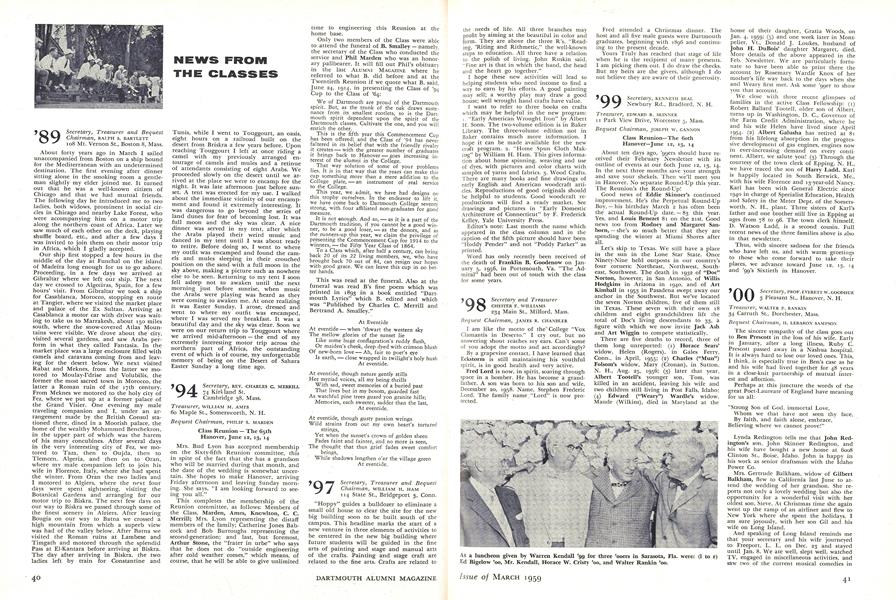
Our Florida contingent is made up of Mrs. Nat Barrows, the Walter Rankins, Ned Bigelows, and Hod Cristys. All of these worthies are guests at the Vinoy-Park Hotel in St. Petersburg. Ned Bigelow, so far as I am informed, the most active athletically plays a round of golf every other forenoon and shuffle board every afternoon. At this rate he is quite likely to qualify as among the antediluvians.
Fred Smith's dilemma in regard to L.B.'s statistics on the size of the average 1900 family is in the way of being solved. Arthur Roberts comes valiantly forward with the proposition that the word family covers a multitude, or thereabouts, of interpretations. He alleges that:
The word family may be used all the way from one person to a hotelful. If one were to regard its archaic use as derived from "famulus" (servant), the statistics based on the presence of servants under one roof would today incline towards zero. Since L.B. could properly use it for a childless couple, his statistics related to the potential family, not to the actual, whether blessed by children or not. At any rate, the old fear that college people would not more than reproduce themselves is vanished, even if early marriages today seldom rival Johann Sebastian Bach with his 21 children. Long ago I noted in the records of 17th century aristocrats in Puritan New England that the average family included about sixteen children. They were more ascetic about church decoration than about families.
So, there you are. If anyone has any more light to shed on this complicated statistical problem, please let it be known.
Secretary, 3 Pleasant St., Hanover, N. H.
Treasurer,34 Carruth St., Dorchester, Mass.
Bequest Chairman,