DARTMOUTH SONGS
Part I (1771-1898) in a three-part series
SONG has always been the most glorious means of self-expression. To its listeners it exposes a person's inner being, through both its words and its music. An ode sounds better when set to music. A rhymed verse is remembered
more easily than a statement in prose, and if the verse is sung it stays in the mind still longer. Sometimes a lusty melody will provide lasting support for an assemblage of doggerel or meaningless chatterings. A poem that has languished for years may become the words to a song which then becomes an everlasting star. Let the melodies that you know best run through your mind. Would you be able to recall their words if they were not borne on the crest of a musical wave?
Memories and songs seem to go hand in hand. Some songs are remembered because of the circumstances under which they were first heard. Others remain with us because they have the gift of recall - like "the crunch of feet on snow" or "when the team in green appears." The "lone pine above her" stands forever etched against the* sky to the northeast even though it is only an after-image remaining from the lightning flash that felled it years ago.
It is the intention of this three-part treatise to follow the windings of Dartmouth song through the decades, and to talk about the personages who brought the words and music into being. There will be tunes that flashed by with the speed of light, soon forgotten. There will be those that lasted through the warm suns and nurturing rains of a summer, or were washed away by the spring freshets after a long winter of crystalline whiteness. Certain hardy varieties had to be revived by transplanting, permitting them to grow to their true fullness and beauty. More were crowded out by more popular and sturdier varieties. Finally, there have been those which became firmly implanted, and are now tall and flourishing in their native habitat.
The space allotted to particular songs, poets, lyricists, and arrangers is not necessarily based on their relative importance or renown. It is dependent as well on the data which could be developed about them - and, in the case of the more recent persons, the amount of information their contemporaries or they themselves could furnish.
It is inevitable that some events and some people will stand high in the clouds - but we will show no disdain for those who lived and walked in the foothills or on the country roads, where the grass increases year by year between the ruts which were once familiar.
DARTMOUTH'S first Commencement occurred on Wednesday, August 28, 1771. Governor Wentworth was present from Portsmouth with a retinue of sixty. There were four candidates for the first degrees to be given in arts. After the customary salutatory, clyosophic, and valedictory orations by Ripley, Frisbie and Wheelock respectively, these three and the fourth candidate, Gray, sang an anthem composed by Frisbie, and set to music by Ripley, who "had some talent in that direction." The President reported later that the performance "met with universal acceptance by great applause."
As if to provide the background for a song that was later to become one of Dartmouth's perennials, the Governor provided an ox which was roasted whole on the Green with a barrel of rum and the "usual accompaniments."
At the Fourth of July celebration in 1817 the Dartmouth Gazette reports that an original hymn and ode was sung by the Handel Society. At the dinner which followed later in the day at the Dartmouth Hotel, Daniel Temple 'l7 sang an original piece composed by Thomas Upham '18. The Gazette gives few details on these musical events, and the subjects of the songs and the quality of their settings are, in consequence, open to dubious conjecture.
It is in order at this point to insert a bit about the Handel Society, which for years has played a substantial part in Dartmouth music. Although it was an organization of the Hanover community, with both sexes eligible for membership, it was called the Handel Society of Dartmouth College and therefore is part of the College's tradition. Professor John Hubbard and Tutor Francis Brown founded the Society on July 23, 1807. At that time John Hubbard was said to have the best musical library in the country, and the choicest morsels of this collection were purchased by the Society at his death, in 1810.
There had been a nameless Musical Society since the early 1790'5, and the record of the 1792 Commencement mentions that several pieces were performed by this group in the Chapel, and that George W. Kirkland of the graduating class received a special testimonial from the Trustees for his musical talents and proficiency. This same unnamed society performed regularly at the College Church services, and President Timothy Dwight of Yale told someone in October 1803 that he had "never heard sacred music rendered with as much taste and skill as were here displayed."
Although it has no plausible connection with this history of "Songs" we cannot throw into the discard information about the first Dartmouth organ, purchased in Lunenburg, Vt., by Joel W. Hemmenway in 1838 and installed in the chapel by permission of the College. Hemmenway gave organ lessons, and permitted the use of the instrument by the Handel Society. The installation was purchased from Hemmenway upon his graduation in 1842 for $5OO, and remained in the chapel until 1868. At that point it was "entirely played out" and was put aside for a melodeon. In the meantime an organ had been purchased for the College Church in 1852, remaining in use there until 1893.
Back now to the Handel Society. Its annual performance became a feature of Commencement Week, beginning in 1808 and continuing until 1842. Its last recorded meeting, until its 20th century rejuvenation, was held on June 19, 1888.
Ritter in his Music in America awarded to the Handel Society the highest accolade. He stated in no uncertain terms: "I consider the Handel Society of Dartmouth College - next to the Boston Handel and Haydn Society - the one that was most beneficial in its influence. Some of the best vocal and instrumental musicians have been sent forth from the Dartmouth society to various parts of the country. To Dr. Jabez B. Upham, Dartmouth 1842, and afterwards president of the Boston Handel and Haydn Society, has been ascribed the building of the Boston Music Hall, the great organ, the music festivals, and the music instruction in the Boston schools."
American college songs appeared sporadically in the middle of the nineteenth century. Up to that time the songs most in use, and remembered, were imports from the world without. "Gaudeamus" was brought back to Yale in 1840 by R. S. Willis, and except for commencement odes this is the first evidence of the existence of a distinctive student song, original or otherwise, in any institution of higher learning. This may be disputed at Harvard, however, for at its bicentennial in 1836 a poem entitled "When the Puritans Came Over" by Oliver Wendell Holmes was sung to the tune of "Dearest Mae." And about the same time Samuel Gilman begat' the first of the Alma Maters with "Fair Harvard." Shortly thereafter appeared the famed piece "The Mountains" authored by Washington Gladden, Williams '59. Brown University's "Alma Mater," also "Song to Old Union" by Fitz Hugh Ludlow, joined the now-increasing list of college songs that have survived to the present. George Clark '99 stated, with proper authority, that "The Mountains" was really the first complete American college song, having both original words and music.
There is of course a Dartmouth myth that three Indian students planted a pine tree on Observatory Hill, smoked their pipes, and sang the verses beginning "When shall we three meet again?" Since Shakespeare had written the same words in 1606 for the alumnae of Cauldron College, the aforesaid students must be accused of plagiarism of the first degree. The myth is more completely destroyed by George Clark's pointing out that the Old Pine was too mature even in the days of the earliest Dartmouth Indians to have been a sapling, that the first records of the Pine Tree Ceremony do not appear until 1840, and that the real distinctive third verse of the song did not appear in the original publication.
The imported "Gaudeamus" soon made its way to Hanover, and was joined by two other Latin companions, "Lauriger" and "Integer Vitae." These had rousing harmonies, with the words incon- sequential. Ability to sing them only proved the ability to articulate the Latin language properly, and to remember the proper sequence of the slow, ponderously sung Gallic syllables.
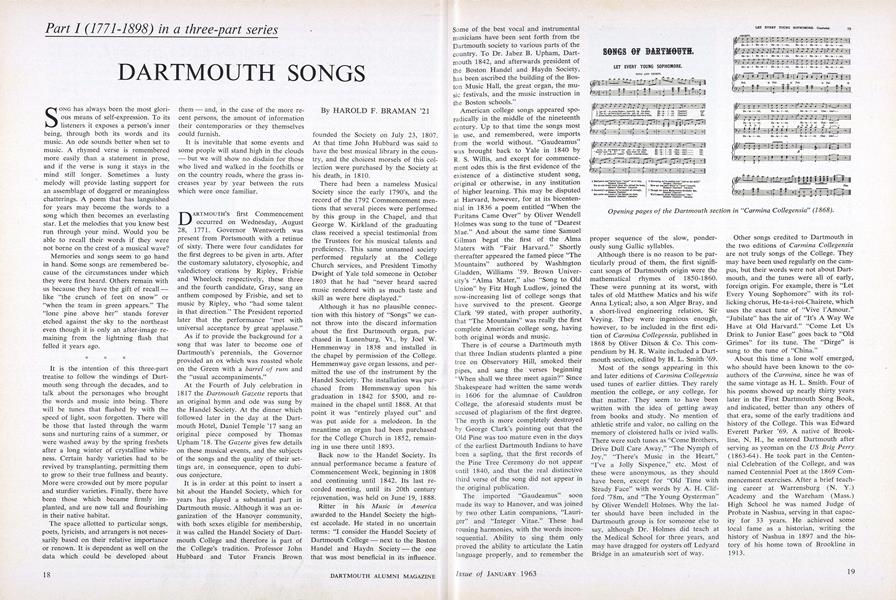
Although there is no reason to be particularly proud of them, the first significant songs of Dartmouth origin were the mathematical rhymes of 1850-1860. These were punning at its worst, with tales of old Matthew Matics and his wife Anna Lytical; also, a son Alger Bray, and a short-lived engineering relation, Sir Veying. They were ingenious enough, however, to be included in the first edition of Carmina Collegensia, published in 1868 by Oliver Ditson & Co. This compendium by H. R. Waite included a Dartmouth section, edited by H. L. Smith '69.
Most of the songs appearing in this and later editions of Carmina Collegensia used tunes of earlier ditties. They rarely mention the college, or any college, for that matter. They seem to have been written with the idea of getting away from books and study. No mention of athletic strife and valor, no calling on the memory of cloistered halls or ivied walls. There were such tunes as "Come Brothers, Drive Dull Care Away," "The Nymph of Joy," "There's Music in the Heart," "I've a Jolly Sixpence," etc. Most of these were anonymous, as they should have been, except for "Old Time with Steady Face" with words by A. H. Clifford '78m, and "The Young Oysterman" by Oliver Wendell Holmes. Why the latter should have been included in the Dartmouth group is for someone else to say, although Dr. Holmes did teach at the Medical School for three years, and may have dragged for oysters off Ledyard Bridge in an amateurish sort of way.
Other songs credited to Dartmouth in the two editions of Carmina Collegensia are not truly songs of the College. They may have been used regularly on the campus, but their words were not about Dartmouth, and the tunes were all of early, foreign origin. For example, there is "Let Every Young Sophomore" with its rollicking chorus, He-ta-i-roi-Chairete, which uses the exact tune of "Vive l'Amour." "Jubilate" has the air of "It's A Way We Have at Old Harvard." "Come Let Us Drink to Junior Ease" goes back to "Old Grimes" for its tune. The "Dirge" is sung to the tune of "China."
About this time a lone wolf emerged, who should have been known to the co- authors of the Carmina, since he was of the same vintage as H. L. Smith. Four of his poems showed up nearly thirty years later in the First Dartmouth Song Book, and indicated, better than any others of that era, some of the early traditions and history of the College. This was Edward Everett Parker '69. A native of Brookline, N. H., he entered Dartmouth after serving as yeoman on the US Brig Perry (1863-64). He took part in the Centennial Celebration of the College, and was named Centennial Poet at the 1869 Commencement exercises. After a brief teaching career at Warrensburg (N. Y.) Academy and the Wareham (Mass.) High School he was named Judge of Probate in Nashua, serving in that capacity for 33 years. He achieved some local fame as a historian, writing the history of Nashua in 1897 and the history of his home town of Brookline in 1913.
Parker's poetry included "College Days," "Old Dartmouth's Silver Punch Bowl," "The Graduates' Farewell," and the "Old Conch Shell." The description of a winter's day is really quite expressive:
"When howling winds of winter, sweeping down from Grantham's peaks,
Gyrate around old Dartmouth Hall in loud demoniac shrieks.
Student lays down to sleep, secure, and dreams he hears the college yell,
Or the wailing of the freshman, as with diabolic glee,
He confers on him the honors of the Greek society;
And he hugs himself in ecstasy, and pities those who plod
Their weary way in teaching, near the billows of Cape Cod."
In 1882 Oliver Ditson & Co. published the first of a series of American College Songbooks which graced the music racks of every piano, melodeon, and home organ in America along with the Hymnal, the Simple Piano Pieces for Four Hands, and The Pianoforte in Fifty Easy Lessons. This Songbook contained the first genuine songs of Dartmouth, with several written by undergraduates. Here were printed the works of a group of young men, forerunners of a long line that has now stretched far into the second half of our century.
The first team:. W. E. Strong '82, A. W. Jenks '84, W. A. Bartlett '82, W. B. Patterson '83, Benjamin Tenney '83, William S. Strong '82, William R. Conant '83 - and the debut of Richard Hovey '85.
These men were all in Hanover at the same time, and apparently had one interest in common - music. They were members of the Glee Club and each had a turn at a Dartmouth song. As songs went they were no great shakes, and since all these men turned to other professions in later life their musical careers in Hanover must be considered as undergraduate avocations.
Benjamin Tenney, native of Thetford, Vt., went on to be a successful surgeon at Boston City Hospital, taking on this career after several years of teaching in Massachusetts secondary schools. Other accomplishments, not associated with music, included the presidency of the Dartmouth Alumni Association of Boston in 1912, and the siring of Dr. Benjamin Tenney '21, who followed illustriously in his father's Hippocratic footsteps. It was at his home on Marlboro Street that Richard Hovey and Henriette Russell were married on January 17, 1894. Ben's wife was Alice Parker, the daughter of Professor Parker who had been Hovey's Latin teacher.
Walter Patterson, who collaborated with Tenney in the Student's Song, went on to spend 48 years in the Educational Service of the District of Columbia until his retirement in 1931. He likewise was able to pass along the Dartmouth tradition to a son, Russell B. Patterson '11.
Arthur Jenks chose a ministerial career which started with a pastorate at St. Thomas Episcopal Church in Hanover, and concluded with a professorship in Church History at General Theological Seminary in New York City. In 1911 Dartmouth awarded him the honorary degree of Doctor of Divinity.
William E. Strong, along with Jenks, wrote the aquatic ballad, "The Watery Glee Club." He was in the middle of a line of Dartmouth men, being the son of Elnathan E. Strong '52 and the father of our beloved Robert C. Strong '24. He also chose the ministry, receiving his training at the Hartford Theological Seminary and holding pastorates in Beverly, Mass., Jackson, Mich., and Amherst, Mass. Later he was Foreign Secretary of the American Board of Commissioners for Foreign Missions, and Editor of the Missionary Herald. He continually made use of his poetic talents in a non-professional way, never neglecting the chance to put forth his iambic efforts to commemorate some special event like the departure of a colleague, the annual Christmas get-together lunch, etc. He likewise was given the honorary degree of Doctor of Divinity at his 30th reunion in 1912.
William Alfred Bartlett came as close as any of his group to having his name inscribed in the Hall of Musical Fame. In college he was a member of the Handel Society, organist for the College Choir, and first tenor in the Glee Club. In the class report of his 50th reunion it was noted that his musical gifts were asso- ciated with the Hanover church and chapel organs, and (secularwise) with the part of Josephine in Pinafore. Many of his contributions are recorded in church hymnals, kindergarten songbooks and musical albums for church choirs and soloists. He made a reputation for himself by offering from time to time a Lecture on Music, ably assisted by his daughter, Doris - whose lovely voice, according to press reports, "made a deep impression on her audiences."
Bartlett followed the same pattern as the contemporaries just mentioned. He likewise graduated from the Hartford Theological Seminary and held pastoral assignments in Chicago, Lewiston, Me., Hartford, Conn., and Lowell, Mass. He was director of Near East Relief from 1920 to 1926. He was the son of Dartmouth's eighth president, Samuel Colcord Bartlett, and the brother of Samuel Bartlett '87, who comes up for comment a little later on.
William Rawson Conant was a country boy from nearby Orford, N. H., who prepped at Kimball Union Academy, where he taught briefly after graduation in 1883. Apparently music was just an avocation, since he spent four years in education, ranging from Santa Fe, N. M., to Norfolk, Conn. Then for twelve years he was in Y.M.C.A. activities, finally having to return to Orford to assist his ailing father in the carriage and harness business. He later became postmaster in the town, and wrote the history of Orford for its 150th anniversary celebration in 1915. His son, Louis C. Conant '26, was Professor of Geology at Smith College, and at last reports was with the U.S. Diplomatic Service.
THE top banana in the octet who made the grade in Carmina Collegensia was, need we say, Richard Hovey, about whom so much has been said and written. Quite naturally, he plays the principal role in this drama of Dartmouth songs, and it is difficult to believe that any one figure will ever appear in the star-spangled firmament to eclipse this forceful personality. The story of Hovey has been told again and again, but possibly a few new facets can be added as we take a microscopic look at those moments in his career when Dartmouth and her songs occupied his complete thought and attention. We will omit, quite properly, all reference to his successes (with some few failures) in the fields of drama, Arthurian legend, teaching, lecturing, Delsartism, and Symbolism.
Just a paragraph of biography. He was essentially a New Englander, a Vermonter. Although Richard was born in Normal, Ill., his father had been born in Thetford, and had lived there for a quarter of a century. A logger, teamster, barn builder, blacksmith, and school teacher through his late 'teens, the elder Hovey had entered Dartmouth at the age of 21 and graduated in the Class of 1852. His mother, although born on Nantucket Island, was a Spofford, which family for generations had lived in Essex County, Massachusetts. This county is in the extreme northeastern corner of the state, contiguous to New Hampshire. It was to the matriarchal home in North Andover that Richard was transported, when only a few months old - and it was there that he found his last resting place.
At Dartmouth Hovey came under the tutelage of Prof. Charles Francis "Clothespins" Richardson '7l, and as an undergraduate came to admire the "singing poets" such as Shelley, Swinburne, and Poe. In his earliest poetry it was possible to detect the skill in metrical experiment that set him apart from campus contemporaries. He adored to recite, loved the quality and flavor of words; in his sonorous baritone voice he would reel off whole pages of verses which he had memorized. He was appointed one of three to represent his class in the forensic contest of Commencement Week, 1884. He later won the dramatic prize for his recitation of "The Bells" which was particularly adaptable to the wide range of his voice. However, through all this prize-winning he never won a single citation for writing.
It was eight years after leaving Hanover that his poetry first showed up in a published volume. In 1893 Bertrand A. Smalley '94 published the second edition of Dartmouth Lyrics. Its aim was the "inclusion of representative poems of representative Dartmouth literary men," with the intention of making the book a faithful exponent of Dartmouth poesy, past and present. The volume included the efforts of some 34 Dartmouth men, ranging from John Adams Bellows '70 to sophomore Isaac J. Cox '96. Seven of Hovey's poems are scattered through the volume, but to the uncultured ear of this narrator they bear faint resemblance to the gloried verse of the man's later years.
We believe we are correct in making the statement that all of Hovey's Dartmouth songs were written as lyrical poetry - and that all the musical settings were superimposed afterwards. Hovey was a poet, not a musician. He has also been termed a lyricist. This meant that almost every one of his shorter poems, being in proper meter, of limited stanzas, and in suitable verse form, could be, and were, readily adapted to music.
This helps to explain why many of the Hovey "songs" lay dormant for months and even years, like paintings in an artist's studio before the gilded frame, the subdued but projected lighting, and the sanctified air of a salon came along to provide the settings they needed to bring them immortality. From time to time these "frames" or settings have been changed - mostly for the better - but many poems still remain in dark corners awaiting a master craftsman to display them properly.
A classic example of this relationship between poem and setting is provided by "The Stein Song," chosen in a Collier'sMagazine contest as "the most popular college song in America."
Most Dartmouth alumni will assert loudly and strongly that this song is of, from, and about Hanover. But if the words are read carefully, nothing can be found to connote Dartmouth, no idiom that wouldn't apply to any group assembled for "good cheer," no reference to weather that couldn't be tied in to almost any spot in the north temperate zone of North America.
"The Stein Song" was lifted bodily from a Hovey poem entitled "Spring," read by its author at a national convention of Psi Upsilon Fraternity in Ann Arbor, Mich., on May 7, 1896. Hovey had been commissioned to write this piece while living parsimoniously in England. He agreed to the assignment only if his fare were paid from England to Detroit, and back to Washington, where Mother Hovey was living. The poem was not written until he reached Washington, and it was barely finished when it was time to depart for Ann Arbor. Biographer Allan Macdonald reports that "there was no definite contract, no stated length - and Hovey might have turned out a perfunctory performance. He did not. Though he wrote a poem for a specific occasion, he made it true to himself and his faith, and kept it alive through its considerable length by his skill in shifting beat and measure and tone to the need of mood and thought. Characteristically the world has adopted the incidental 'Stein Song' to maudlin fellowship which has little to do with Hovey's high sense of comradeship. His most famous lines are roared or stammered the globe over, as they deserve to be, but the lyric exultance and high goal are unsung, as they do not deserve to be."
At Ann Arbor, President James B. Angell of Brown, Bishop Perry of lowa, and others, had completed their symposium on university education. Hovey rose to deliver his masterpiece, and his rich, controlled voice carried the audience through the long poem to enthusiastic acclaim. The following day delegates and guests took a special train to Detroit, and on an upriver excursion on the ferry Promise the poem was delivered again. The poem had solved his problem of getting back to the States, but about all he had left in his pockets was a railroad ticket to Washington.
A year or more later, Edwin Grover '94 started a program which was to culminate in the First Dartmouth Song Book. Details of this will come later, but it will be necessary to mention it here in order to carry our "Stein Song" story to its conclusion.
One of the first choices of Hovey poetry that Grover made was the three middle stanzas of "Spring." They had provided an entr'acte to relieve the ponderance of the long irregular lines, with their deliberate plodding speeds. This same device is familiar to orators, who interject a quip or a piece of light humor into an extended and otherwise serious dissertation. The first septet was not used in the first songbook - the one that starts "When the wind comes up from Cuba." The fourth - "Give a rouse then in the Maytime' - became the first stanza, and the second and third remained in proper order.
Arthur Custance, whom we shall deal with later, was given the chore of framing these three lively excerpts, and it is his music which appears in the First Songbook. That is the only place that this setting ever appeared, because shortly thereafter a more renowned music-master, Frederic Bullard, took over. It is his setting that has identified the song ever since.
Bullard had gone to Boston Latin School, spent several years at Tufts, and had received a degree at M.I.T. in 1887. As described later in the Boston Herald of February 25, 1906, the "old boys" of the Latin School were to hold a reunion banquet, and Bullard was in charge of the music. He sent for four of his former classmates to come to his home and try out a song he had just finished. It was "The Stein Song" set to his new music. It was a hit. Bullard hastened to have it published in sheet music form. It put him on his financial feet, money began to tumble in from royalties, he got clear of all his debts and had sufficient left over to go abroad and further his musical education.
Because of Bullard's connection with Tufts and both of these alma maters pounced on the "new" Stein Song, and both insist to this day that it is theirs by divine right. At M.I.T. alumni parties they always sing "when Tech Men get together," and then rise in honor of the composer.
So it looks as if Dartmouth aficionados would have to be content with the knowledge that although the words were from a poem by a Dartmouth genius and first appeared as a song in a Dartmouth Songbook, "The Stein Song" must not be claimed as its own but must be shared convivially with the whole world.
ALTHOUGH it may be said that the last decade of the century was heavily weighted by the Hovey influence, solid recognition must be given to the song which has been sung longer, more times, and by more Dartmouth men than any other. It is still the Alma Mater song, despite the efforts of some to have "Men of Dartmouth" considered as sort of a co-captain in the musical ranks. It is very properly titled "The Dartmouth Song."
The song was a product of undergraduates and first sung, by undergraduates. It persists through the four years of campus life, and is borne away at the end of senior year as an intangible treasure, to be brought out for display on occasion, but mostly held closely within the heart. It is a song of friendliness to be sung at the end of a college year, at the end of the college career, at the end of a class reunion, at the end of a service of commemoration or dedication - a song of remembrance. "Thine honor shall be ever dear," "thy name we'll cherish all our lives," and "wish that we were back again within thy classic fold." A song of parting - but not for long. Its counterpart, "Men of Dartmouth," shouts to the world the glories of the College with its words of defiance. It is sung for the universe to hear, and maybe for that reason is not as intimate in color as the earnest plea of "Come, fellows, let us raise a song." The two pieces have a parallel, perhaps, in our country's two patriotic melodies - "America" and "The Star Spangled Banner." The first is of devotion, the other, of pride.
Willard B. Segur '92m was the creator of both the words and tune. Although he had already received an A.B. degree from Princeton in June of 1889, he entered Dartmouth Medical School the following month and remained there three full years, receiving the M.D. degree in 1892. Although this was presumably a graduate course, there were no restrictions placed on Segur's participation in activities of the undergraduate college, because he played tackle on the varsity football team for one year and was moved to center the year following. To prove his versatility he sang in the Glee Club and in his second year in Hanover became its leader. He immediately formed a close friendship with Guy W. Cox '93 who was six years his junior. Segur describes in his own words the events which led to the" writing of our Dartmouth Song:
"Although for the 1890-91 season we had a good program, there was nothing of a personal Dartmouth name, nothing we could call our own or touch that feeling that is such an element in the Dartmouth spirit. One evening, when alone in my room, I wrote down the lines as they came to me, then marked out the music with the help of my guitar. Next evening was the Glee Club rehearsal, and a little before the time a few of us met in one of the fellow's rooms in the Wheelock for a 'hum and strum.' I ran it over with them and they said, 'Let's try it tonight at rehearsal.' This was done and it met with strong approval. We all agreed to keep it quiet and use it for the first time at the annual concert, soon to be given in the old chapel. I confess I was surprised but greatly pleased at the enthusiastic reception with which it was received. The members of the Glee Club as well as the alumni urged that it be retained on the program for the season, and afterwards I found it had become a permanent number."
Although Segur wrote the melody for "The Dartmouth Song," the piece was put into harmony and the accompaniment written by Guy Cox. He was a most able and gifted musician. It is reported that as a child he came to Boston with his music teacher whenever the opportunity presented itself, and would attend every concert or recital that could possibly be squeezed in during these two and three-day visits. He learned to play the piano before he learned to read.
In college Guy Cox not only was accompanist for the Glee Club for four years, and college organist for three, but he also was in the orchestra and band. But, as with so many gifted musicians who could have made a career in the world of melody, he chose the legal profession, receiving his LL.B. from Boston University in 1896. The height of his worldly achievement was reached with the presidency of John Hancock Life Insurance Company. With several others he later entered the prize competition for a new Dartmouth song, but he was ruled ineligible because his equally famed brother Channing, Class of 1901, had been appointed one of the judges.
The second and third verses of "The Dartmouth Song" were omitted from the Sixth Edition of the Dartmouth Song Book (1950). Although they had occasionally been left out in formal renditions, they are very surely a part of the whole, and should be kept available as part of the written record of Dartmouth music.
THE first act of our drama should end climactically. And it can - because here we will tell again the impressive story behind "Men of Dartmouth," the acme of Richard Hovey's attainments in the realm of college song.
Although "The Dartmouth Song" had achieved success with the undergraduates, it had not penetrated to the alumni. This was made evident at a meeting of the Dartmouth Lunch Club of Boston on February 3, 1894, held at the old Tremont House. An unnamed clergyman of the Class of 1844 was aroused to make a motion that a committee of three be appointed to obtain an "Alma Mater song." An honorarium of $lOO was contributed for the purpose and proper publicity was given to the matter.
Richard Hovey was in the vicinity. Since the previous fall he had been in Boston. Only two weeks previously, on January 17, he had married Mrs. Edmund Russell whom he had met in Washington five years earlier. The wedding had taken place at the home of Ben Tenney '83, as previously reported. The couple took up residence first at 15 Blagden Street and later at 601 Boylston.
Word reached Hovey that he was being mentioned for the prize song. He quickly picked up the gauntlet and set to work. His wife wrote Mother Hovey in Washington on Good Friday, March 23: "There he sits thinking of it, and his eyes shining like two moons - you remember the look. ... He enjoys living here because the room is big. He can walk, walk, and smoke, smoke, smoke. Those seem to be necessities when he is writing."
Two days later, Easter Sunday, the poem was complete. According to Macdonald, "he had thrown away the outworn sentiments of the college songs that could belong to any college by mere change of name. He built his poem out of Dartmouth - and by suggestion and symbol built.a new student body."
At Commencement 1896 the committee of three, headed by Prof. "Clothespins" Richardson awarded the prize to Hovey, who was not in attendance. That autumn the Trustees of the College offered the Baker prize of $100 for a musical setting to the poem, to be "suitable for chorus or outdoor singing." This was after several offerings had already been received and turned down. One had been rejected by Hovey himself as "too like a psalm tune." Marie Wurm, who will be mentioned later in connection with "Eleazar Wheelock" and "Our Liege Lady," furnished a very satisfactory version which Hovey said he wished might be used "regardless of how many others were in the competition." He suggested that the song be published "with as many different musical settings as you see fit; indeed, I think the more the better, and -let time try between them." However, Miss Wurm's efforts were spurned, the best excuse being that "she was not a Dartmouth man."Bullard, in sending along manuscripts for "Barney McGee" and "The Winter Song" to Edwin O. Grover, said that he didn't think it desirable to include his setting for "Men of Dartmouth," especially "as you have one already. And, as I have two, and don't know which is surely the best."
Addison Andrews '78, who had been chosen as musical editor of the First Song Book, submitted some music in April 1898 based on the style of "Auld Lang Syne." He stated that it was a tune which "antique and toothless alumni with no voices could pretend to sing at an alumni reunion." He did, however, send in another entry later which was finally selected as the prize-winner, even though Andrews felt that it did not satisfy all the conditions of the contest. And that is the setting that appeared in the 1898 Song Book. There it languished as just another college song.
For a decade there was dissatisfaction with the music assigned to Hovey's masterpiece. In September 1901, at the laying of the cornerstone of Webster Hall, Professor Charles "Harmony" Morse provided a setting for a male chorus. The following year Louis P. Benezet '99 wrote another setting which had the distinction of being used at the laying of the cornerstone of the "new" Dartmouth Hall in 1904. Still, there was a feeling that the job could be improved upon.
Ernest Martin Hopkins, who in 1908 was President Tucker's secretary, made an urgent plea to Harry Wellman '07, then secretary of the College Club in Hanover, to try his hand at still another framing. The muse was kind, and Wellman came up with music that matched every one of Hovey's stirring words - with "broad, homeric chord treatment" when required, and subtle changes in meter and phrasing in the middle passages. The vehicle for the new rendition was the Houseparty Show, "The Promenaders," which took the boards in May 1908. It was a rousing finale for the production, which was repeated before Commencement audiences that June, when Webster Hall was used in the graduation ceremonies for the first time.
Harry Wellman's efforts brought forth a masterpiece that should last in perpetuity, increasing in strength by the seasoning of the years and by its constant use in the gatherings of Dartmouth men everywhere.
Opening pages of the Dartmouth section in "Carmina Collegensia" (1868).
The Glee Club in 1876, just as the first genuine Dartmouth songs were appearing.
Richard Hovey 'B5, poet author of Dartmouth's finest songs the finest, somesay, ever written for any college. Thisphoto was taken about the time Hoveywrote the words for "Men of Dartmouth."
The cover of the first Dartmouth SongBook, published in Hanover in 1898.
An 1898 poster announcing the firstHanover singing of The Dartmouth Song.
HAROLD F. BRAMAN '21
Features
-
 Feature
Three Nominated as Trustees
July 1961 -
 Cover Story
Warming up for 50 years: The yeast of elderly innocence
JUNE 1982 -
 Feature
You Can’t Always Give What You Want
May/June 2004 -
 Feature
Out of the Amazon
MAY | JUNE 2018 -
 Feature
Recommended Reading
Sept/Oct 2010 -
 Feature
Some Faults, Some Solid Achievements
November 1975


