1951
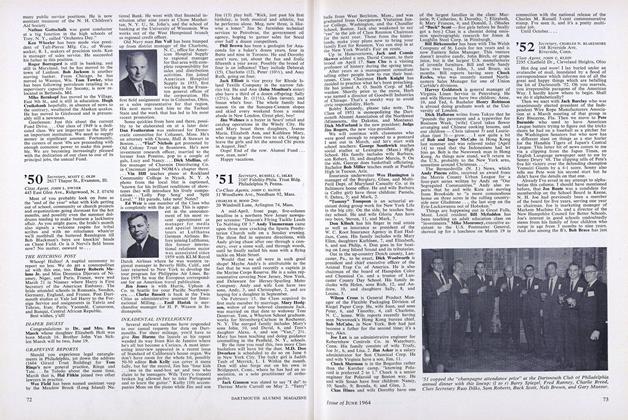
Special functions of local alumni clubs provide ideal opportunities for groups of classmates to get together. Eight '51's showed up at the Dartmouth Club of Philadelphia's stag annual dinner on March 3 and walked away with the class attendance cup and accompanying champagne.
The octet consisted of Charlie Breed (out riding the alumni fund circuit for the College), Nels Brown, Gary Mansur, Fred Ranney, Sam Roberts, "Buck" Scott, BarrySpiegel, and yours truly. I also retired as club secretary (after eight years) to become vice-president.
The Glee Club tour just ended provided further opportunities, which we hope were taken advantage of, for class gatherings in several cities. Then there's the '51 only function, such as our New York contingent's second annual cocktail party on Friday, April 10, at the Dartmouth Club in the Hotel Commodore from 5 to 8 p.m.
Ralph Watkins is the new Director of Training for E. F. Hutton & Company. Ralph will be responsible for training prospective Hutton sales representatives in major areas of the securities field. Ralph comes to the job from Kodak's public relations department by way of the institutional investors information program of the New York Stock Exchange.
Bob Moore has been named treasurer of Ryerson & Haynes, Inc., manufacturers of automotive accessories in Jackson, Mich. Bob joined R&H two years ago as controller after working for the Crampton Manufacturing Co. in Grand Rapids.
Dave Skinner and two other San Francisco lawyers have formed the firm of Gold- stein, Kopp & Skinner. The Kopp is Quent Kopp '49, well known to many of us.
Sel Atherton, a vice-president of the First Agricultural National Bank in Pittsfield, Mass., has been appointed treasurer of Pleasant Valley Sanctuary. The newspaper clipping fails to disclose whether the sanctuary is for bird, beasts, or bewildered people. Sel has been active in United Fund campaigns and is vice-president of the Dartmouth Club of Berkshire County.
Sel's "Agricultural Bank" leads right in to classmates in agriculture. (I'm beginning to suspect that half of the class has returned to the soil.) Our featured farmer for this month is Marc Heifer, Knitson Farm, Corfe Castle, Dorset, England. Marc writes:
"To recap: After release from USN, did a year and a half postgrad work in English in London, living in Chelsea and the British Museum night and day, respectively. Met a wonderful girl and reverted completely to chubberism. Rachel and I now have Emily (6½), Rebecca (5½), Alan Thomas (3), and Martin (1). ...
"Dirt-farming 185 acres with 100 head of Jerseys, 130 ewes for fat-lamb production, 350 layers, six riding ponies. Dabbling when time permits into local archaeology, more specifically medieval agriculture and architecture. Live in a fabulous newly modernised 16th century farmhouse, central heating, etc., and only four hours from London, but nobody comes to stay! Some of the affluent '51's must occasionally journey Europeward - hospitality abounds if they'll just invite themselves."
The annual trickle (which some mistakenly view as a deluge) of mail on the Alumni Fund is beginning. I'd like to put in my six cents worth now and then shut up.
My feelings about Dartmouth - and the Alumni Fund - are rather strong and intensely personal. At the risk of being banal, I want to share them with you.
I begin with a feeling of eternal gratitude for the opportunities which Dartmouth afforded me educationally, in extra-curricular activities, and in friendships. I know how much richer my life has been, is, and will be in every respect because I spent four years in Hanover instead of living at home and hanging daily on a subway strap on my way to Penn, Temple, or Drexel.
While this is in one sense the nostalgia-sodden past, it's still a part of me and, I suspect, of every other classmate today. I've yet to discover another college which has engendered the same rapport, esprit de corps, or whatever you want to call it, among its alumni.
I'm equally infected with the Hanover Dartmouth of today. In this area, other than our classmates on campus, I suppose that I have as much exposure to this _ contagious disease as any classmate. I'm legitimately in Hanover four times a year and also make it my business to keep in touch with undergraduates I've interviewed from the Philadelphia area
Let's start with the undergraduates, for they are, as John Dickey says, the "stuff of the institution." I wish that each and every one of you could sit down with me for Sunday dinner at the Hanover Inn with several of them on one of my quarterly weekends in Hanover.
I wish that you could. listen to them as they toss their bouquets - and brickbats to the College. I wish that you could share the impact the Hopkins Center has made upon their lives. I wish that you could sense the social conscience which pervades today's undergraduates.
I wish that all of you could have the same exposure to what is cooking on the faculty and administration side of the desk. I don't think it's just provincial pride to say that Dartmouth is in the forefront of private higher education today, quality wise, experimentally and also in terms of social conscience — Kemeny, Stockmayer, non-Western studies, "ABC," and so on.
This vibrantly living organism which is Dartmouth today is but one important segment of private higher education. That, in my view, cannot pass from the American scene without inviting catastrophe. For it enjoys an independence which public education will never have.
This is the 50th anniversary of the Dartmouth Alumni Fund. Whether you know it or not, our Alumni Fund set a pattern which has kept private higher education as alive in this country as it is today. May we not drop the torch.
I would put the Alumni Fund in the same class as procreation of the species. Others before us did it so that we had a Dartmouth to go to. If we don't do it for the Dartmouth undergraduates of next year and fifty years from now, we shall bear the guilt for having let the line die out.
This leads to the question of how much our individual responsibility costs. I want to mention our Century Club, men who give $100 or more. I nominate as honorary members thereof many men who won't qualify this year - Bob Kidd, in the Peace Corps in Thailand, scores of undercompensated classmates in education, the ministry, and similar occupations, and those men whose families have faced misfortune and for whom a $5 or $10 contribution constitutes a real sacrifice.
My own giving to Dartmouth includes a helluva lot of time and literally hundreds of dollars of unreimbursed out-of-pocket expenses. I don't expect any medals for that, but it has some bearing on the size of my own Alumni Fund contribution.
True, I'm not starving, and I'm a bachelor. But I'm far from rich, and I could never have gone to Dartmouth without scholarship aid. Yet, when it comes to the Alumni Fund, I find myself among the ten largest contributors in the Class. I'm not bragging.
I think I belong in only the top 100. I challenge those of you who are in a position to do so to match me, and I hereby authorize Head Agents Charlie Hood and JohnHatch to tell you privately how much I'm in for if you're willing to do so.
One final word: The way to come in out of the rain of Alumni Fund mail is to make a thoughtful, responsible gift or pledge early in the game.
Charles H. Hood 2ndNew Co-Head Agent for the Class of 1951
Secretary, 2107 Fidelity-Phila. Trust Bldg. Philadelphia 9, Penna.
Co-Class Agents, 31 Woodlawn Ave., Needham 92, Mass.
CHARLES H. HOOD 2ND 20 Windmill Lane, Arlington 74, Mass.