Supreme Court Judge at 31
Staff Writer, Clarksburg Exponent
Richard Neely '64 is a study in contrasts. He never expected to be an appellate judge, yet he is the youngest appellate judge in the English-speaking world. At Dartmouth he never took an English course, yet he was a regular member of the" afternoon group around Sanborn House, where he maintains he received his most valuable experience as an undergraduate.
Neely lives in Charleston's Imperial Towers where his apartment is furnished in formal Georgian style and adorned with his family's art collection, yet he never socializes and limits his guests to a few old college and law school friends. His clothes are all tailored by Burstow and Logsdail of London's Saville Row, yet he scrupulously avoids surrounding himself with the "smart set" professionals. He never visits any of the country or hunt clubs of which he is a member, and his social life as one of West Virginia's most eligible bachelors is circumscribed by a 14-hour workday six days a week.
He attended prep school in New England and then graduated from Dartmouth and the Yale Law School. According to his law clerk, Jonathan Noetzel, who left Harvard 25th in his class to accept the challenge of a legal and political experience in Appalachia, Neely can talk for two and a half uninterrupted hours on 13th Century English land tenure, yet he can lead a packed union hall in singing "A Miner's Life is Like A Sailor's." He is known among lawyers who practice before the Supreme Court as a judge who does not hesitate to express principles of law in Latin maxims, and he is known among Democratic precinct workers as a man who can entertain an entire Democratic picnic with a half-hour of yodeling and hog calling.
The grandson of the late United States Senator Matthew Mansfield Neely, who served West Virginia four terms as Congressman, once as governor, and four terms as United States Senator, young Neely inherited social position, a name, and a responsibility to service.
When asked his reasons for seeking public office, Neely quoted a poem by Goethe from Faust: "If thou wisheth to understand the poet, thou must enter into the land of the poet. If thou wisheth to understand the poem, thou must enter into the land of the poem."
"Politics is a study of life," Neely said, "and one can understand it only through involvement."
After Yale Law School and a tour of duty as a captain with the Army in Vietnam, Neely returned to his native Marion County and a year later was elected to the State Legislature, where he served two years as a member of the important Finance Committee.
He said that he enjoyed his short stay in the House of Delegates where his colleagues quickly recognized his understanding of economics in rural areas - a subject on which he had testified as an expert witness before the U.S. Senate Subcommittee on Employment and Manpower dur- ing his senior year at the College.
While in the House, Neely authored legislation to permit the use of tax-free municipal bonds for the financing of pollution control devices, and the Neely Higher Education Assistance Act, authorizing the state to lend college students up to 41500 per year.
Midway through his term in the Legislature, est Virginia's senior United States Senator, Minings Randolph, was expressing serious doubts whether he would seek reelection at the age of 71. The moderate wing of the Democratic Party turned to Neely as a potential successor.
Neely appeared to be acceptable to business, labor and industry - the traditional Democratic coalition in West Virginia - and he announced his candidacy for the nomination. Six months later, Senator Randolph announced for reelection and Neely graciously whdrew in the incumbent's favor at the behest of the leadership of the Democratic Party.
Party leaders were impressed with the vigor of Neely's short-lived Senate campaign; the media praised him for the dignity of his efforts and his support of Randolph for the sake of party unity. Recognizing his voter appeal. Party leaders encouraged Neely to run for the State Supreme Court.
Political historians conclude that when the economy is bad the ballot is long, and such was the case in West Virginia in the spring of 1972 as record numbers of candidates filed for office. Neely, though he had received good publicity in his bid for the Senate, faced strong primary opposition.
Shaking countless hands at factory gates, meeting the first shift in the morning and the last at night - eating breakfast with a business or civic group - lunching with college students - sipping afternoon tea with the ladies - handing out cards at shopping centers and on street corners - conferring with county chairmen and party officials - paying a courtesy call to a newspaper editor or broadcast manager - complimenting the cooks on cold chicken or dry roast beef before speaking at an evening banquet - Richard Neely demonstrated a style and vigor unparalleled since his grandfather, "The Old War Horse," fulfilled the same itinerary.
When Neely speaks, everyone listens. While entertaining his audience with an actor's skill, often evoking side-splitting laughter, he avoids political pablum. Rather, he talks of important issues, challenging his listeners to respond. Respond they do, as Neely's 35,000-vote primary victory clearly indicates.
There are many factors responsible for Neely's success, not the least being his family name. But a name alone is not sufficient, witness John D. Rockefeller IV, who lost the West Virginia governor's race to incumbent Republican Arch A. Moore Jr. by 73,000 votes, at the same time that Neely was defeating an incumbent Republican Judge by 52,000.
Neely's term on the high court does not expire until 1984, and while the highest ambition of many politicians is retirement to a court, free from the worry of campaigning, Neely probably will not complete his 12-year term.
He says that he enjoys being a judge, and that his first obligation to the people of West Virginia is to be a good judge. Already he has overruled a precedent of 24 years' standing which denied recovery to workmen covered by workmen's compensation in an action against doctors for malpractice. He has written concurring opinions arguing that insurance contracts are not strictly contracts of indemnity, and that they create rights in third parties. In a state which is notorious for having one of the most conservative bodies of decisional law in the country, Neely is already bringing new hope to the younger and more imaginative members of the bar.
The next Senate seat for which Neely can run becomes available in 1978, when by custom a candidate from Northern West Virginia will be expected to succeed Senator Randolph. With the Democratic Party still divided by the last election, however, the Senate race is years away and not an issue. What is an issue is who will lead the top of the state ticket in the election of 1976.
While expressing disinterest in the job of governor because he does not enjoy that type of "dictatorial power," the choice may not be entirely his own. There are the needs of the party and the element of timing to consider. Whether he wants the job or not, in capitol corridors and Charleston supper clubs, it is not unusual to hear people speculating about "Governor Neely," but thistime his name is Richard.
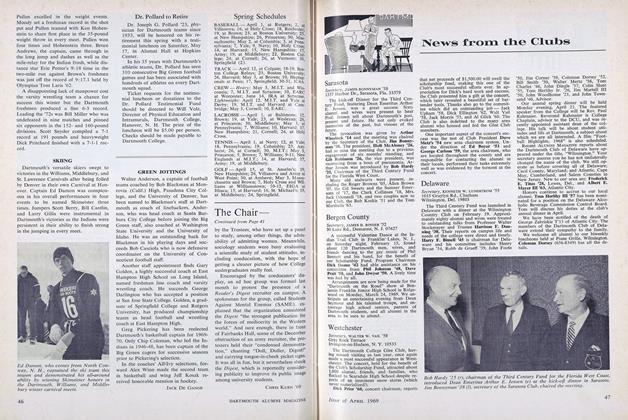
Judge Richard Neely '64 in his chambers atWest Virginia's highest court.
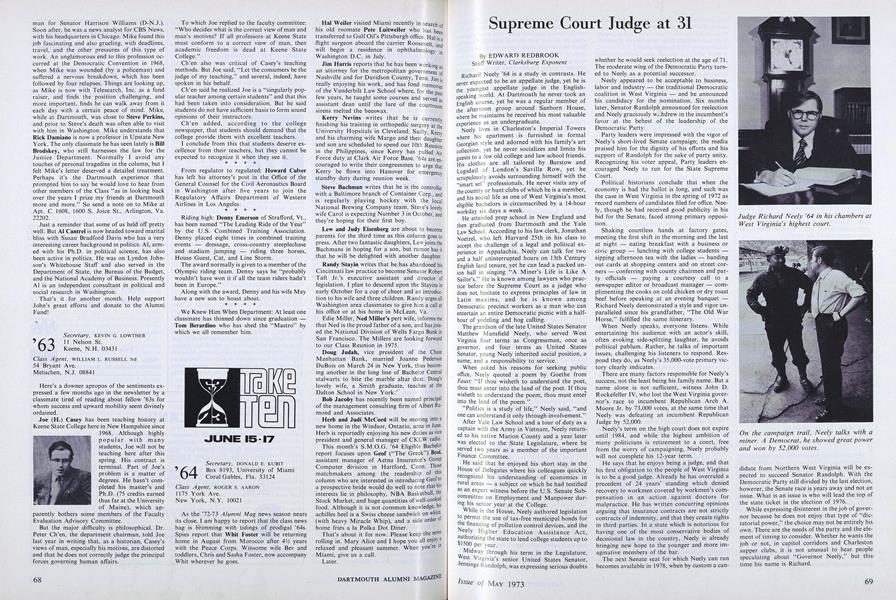
On the campaign trail, Neely talks with aminer. A Democrat, he showed great powerand won by 52,000 votes.