"All Deaned Out"
There weren't any engineers in my family my father was a plasterer. But I always wanted to be a civil engineer. It was a good way, it seemed to me, of developing a reasonable level of comfort and success upward mobility. I never thought about being anything else."
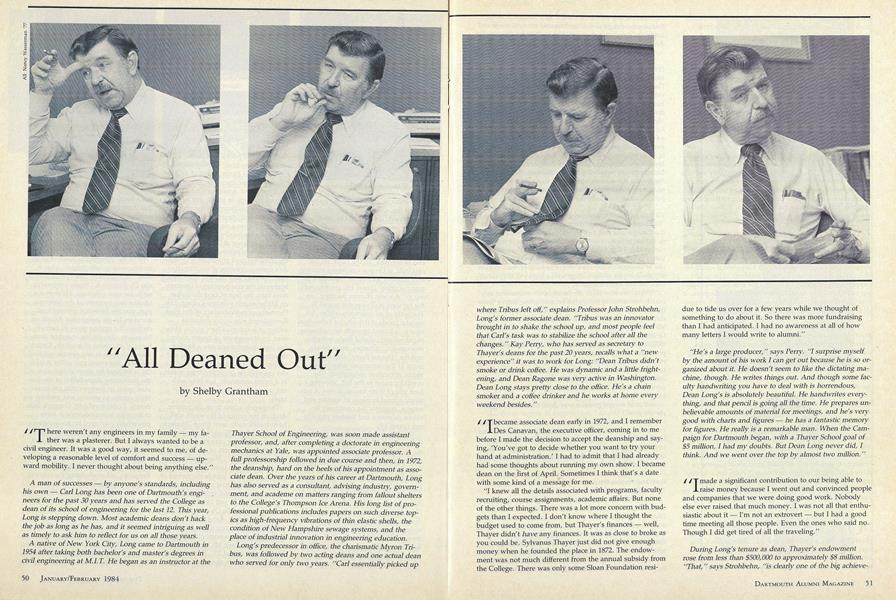
A man of successes by anyone's standards, includinghis own Carl Long has been one of Dartmouth's engineers for the past 30 years and has served the College asdean of its school of engineering for the last 12. This year,Long is stepping down. Most academic deans don't hackthe job as long as he has, and it seemed intriguing as wellas timely to ask him to reflect for us on all those years.A native of New York City, Long came to Dartmouth in1954 after taking both bachelor's and master's degrees incivil engineering at M.I. T. He began as an instructor at theThayer School of Engineering, was soon made assistantprofessor, and, after completing a doctorate in engineeringmechanics at Yale, was appointed associate professor. Afull professorship followed in due course and then, in 1972,the deanship, hard on the heels of his appointment as associate dean. Over the years of his career at Dartmouth, Longhas also served as a consultant, advising industry, government, and academe on matters ranging from fallout sheltersto the College's Thompson Ice Arena. His long list of professional publications includes papers on such diverse topics as high-frequency vibrations of thin elastic shells, thecondition of New Hampshire sewage systems, and theplace of industrial innovation in engineering education.
Long's predecessor in office, the charismatic Myron Tribus, was followed by two acting deans and one actual deanwho served for only two years. "Carl essentially picked upwhere Tribus left off'," explains Professor John Strohbehn,Long's former associate dean. "Tribus was an innovatorbrought in to shake the school up, and most people feelthat Carl's task was to stabilize the school after all thechanges." Kay Perry, who has served as secretary toThayer's deans for the past 20years, recalls what a "newexperience" it was to work for Long: "Dean Tribus didn'tsmoke or drink coffee. He was dynamic and a little frightening, and Dean Ragone was very active in Washington.Dean Long stays pretty close to the office. He's a chainsmoker and a coffee drinker and he works at home everyweekend besides."
I became associate dean early in 1972, and I remember Des Canavan, the executive officer, coming in to me before I made the decision to accept the deanship and saying, 'You've got to decide whether you want to try your hand at administration.' I had to admit that I had already had some thoughts about running my own show. I became dean on the first of April. Sometimes I think that's a date with some kind of a message for me.
"I knew all the details associated with programs, faculty recruiting, course assignments, academic affairs. But none of the other things. There was a lot more concern with budgets than I expected. I don't know where I thought the budget used to come from, but Thayer's finances well, Thayer didn't have any finances. It was as close to broke as you could be. Sylvanus Thayer just did not give enough money when he founded the place in 1872. The endowment was not much different from the annual subsidy from the College. There was only some Sloan Foundation Residue to tide us over for a few years while we thought of something to do about it. So there was more fundraising than I had anticipated. I had no awareness at all of how many letters I would write to alumni."
He's a large producer," says Perry. "I surprise myselfby the amount of his work I can get out because he is so organized about it. He doesn't seem to like the dictating machine, though. He writes things out. And though some faculty handwriting you have to deal with is horrendous,Dean Long's is absolutely beautiful. He handwrites everything, and that pencil is going all the time. He prepares unbelievable amounts of material for meetings, and he's verygood with charts and figures he has a fantastic memoryfor figures. He really is a remarkable man. When the Campaign for Dartmouth began, with a Thayer School goal of$5 million, I had my doubts. But Dean Long never did, Ithink. And we went over the top by almost two million."
I made a significant contribution to our being able to raise money because I went out and convinced people and companies that we were doing good work. Nobody else ever raised that much money. I was not all that enthusiastic about it I'm not an extrovert but I had a good time meeting all those people. Even the ones who said no. Though I did get tired of all the traveling."
During Long's tenure as dean, Thayer's endowmentrose from less than $500,000 to approximately $8 million."That," says Strohbehn, "is clearly one of the big Achievements of his deanship." An enormously successful alumnifund at Thayer was also begun under Long's leadership.
There wasn't a Thayer alumni fund when I became dean. Most estimates of the value of one were so low that it was considered doubtful whether we could pay even staff costs with it; but the overseers were hankering to do it, and I supported it. However, my father died the night before the meeting to discuss such a fund. I had to be at the funeral, and I left word for the overseers to go ahead with the meeting or go home, as they thought best. When I got back, Thayer had a Dean's Fund. It started in 1977, when it brought in $12,000, and last year it reached the $10,000 mark. Sometimes I wonder whether I'm more effective when I'm here or when I'm not."
"The most difficult thing about being dean," says Strohbehn, "is probably dealing with student honor code or discipline problems. Carl dealt with them forthrightly and wasalways very careful about procedures and yet very fair. Hetreated tenure questions the same .way. Carl was dealingwith people's lives in both cases, and the right thing alwaysgot done; he never backed off from it even if there was aneasier way."
The only thing I didn't enjoy as dean was the occasional reporting of the actions of the faculty on tenure. When the decision was positive, it was fun; when it was negative, it was no fun. Also, the interaction with students was significantly greater than I assumed it would be. There were admissions questions, problems of financial support and emergency loans, and the difficult job of figuring out what to say to students who wanted to drop out. It was hard for me to realize how much time a dean is expected to spend with students."
Perry reports that, in fact, Long has all along been deeplyinvolved with the students, and she senses a real growth inThayer's popularity with students over the last 12 years,during which graduate student enrollment in engineeringhas nearly doubled and the number of undergraduate engineering majors has tripled. Strohbehn points out that whilea dean is not expected to continue to teach, Long has doneso, and both Strohbehn and Perry cite with enthusiasm thedean's open door policy. From undergraduate to upperlevel, anyone can walk into Carl's office unannouncedsays his colleague, and his secretary concurs: "The constantinterruptions don't seem to bother him. If a mother and father show up with a prospective student to be shownaround the school and nobody else is available, the deanwill do it. He's a very sensitive person, I think. If anyoneon the staff has a problem, he is anxious to meet with himor her to talk about it. He is very good about keeping usposted and about keeping morale up." Perry has a furthergood word for the dean's temperament: "I really appreciatehis even disposition. Things don't seem to throw him. If hehas worked hard for something and gets shot down, hesays, 'Well, so be it. We'll prepare for the next one.' "
One of the biggest troubles a dean has is that the faculty don't always agree with all the wisdom he displays. You have a great idea and they shoot it down. It is very difficult to tell the faculty what to do. When you try, nothing happens. How is it done? Oh, well, that's a trade secret. To be serious, though, it's usually a matter of Enisting some faculty who lean toward what you want to do. You discuss things so you can respond to reservations and hope you can convince others. You can't order things to be done. It just never happens."
"There's no games-playing with Carl," says Strohbehn."He is very forthright —to the point sometimes of beingblunt. He's an excellent dean, with a great deal of integrity.I never felt I had to 'get around' him. f could always saywhat I felt to him when I was associate dean. When I toldhim what I thought was wrong, he listened. We arguedabout teaching loads, for instance. I wanted to decreasethem; he didn't. But we could discuss it. We disagreed alot, in fact but I never felt that he was not letting me geta fair hearing for what I wanted to do. And he was willingto change his mind. He may have been a little conservativein some senses, but he gave the school some very levelheaded leadership and some very creative administration.He was always examining ways to improve the status ofthe faculty. He was very concerned about that though,of course, not all of his schemes for accomplishing itpanned out."
If I have one negative comment with respect to the relationship between Thayer and the administration of the College, it is that they haven't always shared my views as to how important to Dartmouth this place is. It frustrates me because I don't understand why they don't understand that. I believe very strongly that by any set of criteria you use to measure quality, you would be hard-pressed to identify another part of the College with a higher-quality faculty than the one that exists here.
"When I became dean, the faculty's involvement in research had softened somewhat because of the lack of continuing leadership. I saw as a major function of the dean indicating to the faculty what it was necessary for them to do. We started publishing abstracts of all students theses and faculty research projects and publications. The first year, 1972-73, only three pages went to faculty publications and presentations. Two years later, with no tremendous change in the number of faculty, we published 17 pages describing faculty work. We distributed it to all other engineering deans in the United States, and that contributed to the reputation of the school. The faculty got to doing more, too. We advertised our competence we had enough of it - and once we got going, it was apparent that these people are good.
"Sponsored research can be used as a measure of quality, too. In the mid-seventies, we were doing half a million dollars' worth of externally-funded research. Last year it rose to the level of $2 million. That means a lot of high quality and very exciting work is going on here. And it's not just a few nice relationships with the same outfits year after year - there is a great diversity in supporting agencies. Foundations and corporations now have an increased awareness of Thayer School. I like that.
"Thayer School's outreach into other areas — computer and information science, the Cold Regions Research and Engineering Laboratory, the medical school, environmental studies, earth sciences is very satisfying, too. We're getting involved everywhere, sticking our fingers into everything. Half of what we are doing now didn't exist ten years ago. Biomedical engineering, cold regions science, resource systems policy. Much of this kind of innovation is driven by the interest of the students. Students ask for courses in biomedical engineering, so we contact the medical school. That leads to faculty interaction, which leads to supporting courses, which leads to faculty members committed to making the courses work, which leads to someone's suddenly realizing, 'My god we've got a program here. What can we do to make it really good?'
"Engineering is an appropriate member of the science division of the College, and an appropriate part of the undergraduate opportunity at Dartmouth. In a world of increasing sensitivity to the contributions of technology, an engineering science major is a good way to understand those contributions and a good way to figure out how one can contribute personally. And I think that now the Engineering Sciences Department is beginning to be accepted for what it is trying to do educationally. We have been very careful to develop an undergraduate major appropriate to the liberal arts goals of the College. (We may even have been too successful: half of all our majors become lawyers, business people, and doctors not engineers.) The College is becoming more aware of the presence of the place and of the positive side of that. Thayer is a much more important part of Dartmouth College now than it once was."
Long points out, however, that setting the guidelines for post -graduate activity at Thayer poses much more difficultquestions. For Long, one of the ways to address thosequestions was to establish a design center at Thayer, whichStrohbehn cites as the second big achievement of Long'stenure: "Carl also deserves credit for establishing the JohnBrown Cook 1929 and Marian Miner Cook Engineering Design Center at Thayer.. He created a home for the design effort initiated by Tribus. Engineering is a discipline thattakes wild swings, and before World War II, it was prettymuch a cookbook affair, with very little science and notmuch innovation. But the war effort caused a big swing toward science. Tribus felt that the pendulum had gone toofar, though, and that it was important to remember that themajor work in engineering is to design solutions to problems. He felt design ought to be reintroduced, but that ideawas not completely in tune with the training of most academics. It's a matter of the professional engineer versus theresearch engineer. Carl felt design had to have a place atThayer where it was the major thing going on, and for thatpurpose he brought the Cook Center into being."
Engineering design is a real complement to a professional degree in engineering. I couldn't understand why everyone else was not as enthusiastic about the design center as I was. I worried it to death till I got it. An academic institution interacts most often with the federal government as sponsor mostly for basic, pure research. Industry is less interested in pure research, and the purpose of the design center was interaction with industry. There were legitimate questions involved. Government gets results and publishes them; industry gets results and says don't tell anybody else. There were doubts, too, as to whether the quality of the problems posed by industry would be high enough for our students. We want to be at the forefront in design, not just solving problems any old good engineer could solve.
"Achieving an appropriate balance between commitment to research and commitment to professionalism design - involves a recognition that some people want to go into research and need a different education from those who want a career in engineering. I felt the kind of work we might get from industry was complementary to the goals of the school. Our students will have responsible positions in industry, so it seemed reasonable to involve them in it as part of their education in its problems. It develops a sensitivity not available with federally supported stuff. Nobody buys that; but whether anyone would buy something is important in industry. And as to the quality of the work that comes from industry, I felt that faculty ought to be free to accept as contract work, on their own behalf or on the students' behalf, anything that they could successfully defend to the rest of the faculty. In any event, I pushed, the overseers supported it, the faculty accepted it, and the Cook Center was started.
"And then I got the thing endowed. With the largest single gift the school ever received $1.3 million from Marian Cook. (When Thayer School was begun, it would have added someone's name to the school itself for that much money.) Today, 20 per cent of the engineering research at Dartmouth College is funded out of the private sector. Nationwide, the figure is only ten per cent. I feel good about that, too."
Despite having hadas he says, a very good time beingdean at Thayer, Long is certain that it is time for him tostep down. He is, he says, "all deaned out."
I can't see myself spending six to eight years more doing this. I feel, especially with the upcoming expansion plans for Thayer, that the same problems are coming around again, and I fear I would use the same solutions. You can't do that. Life is never that simple."
Beyond a return to teaching, Long is not talking in specifics about what comes after the usual sabbatical year thatoutgoing deans take for recovery. He has, he says with asmile, been careful while dean not to hire anyone with thesame disciplinary competence he has, so that he's certainthat the courses he's comfortable teaching will still be needed at Thayer.
"I had a good time when I was a faculty member and nothing suggests I won't again, though whether I can meet the standards we've set up around here, I don't know. I can hardly understand the technical journals anymore. Can I catch up after 12 years and compete? Who knows? I'm not outdated, but I'm not as current as I should be, especially where computers are concerned. I'll spend my sabbatical boning up."
Long says that though his wife and two children enjoythe status attached to being a dean's family, they will besomewhat relieved when he leaves the position.
"I always felt the place hired me, but my wife did not to tally agree. She felt her responsibilities as a dean's wife very strongly, although she is beginning to get a little tired of discharging them. She put up with a lot evenings and weekends when I was working and on the road. And my absences didn't bother the kids because of her efforts to see that they didn't. I hope she has taken some satisfaction in Thayer's successes over the past decade."
Pushed about what comes next, Long recalls wistfullyhow Leonard Rieser said he wanted to go around the worldwhen he stopped being provost of the College - and did,in part on College business. If, Long says, the Collegewanted to send him to Europe - say to meetings involvedwith Thayer's exchange programs in Stockholm and west Germany (programs begun, incidentally, under his aegis) - well, he would certainly be willing to go. And so, hethinks, would his wife. Pushed again, he finally addressesthe question seriously.
Career people tend to take steps to something else when one thing is done. But you won't find anybody who knows what the next step is after a deanship. There are only a handful of full-scale engineering schools in the country (Dartmouth has an engineering school; M.I.T. is one), maybe a dozen, to be run, and an engineering deanship is normally thought of as something to do for four years or so before you go back to the faculty. Maybe that's what will happen. Nobody's beating my door down about anything else at the moment. But I've got nine months. I'd like to run something bigger not another engineering school. That would be the same thing over, even if the scale changed. You'd have to add an extra zero to the money to be raised, but that's all that would be different.
It would be fun, I think, to run a foundation and decide who gets the money. Just a passing thought. Having spent so much time doing the asking, it would be nice now to spend time having others ask me."
The professor-1967.
The young dean-1973.
The veteran dean - 1982.
At home, the dean begins a new project in a long-deferredhobby - model building.

More From This Issue
-
 Feature
Interpreting Orozco's Epic
January | February 1984 -
 Feature
The Peripatetic "Silver Fox"
January | February 1984 -
 Feature
The Outing Club at 75
January | February 1984 -
 Cover Story
Aiming for Gold
January | February 1984 -
 Article
Modern politics "up close"
January | February 1984 -
 Class Notes
1956
January | February 1984
Shelby Grantham
-
 Feature
Men and Women: What's the Difference?
OCT. 1977 -
 Feature
The Researcher and the Teacher
November 1978 -
 Feature
A winter of discontent, a day of perceiving differences
April 1979 -
 Feature
The big eye in Arizona
SEPTEMBER 1981 -
 Feature
'Far Out and Daring': Dartmouth Abroad
SEPTEMBER 1982 -
 Feature
Intimate Collaboration
MARCH • 1985