A Fallen Classmate's Voice Still Carries
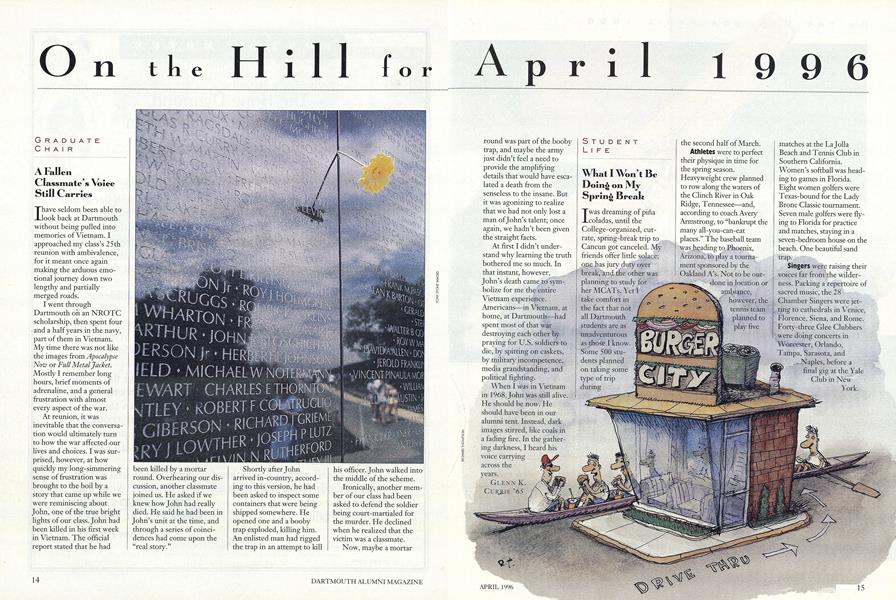
I have seldom been able to look back at Dartmouth without being pulled into memories of Vietnam. I approached my class's 25th reunion with ambivalence, for it meant once again making the arduous emotional journey down two lengthy and partially merged roads.
I went through Dartmouth oh an NROTC scholarship, then spent four and a half years in the navy, part of them in Vietnam. My time there was not like the images from ApocalypseNow or Full Metal Jacket. Mostly I remember long hours, brief moments of adrenaline, and a general frustration with almost every aspect of the war.
At reunion, it was inevitable that the conversation would ultimately turn to how the war affected our lives and choices. I was surprised, however, at how quickly my long-simmering sense of frustration was brought to the boil by a story that came up while we were reminiscing about John, one of the true bright lights of our class. John had been killed in his first week in Vietnam. The official report stated that he had been killed by a mortar round. Overhearing our discussion, another classmate joined us. He asked if we knew how John had really died. He said he had been in John's unit at the time, and through a series of coincidences had come upon the "real story."
Shortly after John arrived in-country, according to this version, he had been asked to inspect some containers that were being shipped somewhere. He opened one and a booby trap exploded, killing him. Ail enlisted man had rigged the trap in an attempt to kill his officer. John walked into the middle of the scheme.
Ironically, another member of our class had been asked to defend the soldier being court-martialed for the murder. He declined when he realized that the victim was a classmate.
Now, maybe a mortar round was part of the booby trap, and maybe the army just didn't feel a need to provide the amplifying details that would have escalated a death from the senseless to the insane. But it was agonizing to realize that we had not only lost a man of John's talent; once again, we hadn't been given the straight facts.
At first I didn't understand why learning the truth bothered me so much. In that instant, however, John's death came .to symbolize for me the, entire Vietnam experience. Americans in Vietnam, at home, at Dartmouth had spent most of that war destroying each other by praying for U.S. soldiers to die, by spitting on caskets, by military incompetence, media grandstanding, and political fighting.
When I was in Vietnam in 1968, John was still alive He should be now. He should have been in our alumni tent. Instead, dark images stirred, like coals in a fading fire. In the gathering darkness, I heard his voice carrying across the years.

More From This Issue
-
 Feature
Square Legs ON THE GREEN
April 1996 -
 Cover Story
We asked Simone Swink '98, a student guide, to give us a short version of her spiel io visifors. Step lively, please, Any questions?
April 1996 -
 Feature
POETS
April 1996 -
 Article
The Dean Hopes for Sober Places
April 1996 -
 Article
TV Guy
April 1996 -
 Article
Oh, Professor, No Charge for You
April 1996