1981

I read about Eric Pierce's work with Maria in a newsletter that Boston's Children's Hospital publishes, and I asked Eric to relate the story to you, in his own words. Here, then, is what our classmate, who lives in Newton, Mass., with his wife, Debora Hoffman, and daughter Hannah, had to write. (On the Internet Eric resides at .)
"Maria was 5 when I first met her, an enchanting elf with a glowing smile. She was accompanied by her grandmother, who is her guardian. Maria has AIDS and suffers many of the complications from that nightmare of a disease. I was seeing her because she was losing vision in one of her eyes, due to cytomegalovirus (CMV) retinitis, the most common cause of vision loss in AIDS patients. I am a pediatric ophthalmologist.
"Our first encounter was terrible. To dilate her pupils for my exam, I needed to put drops in her eyes, and Maria, having been sick coundess times, had been tortured by doctors too often. She did not submit easily to even something as benign as drops. In the end, Maria's grandmother had to hold the girl tightly, and I had to pry open her eyes. It was torture for both of us, and our struggle made the rest of the exam difficult as well.
"For her second visit, I got smart. I had her grandmother put the drops in at home, and this visit was a different experience altogether. When she left, Maria gave me a hug, truly a big deal for her. AIDS has damaged Maria's nervous system, making it almost impossible for her to walk, and to deliver her hug, she had to walk, with incredible effort, across my office. I was moved, but I also felt like it was going to be hard to live up to her trust. I was already thinking surgery for her and knew there would be more than simple eye exams in the future.
"Maria had been receiving intravenous medication twice a day for months to slow the effects of the CMV, and as in most patients, this worked initially. It soon failed, however, and her vision worsened. During my fellowship training, I had learned how to surgically insert an implant containing antiviral medication directly into the eye to treat CMV retinitis. It is a common treatment in adults but, at that time, had been used in only a few kids across the country.
"I suggested to her grandmother this new technique for Maria, and after much discussion, we decided to give it a try. I have to say that both Maria and I were terrified. Most of the time when I do surgery, I am working on the front of the eye cataract surgery, for example, is 'front-of-the-eye' surgery. To insert this implant, I had to cut into the back of the eye, into the dreaded vitreous, or gel inside. Now, vitreous is what you try to avoid if you can help it; most ophthalmologists never see vitreous unless there's trauma to the" eye or complications during surgery. In addition, this was also the first time I'd done this surgery where I was the attending physician in charge.
"Despite my fears, the surgery went really well, and the implant has halted the progression of Maria's retinitis. It has also enabled her to eliminate her IV medications; she no longer must spend three hours a day hooked up to an IV pump a real quality-of-life issue for a small kid.
"I still follow Maria, both to monitor the effectiveness of her implant, which I have replaced once, and to keep a watch on her other eye. She continues to be a delight to see, and I marvel at her absolute joy in life." 4807 Dover Road, Bethesda, MD 20816; (301) 652-8129 (h); ;
Erie Pierce Performed mplant surģery on the eye of 5-year-old Maria. who was losinģ her vision due to complications from AIDS. ABNER OAKES '81

More From This Issue
-
 Cover Story
Dartmouth on Mount Washington
November 1997 -
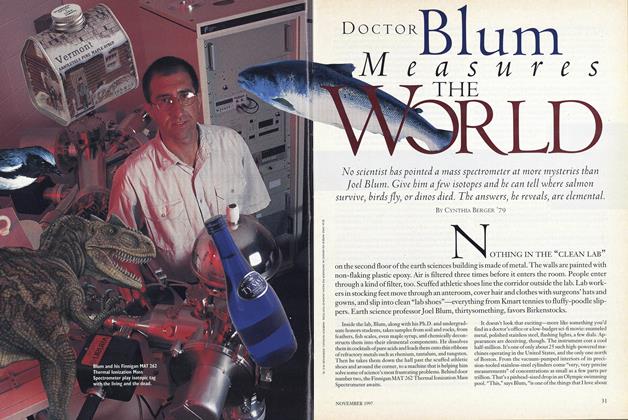 Feature
Doctor Blum Measures the World
November 1997 -
 Feature
"Hi. My Name's John. I'm a Zero."
November 1997 -
 Article
The Truth, The Half Truth, and Nothing of the Truth
November 1997 -
 Article
The President Steps Down
November 1997 -
 Article
The Collis Silverware Mystery
November 1997