Prof's Choice
Arts, Classrooms, and Multiple Intelligences
John Dewey, Ail as Experience (edited by Jo Ann Boyd ston, textual editor Harriet Furst Simon; Southern Illinois University Press, 1989). "Art," writes the father of progressive education in this dense but rewarding volume, "is a mode of prediction not found in charts and statistics, and it insinuates possibilities of human relations not to be found in rule and precept, admonition and administration."
Philip W. Dewey and the Lessons of Ait, (Yale University Press, 1998). What lessons do the arts have to teach us about how to live our lives? How might teachers use the lessons of art to improve their teaching? This book is a series of extended meditations on John Dewey's understanding of art by the immediate past president of the John Dewey Society.
Leo Tolstoy, What is Art? (Hackett Publishing, 1996). Tolstoy attends an opera rehearsal, sees how shoddily its cast and crew are treated by the concert master and concludes, "It would be difficult to find a more repulsive sight." Next he takes aim at Beethoven's Ninth Symphony, saying, "I am compelled to conclude that this work belongs in the rank of bad art." Find out what Tolstoy thinks art is (and is not). A book that could only be written by the author of War and Peace .
Thomas Armstrong, Multiple Intelligences in the Classroom. (Association for Supervision and Curriculum Development, 1994). A concise application of Howard Gardner's multiple intelligence theory to the classroom.
Eleanor Estes, illustrated by Louis Slobodkin, The Hundred Dresses, (Harcourt Brace and Co., 1972). A Newbery Honor bookfor children containing a poignant lesson about the place of art in one child's life.
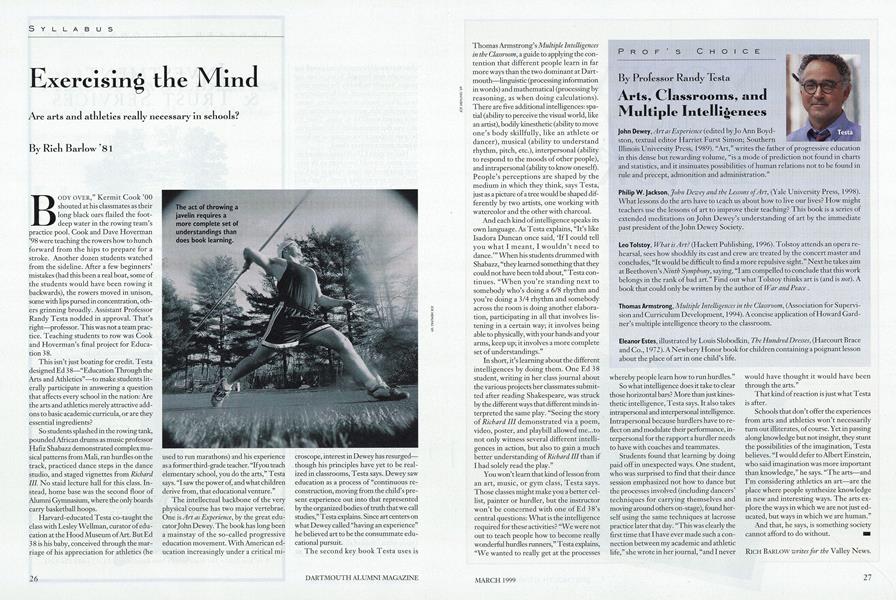
Testa