How the Right Went Wrong
Professor Emeritus Jeffrey Hart ’51 doesn’t lack for conservative credentials. But he’s never been on board with the Bush administration.
Professor Emeritus Jeffrey Hart ’51 doesn’t lack for conservative credentials. But he’s never been on board with the Bush administration.
PROFESSOR EMERITUS JEFFREY HART '51 DOESN'T LACK FOR CONSERVATIVE CREDENTIALS. BUT HE'S NEVER BEEN ON BOARD WITH THE BUSH ADMINISTRATION.
effrey Hart has the personality of a sportsman. A retired professor of English, now 76, Hart still attends every Dartmouth football game, he says, "until it gets freezing."
"I saw a student waiting there. Nobody around. So we played a set. Not a real competitive set. I beat the guy. Turns out he was No. 1 on the varsity. The coach showed up while we were playing. He said, 'You ask me before you go on the courts.' I said, 'You weren't here.' He said, 'You wait until I'm here.' Our relationship went downhill from there."
This episode turned out to be a problem for the coach, who "played tennis in his old Army trousers and black socks," according to Hart, then ranked on his regional Junior Davis Cup squad but not yet a member of the Dartmouth team. "To be fair, I was not lacking in self-confidence."
After two years at Dartmouth Hart transferred to Columbia, where he became one of Lionel Trillings best students. Diana Trilling, the wife of the literary and social critic, calls Hart one of the "Who's Who of the gifted undergraduates of the 19305, 1940s and early 19505."
Hart also joined the tennis team at Columbia. "Playing No. 1 at Columbia I won my match at Dartmouth during Green Key Weekend, and was pleased to be congratulated by the Dartmouth coach," he says. "I was polite when the coach congratulated me. I felt like saying a few other things."
Hart retired in 1993 as one of Dartmouth's most admired professors of English—and one of its fiercest. In that year he taught his final course—on Hemingway, Fitzgerald and T.S. Eliot—to a roomful of 600 students. "It was given in Spaulding Auditorium," he complains. "I had to use a microphone. I felt like Fidel Castro addressing a mob."
Today Hart lives with his wife, Nancy, in a former schoolhouse in Lyme, New Hampshire, that was once owned by his father, Clifford (class of 1921). Nancy uses a corner of the house, by the stove, to keep the antique embroidery and quilts she sells at a stand in Quechee, Vermont. The other comers are filled with old paintings, mainly of ships. "Franklin Roosevelt's personal sailboat is up there," notes Hart, motioning toward the paintings.
Also visible are some less-expected items—a manuscript called Our Era Defined:Contempt for Fact and a dossier on "WMD Claims." Hart's dining room table displays an official-looking document called "The Constitution in Crisis: The Downing Street Minutes and Deception, Manipulation, Torture, Retribution and Coverups in the Iraq War," produced as the "Investigative Status Report of the House JudiciaryCommittee Democratic Staff."
"I do my homework," Hart mutters.
A former speechwriter for Nixon and Reagan, Hart does not lack for conservative credentials. He has advised National Review longer than anyone except its founder, William F. Buckley Jr. During his teafhing days he flew to New York City every two weeks to attend editorial meetings as the magazines senior editor. He still holds the title but the frequent trips have ended. A mentor to generations of Dartmouth students, Hart has also seen a small army of them graduate and settle into the conservative circles of Washington and New York. They have landed jobs at National Review, The Wall Street Journal and in Republican administrations, including the George W. Bush White House.
The conservative Dartmouth Review—"Dartmouth's school of journalism," as Hart calls it—was founded upon Harts suggestion in his own living room in 1980. Hart continues to serve as the newspapers advisor, lunching regularly with student editors at his new favorite restaurant, The Canoe Club on Main Street.
Yet in 2005, not long after Bush's reelection, Hart fired his first volley against the administration. In the galley copies of The Making of the American Conservative Mind: National Review and Its Times, his history of the magazine, Hart included the following statement in his final chapter: "Bush will be judged the worst president in American history, from both a conservative and a liberal point of view, finding a consensus on the bottom, at last, and so achieving a landslide victory that evaded him in 2004."
Hart's strong words put him at odds with the editorial line of the magazine he was writing about and representing. His statements complicated plans to tie the book into the magazines 50th anniversary celebrations, part of which Bush was scheduled to take part in that fall—not as the "bottom" among American presidents but as the magazines honored guest.
Hart has always held certain views outside of the conservative mainstream. An advocate for stem-cell research, Hart debated another National Review editor on the subject in 2004. Early in 2005 Hart wrote a long editorial for the Pittsburgh Post-Gazette called "The Evangelical Effect." Finding fault in Bush's evangelicalism—in 2000 Bush declared that Jesus Christ was his most influential political philosopher—Hart wrote: "The Bush presidency often is called conservative. This is a mistake. It is populist and radical, and its principal energies have roots in American history, and these roots are not conservative."
When his book finally appeared in hardcover at the end of 2005, after a rewrite, the Bush attacks were expunged, but a number of other position statements—on abortion, stem-cell research and Iraq—still contradicted National Review's editorial line and the line of the Republican Party. It was of little surprise that Harts book remained absent from his magazines anniversary celebration. But Hart was only emboldened by the experience. By the end of 2005 he was engaged in the most controversial political match of his career.
After the episode over his book, Hart wrote an editorial on the conservative movement for The Wall Street Journal. Called "The Burke Habit," it traced a line of conservative thought from Edmund Burkes Reflections on the Revolution in France (1790) to Russell Kirk's The Conservative Mind (1953).
Drawing on philosopher Blaise Pascal's statement that "man is neither angel nor brute, and the misfortune is that he who would act the angel acts the brute," Hart wrote: "The conservative mind, most of the time, has shown a healthy resistance to utopianism and its various informed ideologies. Ideology is always wrong because it edits reality and paralyzes thought."
Point by point Hart used this definition of conservatism to attack Bush and the Republican Party platform for not being conservative enough, on the grounds of their "ideology." He knocked the Republican record on the environment, suggested that a ban on abortion would never succeed and lamented Bush's neoconservative approach to Iraq. "Conservatives assume that the Republican Party is by and large conservative," he concluded. "But the party has stood for many and various things in its history. The most recent change occurred in 1964, when its center of gravity shifted to the South and the Sunbelt... The consequences of that profound shift are evident."
Reaction to the editorial was swift. In a little more than a week Peter Wehner, director of the White Houses Office of Strategic Initiatives, a special staff unit that reports to Deputy Chief of Staff Karl Rove, e-mailed to journalists a five-page rebuttal titled "Responding to Professor Jeffrey Hart."
Hart called Wehner s response "a worthless regurgitation of 'democracy is breaking out all over the world.' Abstractions, abstractions."
Hart had more to say in a letter to Michael Ellis '06, a former editor of The Dartmouth Review who now works with Wehner in the White House: "First of all, everything Reagan attempted succeeded. Everything Bush has attempted has failed. Social Security, prescription drugs, budget, Iraq, Katrina. More 'ownership society' bunk is coming up in 'medical accounts.' " On the policy of preemptive war in Iraq: "In contrast to Bush, Reagan was very cautious in his use of force. As Margaret Thatcher said, he destroyed the Soviet Union 'without firing a shot.' That was a major achievement. Iraq is a disaster."
Even while falling out with his party, Hart relishes the sport of his latest engagement, as expressed in a more recent series of editorials, including one for the left-wing Washington Monthly that ran in October. He also appeared on National Public Radio denouncing Bush on stem-cell research, and he used a book-signing at the Dartmouth Bookstore, which aired on C-SPAN, to attack Bush on national TV.
"Like the Whig gentry who were the Founders, I loathe populism," Hart says, "most especially in the form of populist religion, i.e., the current pestiferous Bible-banging Evangelicals, whom I regard as organized ignorance, a menace to public health, to science, to medicine, to serious Western religion, to intellect and indeed to sanity. Evangelicalism, driven by emotion, and not creedal, is thoroughly erratic and by its nature cannot be conservative. My conservatism is aristocratic in spirit, anti-populist and rooted in the Northeast. It is Burke brought up to date. A 'social conservative' in my view is not a moral authoritarian Evangelical who wants to push people around but an American gentleman, conservative in a social sense. He has gone to a good school, maybe shops at J. Press, maybe plays tennis or golf and drinks either Bombay or Beefeater martinis or maybe Dewar s on the rocks or both."
While Hart has won some supporters on the right, conservatives such as George Will, Francis Fukuyama and Buckley, who have questioned the prosecution of the Iraq war, have largely refrained from commenting on Hart's broader claims about Bush's Evangelical ideology.
Hart's former students have different perspectives on their teacher's latest game.
"Bush has been fortunate in his enemies," notes Joe Rago '05, a former editor of The Dartmouth Review and now a member of the editorial board of The Wall Street Journal. "That's not the case with Jeff Hart. His critique of the Bush administration, whether one agrees with it or not, is probably the most rigorous, utterly principled and intellectually stimulating ever set down."
Alston Ramsay '04, a former editor of both The DartmouthReview and National Review who works for outgoing Secretary of Defense Donald Rumsfeld, disagrees: "There is no doubt that Hart's encyclopedic knowledge of literature could make even the lousiest argument take on the sheen of verisimilitude. But in his recent writings the willingness to ignore contradictory evidence, the monopolistic way he defines his terms, the baffling dislike of Evangelicals—it all adds up, and even his legitimate points become hard to discern through the haze of his own internal contradictions. About the only thing Jeff Hart has convinced me of recently is that conservatism' is what Jeff Hart says it is. No more, no less."
Hart's young colleagues at National Review have been equally unsympathetic: "In every generation," wrote Jonah Goldberg and Ramesh Ponnuru in the magazine, "some conservatives will lose the intramural debates, and it will be only natural for them to feel that they have lost them unfairly. They will maintain that they alone have stayed true to the faith. Liberals will, in turn, be delighted to tout these scolds as exemplars of a good conservatism."
The amusing affectations of Hart s teaching days—the meerschaum pipes, the "TR for President" buttons—are now notably absent, replaced by the resolve of a sportsman intent on a win. He has sworn off alcohol. His daily schedule takes him from writing editorials in the morning to Baker Library, where he conducts his research, to answering letters and sending e-mail in the afternoon.
Hart has just completed a manuscript of essays called The Living Moment: How Literature Matters. During the fall term he audited Robert Hollanders class on Dante. "He's a major scholar in Dante, probably the best in the English-speaking world," Hart says of Hollander. "Very demanding."
And Harts next project?
He's considering a memoir, among other things. "I don't know whether to do that next or whether to write a book called How theConservatives Committed Suicide by Forgetting Burke and Backing Bush. I'm going to see if I can get an advance from an agent on that," he says. "I've got to do that quickly before it's banal."
It may not be match point, but Hart is clearly content to run the president, and the conservative movement, all over the court.
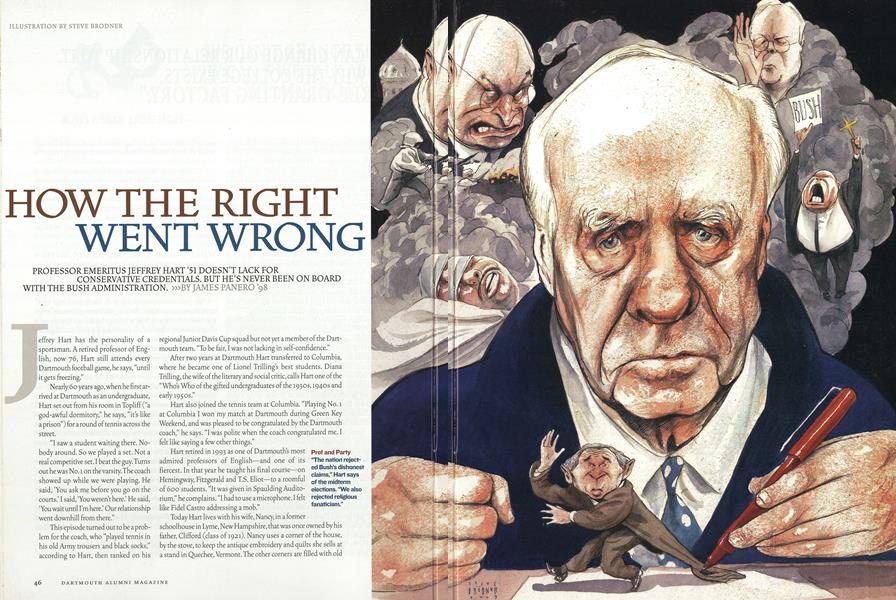
Prof and Party "The nation rejected Bush's dishonest claims," Hart says of the midterm elections. "We also rejected religious fanaticism."
"A social conservative' in my view is not a moral around but an American gentleman, conseiyative in a He has gone to a good school, maybe plays tennis authoritarian Evangelical who wants to push people social sense. or golf and drinks either Bombay or Beefeater martinis." JEFFREY HART
JAMES PANERO is managing editor of The New Criterion and coeditor of The Dartmouth Review Pleads Innocent (ISI), an anthologyof the conservative student newspaper.
More From This Issue
-
 Cover Story
The Slaves of Dartmouth
January | February 2007 -
 Feature
Picking Up the Pieces
January | February 2007 -
 Feature
Notebook
January | February 2007 -
 Feature
Alumni News
January | February 2007 -
 Interview
Life with Oppenheimer
January | February 2007 -
 OUTSIDE
Are You a Chubber?
January | February 2007