1940*
ON CONWAY
Bill Cunningham is not a man whom I have ever looked to for accurate reporting. But I think it may be safely assumed that he spoke truthfully when he quoted President Hopkins in last month's ALUMNIMAGAZINE. For President Hopkins to say that he was worried about the undergraduate body when one of its leaders began "making the rounds" of peace meetings would be typical of Dartmouth, and, I am afraid, of President Hopkins.
I only mention it because another man who was typical of Dartmouth died a month or so ago, in an airplane crash, getting ready to fight a war. His name was Conway. He never went to peace meetings.
Dan Conway used to say that peace meetings were for longhairs, that sitting around and talking and doing things about leagues of nations, and the business of the world, and ways to end war were none of his concern. It may even be presumed that Dan, like the rest of us, thought of people in far off countries as "those foreigners," that like the rest of us, he summed up the war of fascism in Spain with a shrug of the shoulders and the thought that there they were—"at it again." That would be typical of Dartmouth, and of Dartmouth's President, and of all of us.
Yet Dan Conway was killed in a war. It is not important that he wasn't shooting. He died in action, and his death is of the same cause and birth and nurturing as are the deaths of millions of other men locked in battle, in a far, far off land.
Dan Conway's dying is important to us. Not only because we knew him, and he was one of us, but because it gives us a chance to learn that we were all wrong; that we had no ivory tower against the world's business; that the world's business is our business, too.
ON REUNING
I am no teetotaller and in fact I think that liquor is a good thing, particularly if taken in small quantities. Nevertheless I cannot help wondering why it is that that whenever a man from Hanover comes to town whom you have not seen for six months or a year or two, you feel it incumbent upon yourself to go the whole hog. Take for example this month. Ellsworth was here.
We were all in pretty good shape too because Rourke and Mac Cross, Tom George, Jack Preiss, A 1 Eiseman and myself play touch football twice a week in Central Park getting back that dry-lipped, tired feeling and the chance to yell again. Rourke takes along an atomizer for his hayfever, so he has to stop now and then, giving us a chance to pull up, and puff and pretend we're waiting for him. He was the worst, but is improving and I am getting away from my point which was that none of us are in very good shape anymore.
First there was a party when the Berry and Barb got here, which was billed as "for cocktails" but it got late and there was no sense calling it that anymore. Then there was a party at Tom Ballantine's house where we gathered in the kitchen with Jim Young, who has been released from the army, and discussed the fact that Young and Ellsworth made a ten dollar bet two years ago next June as to which would be the biggest Babbitt five years after graduation. You would be surprised how long that took.
And then the next day it comes up Princeton week-end and you know all about that.
And so on Monday we are kicking ourselves all the way to work and about twelve a.m. Rourke calls up to say that he has just had a letter from Tuffy Reeves who has been on maneuvers and its ends quote: I'll sure be glad to see you after five months of this. Tell Braden to get ready for a return bout unquote.
As I say, it's not that I am a teetotaller or would be ungrateful to an old friend, but I wonder—l used to meet people like this once in a while on Main Street. We would be glad to see each other, and if it were convenient we would stop for a moment and discuss some topic of the day, and when we parted, neither one of us would have the shrieking meemies or be unable to bear up with the thought of home fried potatoes for dinner that night.
Maybe that's what they mean by the good old days.
ON MARRIAGE
You have a right to judge from the paucity of names in this column that I haven't heard from anybody this month. That isn't true. But it's hard to settle down to a list of names. I know it isn't fair to the names. For example, there is the fact that Robert John Rodday married Elizabeth Jean Lobdell in Minneapolis on October twentyeighth. Except for the fact that it was important to them both, that's really all I know. And you see, it's more important to them than that. But here are some others:
Lieut. Robert A. Hale and Mary Richards were married in Pasadena on November 15. John O'Shea went all the way out to the wedding, "figuring that I'll be tied up in the army for the next three years and I might as well have a good time now." Fran Miller and Jo Jeannette Hammond (Colby) were married on October 11, in Portland, Maine. Duke Lyon and Pattie Brown were married in Martinsville, Virginia on July 12. The newspapers did themselves proud on this one with a description of the bride's gown which was short by only two paragraphs of outdoing the recital of the bridegroom's parentage. Walter Goodrich and Martha Burns were married in September in Quincy, Mass. Jim Scott and Marian Fischle (Colby) were married in Larchmont in October and "will make their home in the Finger Lakes region of New York where Mr. Scott is engaged in defense work." Albert De Ronde and Dorothy Sayre were married in Wadhams, New York, in July. Ensign James Kuhns became engaged on September 26 in Bennington, Vermont to Miss Faith Colgan (Knox).
ON US
A lot of us who are not doing something in the army now never knew before what it was like to wait and wait and watch the world go by. Among the draftees, perhaps Walt Bernstein and Danny Harris are do- ing the best job. Walt has written two pieces for the New Yorker, and Danny founded a school at his camp—is teaching math and literature to anyone who wants it, and a lot do. A man I used to room with, E. T. Browne, is reported safe on the U.S.S. Kearny, though many died and Johnny Peacock writes like this: "The scene is a marine transport plane 900 feet above the Lakehurst air station. The characters—Ty Cobb and his command of 11 parachutists.
"The jumpmaster looks at Ty who is sitting by the open door and says, 'Coming on the range.' Ty had been talking to me about various subjects, not even mentioning jumping. But now he and his men get to their feet and snap their static lines onto the cable running through the plane.
" 'Stand by,' shouts the jumpmaster. Ty turns to me and says, 'See you on the ground, John.' The jumpmaster yells 'Go!' and as calmly as you would step into Allen's for a milkshake, Ty steps into air to be followed by his eleven men in six seconds. Twelve pilot chutes flick out and bring forth twelve silken 28 foot chutes. They start their gentler descent toward the earth.
"The jumpmaster heaves a sigh of relief and then points at Ty. 'One of the coolest jumpers I ever saw,' he says."
Outside the army there isn't much talk of the war anymore. Even in Yale law where Jim Tredup, Sudarsky and Robinson are all that are left in the '40 bull session, they don't argue it out. We just wait and wait, and ask a few questions like: when are you going in? There are a few of us who still think of our own skins first, as being somewhat more important than abstract things like liberty and justice, or who still think the world ends where some New England mountain meets the sky, but they are waiting too, only more fearfully than the rest.
I think most of us have waited just about long enough. That would make Bolte right, wouldn't it? Only I am not standing on a platform but am just telling you what is going on.
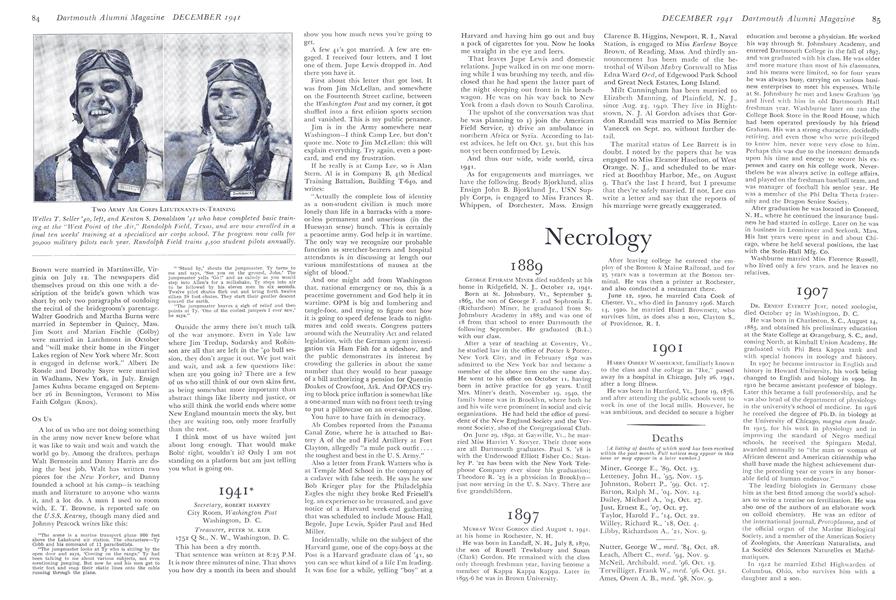
Two ARMY AIR CORPS LIEU I KXANTS IN-TRAINING Welles T. Seller '4O, left, and Kenton S. Donaldson '4l who have completed basic train-ing at the "West Point of the Air," Randolph Field, Texas, and are now enrolled in afinal ten weeks' training at a specialized air corps school. The program now calls for30,000 military pilots each year. Randolph Field trains 4,500 student pilots annually.
Secretary, 353 East 56th St., New York, N. Y. Treasurer, Chase B-11 Harvard Business School, Boston, Mass.