1940*
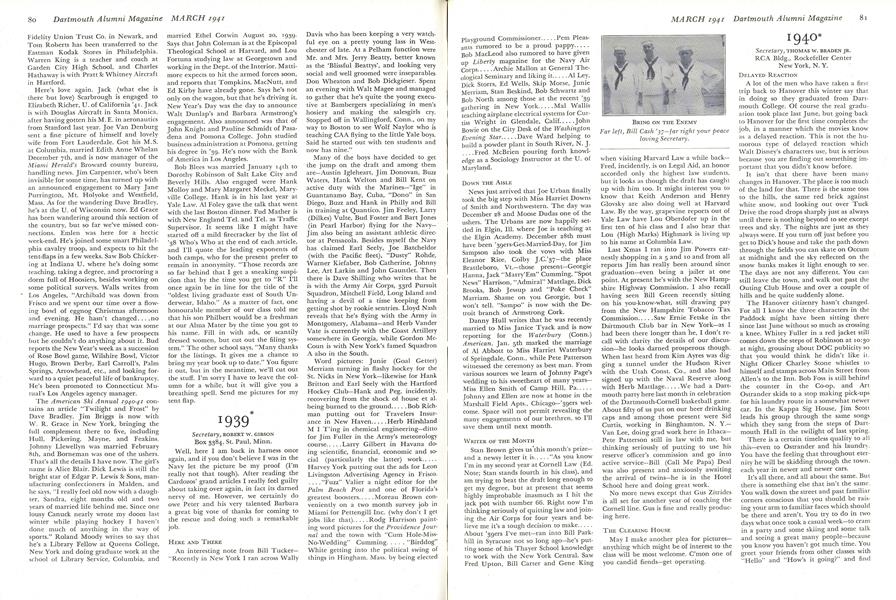
DELAYED REACTION A lot of the men who have taken a first trip back to Hanover this winter say that in doing so they graduated from Dartmouth College. Of course the real graduation took place last June, but going back to Hanover for the first time completes the job, in a manner which the movies know as a delayed reaction. This is not the humorous type of delayed reaction which Walt Disney's characters use, but is serious because you are finding out something important that you didn't know before.
It isn't that there have been many changes in Hanover. The place is too much of the land for that. There is the same toss to the hills, the same red brick against white snow, and looking out over Tuck Drive the road drops sharply just as always until there is nothing beyond to see except trees and sky. The nights are just as they always were. If you turn off just before you get to Dick's house and take the path down through the fields you can skate on Occum at midnight and the sky reflected on the snow banks makes it light enough to see. The days are not any different. You can still leave the town, and walk out past the Outing Club House and over a couple of hills and be quite suddenly alone.
The Hanover citizenry hasn't changed. For all I know the three characters in the Paddock might have been sitting there since last June without so much as crossing a knee. Whitey Fuller in a red jacket still comes down the steps of Robinson at 10:30 at night, grousing about DOC publicity so that you would think he didn't like it. Night Officer Charley Stone whistles to himself and stamps across Main Street from Allen's to the Inn. Bob Foss is still behind the counter in the Co-op, and Art Ostrander skids to a stop making pick-ups for his laundry route in a somewhat newer car. In the Kappa Sig House, Jim Scott leads his group through the same songs which they sang from the steps of Dartmouth Hall in the twilight of last spring.
There is a certain timeless quality to all this—even to Ostrander and his laundry. You have the feeling that throughout eternity he will be skidding through the town, each year in newer and newer cars.
It's all there, and all about the same. But there is something else that isn't the same. You walk down the street and past familiar corners conscious that you should be raising your arm to familiar faces which should be there and aren't. You try to do in two days what once took a casual week to cram in a party and some skiing and some talk and seeing a great many people-because you know you haven't got much time. You greet your friends from other classes with "Hello" and "How's it going?" and find that after you've said that there isn't much to say. You walk into whatever student organization you gave your time to and discover that after you've shaken hands all around and answered the usual unfeeling question about "Why are you back?" with the usual, " Just thought I'd come up and take a look around," there is nothing else to do, and you are probably a little bit in the way. Because after all those boys have a job to do and you are not a part of that job any more. Not that you'd want to be, actually. Already you know more than they do, but you are just beginning to find out what it is you know.
It's partly faces that are gone, partly having no itinerary of business or work to do, partly just understanding for the first time that you don't go to Dartmouth any more. It is not funny, or sad or right or wrong or anything else. It is just a matter of catching up with a ceremony in June and learning what the ceremony couldn't teach you.
Everyone in the Class of 1940 who has gone back to Hanover has said about the same thing as the man who wrote it to me this way: "Last week-end I went back to Hanover and found out I'd graduated from Dartmouth College. Now I can get down to another job."
Like I said, it's a delayed reaction.
GROOMS The society section of the files I keep under Miller's bed are jammed this month with the heads of brides, sheets draped around their necks. According to the clippings, all of the weddings are of outstanding interest to society, and all the brides are lovely. I don't have any doubt about this but I think in justice, there ought to be some mention of how the bridegroom looked walking down the aisle in those Campion tails he bought senior year and is wearing for the second and probably the last time. There never is Miss Joan Stewart (lowa State Teachers) and William R. Wagner, who left school at the end of sophomore year and is now a senior at lowa State, were married in Mason City on December 29. Miss Marjorie Goss (Kendall Hall) and Richard Kidder were married Dec. 1 at Franklin, N. H., with John Heneage and Alan McKernan as ushers. Miss Mary O'Neill and William D. Hutchinson were married on Feb. 15 in New York. Betty Royce (Colby) and John Mathiesen were married in Miami on Feb. 20.
ENGAGEMENTS
Miss Mary Madden to Hugh McDowell in December, Miss Olive Miller to Larry Keeler on Christmas day, Miss Harriet Gesler to Robert Graham on Dec. 7, Miss Hannah Hutchins to Andrew Halbleib on Christmas day, Miss Jan Maitland to George Sheldon on Jan. 7, Miss Hazel Hartwell to Ronald Woodberry on Dec. 24, Miss Margaret O'Rourke to Bert Blake on Jan. 26.
There is one more. Miss Lydia Barber and Ben Stewart were murried in Brattleboro the Friday after Thanksgiving. Ben Stewart died on Jan. 12.
GENERALLY
Bob Skinner is an assistant ski instructor at Yosemite National Park Coleman Ross is in Schenectady with the General Electric Company Fox writes that President Hopkins will talk to the Boston Alumni at a $3.00 per plate dinner. Probably he is going to give out some information he doesn't want anyone in the Class of 1940 to hear Faced with the prospect of coaching a fifty man squad, Harvard ski coach Bill Halsey started practice by sending the whole group on a long cross country run. Next day the number was down to working size Bud Campbell was the first in 194.0 to enlist in the army. He volunteered as a private in September, is now with the weather squadron. Bud spikes a lot of holes in those newspaper features about the glories of recreation, fine equipment and good food in an army camp, says everything is far behind the need, and the last thing anybody thinks about is war Jack Upton has been drafted Butch Heneage and Dan Sullivan are roommates at 193 Beacon in Boston, Butch is working for Colonial Beacon Oil, and Danny is merchandising tires for U. S. Rubber.
Whit Miller writes from San Diego: "The U. S. Air Corps is the last place I thought I'd be last spring. But the set up looks good to me and so does the future.". .. .Art Mountrey and Bill Maxon are in naval training at Northwestern Bill Rothermel is underwriting insurance in Chicago Dick Wilson, who transferred to Northwestern junior year is now in the law school there Dave Rice is working for a printing supply firm in Chicago Chicago's '40 contingent, after a successful class dinner, will have a separate table at the Chicago alumni banquet on March 7 Bob Jordan is off with New York's seventh regiment Soupy Campbell is at Indiana University—remember the "Harvard guards" sophomore year and the huge grimy figure who picked himself up time and again from beneath a pile of opposing linemen to watch Hutch cut out into the open and go splattering off through the mud and rain? .... Red Klein gave up his job with Big Jack Overalls and is in Kansas City hunting another.
Which reminds me that several classmates are doing the same thing. If you hear of any openings, let me know.
Secretary, RCA Bldg., Rockefeller Center New York, N. Y.