1932
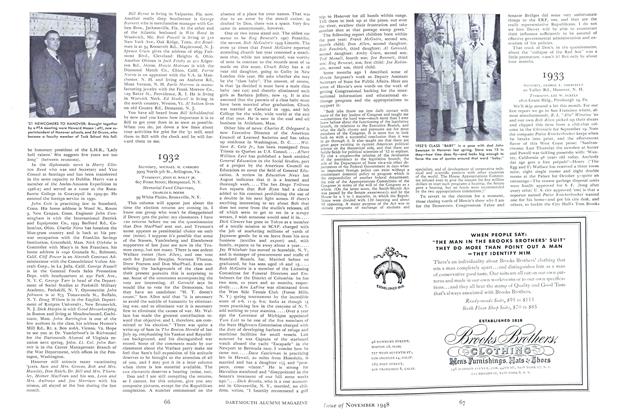
I was out there this morning, November 5, cheering, as Harry came home to stay another four years, and I'm not ashamed to admit it, even to the 99% of you who voted against him. We can all remember turning out to cheer the team when it came back to Hanover after a particularly welcome victory, and that's how it seemed around here today. It drew the biggest crowd I've seen since King George and Queen Elizabeth were welcomed in 1939,.
I have not completed a useful tabulation of the returns on our class poll, so I won't try to give you any of the figures. Instead of a composite picture of the typical 1932 alumnus, I think you may find it interesting to hear what one of us has been doing since 193,2. CharlieOdegaard, at my request, sent in a description of his career since graduation. It gives one an idea of the variety of vistas that open before the Dartmouth graduate. Here is what Charlie wrote:
"After graduating from college, I began graduate work at Harvard, spending the years 1932 to 1934 and 1935 to 1937 in Cambridge (and acted as Assistant in History at Radcliffe College). During the academic year 1934-1935, I was in Europe, spending the larger part of my time in France doing archival work connected with materials for medieval history. After completing my doctorate, in 1937, I taught History at the University of Illinois, with which I was connected until September of this year.
"Early in 1942 I entered the Navy as Lieutenant (jg), assigned to armed guard duty. For the first three days of our brief eight weeks' instruction period, we thought that this meant assignment to duty as flat feet guarding a Navy factory somewhere. We subsequently discovered that the duty was that of commanding Navy gun crews placed aboard merchant vessels.
"I began my duty in the Caribbean on a rat-infested, cockroach-plagued rust bucket, which took me through the Gulf and the Caribbean to the East Coast. After that I put in several months on a fast freighter which made lonely runs to Iceland. Then I had the good fortune to be assigned to one of the slickest Army transports on the Atlantic, making several runs to African ports and England aboard her. About that time (July 1943) the Navy was enlarging the number of chartered transports used for logistic support of its operations in the Pacific. I was ordered to the West Coast, and took over the job of Naval Commanding Officer for the Naval crews and passengers placed aboard two ships in succession. As time passed, the size of the Navy crews grew markedly, principally because the ships were adapted for use in amphibious operations; my two ships participated in three of the Pacific operations, Gilberts, Marshalls, Palaus.
"In December, 1944, I was ordered to San Francisco, and was put in charge of the chartered transport section which was responsible for determining operating procedures on these wierd Naval vessels, of a type which almost no regular in the Navy knew anything about. Three weeks before the war ended, the Navy discovered that I was trained as an historian, and I was ordered to duty as historical officer for the 12 th Naval District, San Francisco area. This turned out to be a very interesting assignment and, oddly enough, though I was eligible for relief as soon as the war ended, I was retained in service as a military necessity. I finally returned to the University of Illinois at the end of January, 1946, where I began giving graduate seminars in medieval history as well as carrying on my lecture work in that and other history fields. This past year the new Dean in the Graduate College, who is a very intelligent and alert physicist, asked me to come into his office on half time to serve as a needier to him for the humanities. That experience has proved very helpful to me in the new duties which I have recently assumed.
"All this ties together. With my experience with all kinds of men under quite different conditions during the war years, I came to a realization of how much men need a sense of continuity and support from the tradition of past human experience when up against the difficulties of our present world. All our knowhow is not enough, and our present generation is almost psychotic—partly, I believe, from a lack of humanistic understanding. Since I have begun to think along these lines, you can perhaps understand why I deserted the University where I was very happily situated to take the position of Executive Director of the American Council of Learned Societies.
"This organization is a federation of 23 learned societies, with offices located in Washington. Its primary field of interest is the humanities in America, and it has served in the past as a planning agency for a variety of developments in the humanistic field. It aids in the planning of research programs; it supports particular research projects; it interests itself in the personnel problems of the humanities, among other things by maintaining a fellowship program; it is an agency which has made and can make a contribution to the place of the humanities in American life.
'By way of a personal but very important addition, I was married to Betty Ketchum in April, 1941. We have one daughter, Mary Ann, aged 5, and by virtue of our move to Washington had to abandon in Illinois a wild and impetuous Irish setter named Bloody Mary."
Charlie received a citation from the Navy for the quality of his service. In case anyone doubts that he is learned enough to run a council of learned societies, I cite the titles of two of his articles: "Imperial Diplomas for Menaggio and Comacina," (Speculum, 1944) and "The Concept of Royal Power in Carolingian Oaths of Fidelity" {Speculum, 1945).
Ed Marks sent some interesting words back last summer:
"Have been enjoying life and work in Switzerland (where he works for the International Refugee Organization ). Children now bilingual. Rather disgusted at the way Congress has acted on many questions. (Note: So were enough of us to do something drastic about it at the polls.) Working for an international organization has its full share of the frustrations of much government work, plus the complications of different cultures, languages, etc. to contend with within the same organization. And our particular program in a small way exemplifies these parlous strained times. But there are many compensations it is really astonishing to see how people of different backgrounds, languages, etc. can learn to bridge differences and work together. And the social part is extremely interesting. While most of our best friends here are Americans (there are plenty in Geneva) we have others among the British, French, Dutch, Belgian, Czech and other contingents.
We went to Bern for Owsley's wedding reception. Mrs. O. is a very gracious and attractive gal. Mother of four, too. Have talked with Hatcher on the phone. We have been to Paris and the south of France (for Easter) and did a bit of skiing this winter in the nearby mountains."
Marv Chandler has just about completed one phase of his "experting" in the SEC hearing that brought him to Washington frequently all summer Bob Hosmer is president of the Foreign Policy Association in Syracuse. .. .. Tom Dublin has been appointed Executive Director of the National Health Council, which, I understand, furthers public health programs. This is signal recognition to Tom's ability Ben Drew is president of the Massachusetts Fruit Growers Association, also an achievement Seven new clippings about Bob Ryan tell us that he is way up the ladder in Hollywood. Our class is doing pretty well; I wish more of them would recognize that the rest of us want to hear from them, about their families and their careers.
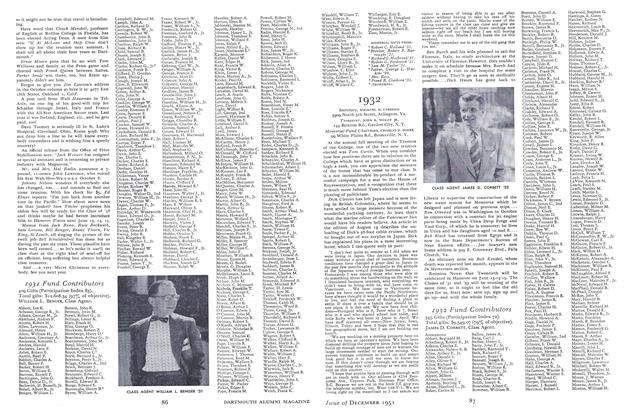
THE MORTONS IN HANOVER: Bill Morton '32 with wife Peg and daughter Betty, 9, while attending a Football Advisory Committee meeting last spring. Not along on the visit was young son Billy.
Secretary, 3909 North sth St., Arlington, Va. Treasurer, 607 Front Street, Hempstead, N. Y. Memorial Fund Chairman, 99 White Plains, Bronxville, N. Y.