1932
One of the perquisites of being class secretary is the privilege of having custody of the "class book," which is a mammoth loose-leaf device for maintaining current information about all the members of the class. It is really a very well-devised mechanism, but its utility depends on two elements. First, you must have a place where you can keep it accessible. That this is no cinch can be understood by the fact that I have found the best place for it to be on the insulated pipes running along the ceiling of our cellar. The metal binding and the dimensions make it very heavy. The second, and really more important, element is keeping it up to date. This would require several hours a month, and I fear that I will not be able to do it, although I will try my best. The most effective arrangement is to have the College make the entries periodically, and I hope to have that done this summer. It means paying for clerical help, and I am looking to the class exchequer to swing it. The result of having it current, instead of about six years behind, would be very desirable, I feel certain, because every mention of a member of the class in the monthly column could be accompanied by something about his past career. You will all appreciate how impossible it is to recall family and professional details about those whom you do not see regularly, and I am constantly afraid of making a boner if I rely on memory.
Partly in the interest of making "the book" complete, and partly to provide some interesting statistical data about the class, DonMacPhail is having a questionnaire accompany his newsletter release. In the working out of the questions to be asked, the story of the Class of '32, Princeton, which appeared in Life, was used as much as a warning of what to avoid as for guidance. I hope there will be a very wide response in our case. The experience of others with the solicitation of statistical data by mail is very discouraging, but it seemed worthwhile trying. If it will encourage any of you to send an answer in (sit down now and get it done!), I promise not only to be discreet, but to consult a trained statistician before using any of the information as the basis of a statistical conclusion. Further, I'll particularly welcome any suggestions on how to use what data we get, and what you fellows would like to know about the class. One of the most interesting bits of information about fifteen-year graduates is, of course, their financial condition, which basically means their income. That is difficult information to obtain, however, because of everyone's desire for privacy, and then it is particularly hard to analyze and weigh properly. Don concluded that it would complicate the project too much to include it for the present, but it might be possible to make the study later on if there is enough interest in it.
One bit of data I should like to see in a statistical study is how many Dartmouth men visit Hanover on their honeymoons, as I did with Alice. The monastic atmosphere of Hanover during our under-graduate days made it especially attractive to go back with a wife and the privileges appertaining thereto. Even after these fifteen years it has its attractions to newlyweds, and, therefore, I was not surprised to receive a note from a classmate, mailed in Hanover, telling me of his marriage a few days before. Nor was I surprised that it was Deke Mack, telling of his marriage, on April 16, to Mrs. Lois Proctor Macdonald in Ogunquit, Maine. Those who were at reunion last summer remember Lois, I am certain. In the July 1947 issue, I paid tribute to Deke's good taste, and now I congratulate him and, on behalf of the class, wish them all the best. Deke's letter says:
"We expect to live temporarily at Longwood Towers, Brookline, Mass., and after several months to rejoin the Washington contingent of 1932. Momentarily, and for several days, we are staying at the spot that means so much to all of us."
Some of the activities of our classmates thoroughly test my ability to describe a political event without editorializing. An example is Joe Fanelli's recent brush with the Attorney General, described at length in the March 23 issue of The New York Times, in connection with the refusal of the immigration officials to permit three officials of the International Woodworkers of America (CIO) to enter the U. S. According to Joe, the chief ground of exclusion was the distribution, by an organization with which his clients are affiliated, of the Communist Manifesto on its 100 th anniversary. Joe's quoted comment was:
"It appears that anybody who distributes copies of this historic manifesto may be excluded from the United States or may be deported. A copy is available in almost every modern library, and when I was handling this case, I had no difficulty in buying copies in the bookstores of Washington. If the Attorney General is right, the operators of these bookstores are subject to ten years in jail."
Joe hopes to get the Attorney General to reverse his decision or to be able to appeal to the courts.
A political note from an unusual source is the announcement that the Rev. Shirley E. Greene presided in March at a meeting sponsored by the social action committee of the Congregational Church of Manhattan, Kansas, on the subject of how the land and ivater resources of the Missouri Valley can best be developed, controlled, conserved and used for the welfare of the people. Shirley is reported to be the agricultural relations secretary for the Congregational Council for Social Action.
Every now and then I receive notes from classmates passing on the news that they saw some other classmate and received the enclosed information from him. Possibly a clipping is enclosed containing news of someone in the class. All too frequently such notes say nothing about the sender. I plead with you to include, in all cases, something about yourselves: at least your job, your marital status, children's ages, and anything else you would like to hear about others. For example, I certainly should like to know what the classmate, who so kindly sent the clipping about Deke Mack's wedding, was doing in Northampton, Mass. Maybe he lives there. If so, I'd like to be able to tell you why.
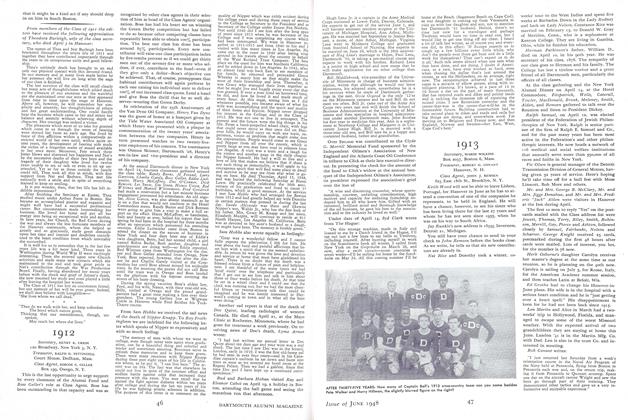
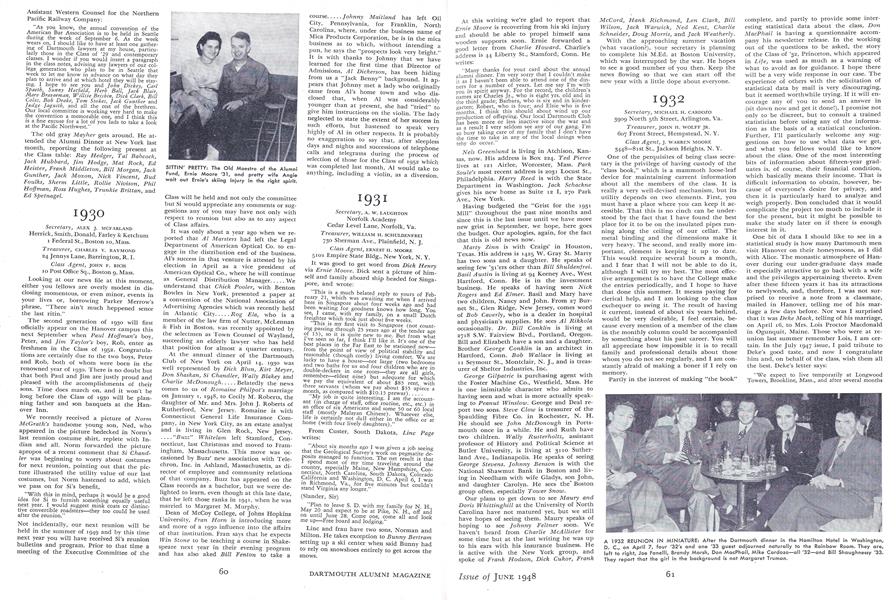
A 1932 REUNION IN MINIATURE: After the Dartmouth dinner in the Hamilton Hotel in Washington, D. C., on April 7, four '32's and one '33 guest adjourned naturally to the Rainbow Room. They are, left to right, Joe Fanelli, Brandy Marsh, Don MacPhail, Mike Cardozo—all '32—and Bill Shaughnessy '33.They report that the girl in the background is not Margaret Truman.
Secretary, 3909 North sth Street, Arlington, Va. Treasurer, 607 Front Street, Hempstead, N. Y. Class Agent, 3448—81 st St., Jackson Heights, N. Y.