1905
There is nothing like grandchildren, I find, to rouse a retired man to get about a bit. It was primarily grandchildren that took Mildred and me to California last spring. It was definitely grandchildren, Jeff, Jimmy and Penny (Abbott) that took me to Berwyn, Md„ the first of September.
While in the vicinity of Washington I took advantage of the opportunity to look up JimStone. In response to my letter, Jim got in touch with me by phone, but unfortunately I was not able to keep the luncheon engagement which he had kindly arranged. However, my daughter Ruth kept my engagement for me and had a very pleasant lunch with Jim. He entertained her, she writes, with many stories of his life in Cuba, South America, Panama, etc. as an engineer. He is now a highway engineer with the government. (Would that all government employees were as essential!) He was married for the first time a year ago (why didn't you let us know, Jim?) and has a new home.
It was grandchildren again that sent Mildred and me back to New England later in September. Two new arrivals in the Putnam clan bring my count to 14, including Mildred s two! These are George Putnam Butterworth (my daughter Anne's third) and Craig Stewart Putnam (Bill's '30sixth).
On this trip we made a short visit to Bustins Island Casco Bay, where we have purchased a small summer cottage with a lovely view down the bay toward Portland and enough land and wood to keep your scribe busy in two of his favorite occupations, gardening and woodchopping
On our trip I dropped in on Cy White. He is looking hale and hearty and evidently full of the joie de vivre. We had a delightful hour reminiscing on the happy days in Hanover and comparing notes on families and our various activities. While Cy keeps up a busy law practice in his home city of Portland, he finds time, apparently with not too bad success financiallv, to' dabble in the market and play around with real estate. Cy told me that it was Walt Conley who was instrumental in bringing about Cy's transfer at the end of freshman year from Cornell to Dartmouth, a good deal all around.
While in Hanover we called on Charlie Widmayer '30, to whose scrutinizing eye I must submit these notes. It was nice to get to know you personally, Charlie.
There are a number of news items going back as far as last May which were crowded out of the October issue the July issue is given over exclusively to reunion news. These are of enough interest to warrant their appearance, late as it is.
The following '05 men were present at the fiveclass dinner in Boston, May 19: Roger Brown.,Chase, Conley, Cornish, Donnelly, Fall, Harding,Hatch, Hills, Lillard, McCabe, Parkinson, Peyser,Weston, White and Wilkins. Especial credit goes to Boh Harding for making the arrangements; it was he who organized these pleasant affairs and ran them for nine vears. The guest speakers were Dick Lane '07 and Walter Powers '06, President of the Boston Bar Association.
Royal Parkinson reports that in the late spring he visited Herford Elliott and his charming wife at their delightful home which stands on the crest of a hill in Westboro, Mass. Herford goes to the office a part of each day, according to Park, and works at landscaping his attractive estate in blue jeans when no camera catches him.
I am told that Perley, who had been chairman of selectmen at Lebanon, N. H., for years without number, was defeated for reelection in the spring. He is said to have gotten more for the town's money than any other town official, bar none.
Among the visitors that Gib and Florence Fall entertained at their summer home on the Cape during the summer were Roger and Frances Brown and Sliver and Alva Hatch. Gib reports that it was on Bob Harding's arrival at his summer home at Megansett, also on the Cape, that he came down with a coronary attack. The latest report is that Bob is making a slow recovery.
Gib further tells me that in July he went over to the Cape Codder Hotel in Falmouth where he had a delightful visit with Clare Barton and his daughter Shirley and her husband Captain Peterson. Shirley has presented Clare with three fine grandsons. Bart and Gib were frat brothers and roomed together with Fletcher Hall in senior year.
George Agry died September 1 at Tarrytown, N. Y. This is our fourth loss in two months. The sympathy of the class goes to his wife Mercedes and daughter Nancy (Cavanaugh).
Bill Knibbs spent nearly all of July ana August at his summer place on a lake near Belfast, Me. According to Tubby Besse,Bi 1 claims to be quite a fisherman. He showed Tubby a lure for bass which he, Tubby, thought looked bigger than any fish he might be likely to encounter, though Tubby adds that he's not much of an angler himself.
Tubby also reports having seen HenryHobart who was interested in some new ideas for television. Best of luck, Henry! Henry's wife has been seriously ill for some time, but was reported a litUe improved.
WHO'S WHO IN 1905 DR. EDMUND E. DAY
In the fall of 1901, to the dim purlieus of "Bedbug Alley," of blessed memory, the third floor ot old Dartmouth Hall welcomed a rather outstanding aggregation of freshmen. Drawn together primarily by a common lack of this world's wherewithal, they formed a firm and lasting friendship, the self-styled Old Guard. Their willingness to work hard to take advantage of what life at Dartmouth had to offer was matched by their love of good, clean fun and adventure. Numbered in this group were "Rufus" Day, "Ike" Eicbenauer,Charlie Hodgman, "Pink" Laing, "Paene" Moore,"Put" Putnam and "Sylvie" Sylvester. Each of these men went on to achieve in later life some degree of distinction in his chosen field.
It was Rufus Day, however, who was destined to stand out as the most distinguished member not only of this little coterie but indeed of the entire class of 1905. Teacher in four colleges and universities, top administrator in two universities, counsellor to the United States government at high levels under four presidents in two wars, expert adviser to the State of New York, president of numerous state and national associations and commissions in the fields of education, economics, social science, and industrial relations, honored with no less than 15 degrees, he earned high editorial praise when he retired from the presidency of Cornell University last year and from the chancellorship this year.
The New York Times ranks his as "a career of great distinction," while the New York HeraldTribune refers to Dr. Day's "academic statesmanship, shrewd counsel, and unassuming friendliness."
An excellent student and thinker, at the end of freshman year he received the Rufus Choate scholarship for high scholastic achievement. From this attainment came the affectionate nick-name "Rufus." In his college course he specialized in economics and philosophy. At graduation he was in the BK group and was one of the commencement speakers.
Day was not the ivory tower type of scholar, however. His interests were wide. He became a varsity debater and in senior year was manager of the track team. His versatility, good judgment, and likeable personality marked him more and more as a natural and exemplary leader in college.
After graduating, he remained at Dartmouth to take an M.S. degree in preparation for teaching.
While in Hanover, he fell in love with Emily Emerson, lovely daughter of our old friend, Dean "Chuck" Emerson. They were married in 1912. They have four children and, at the present writing, seven grandchildren. Mrs. Day's charm as a hostess and helpmate to her husband is proverbial and their home life has been exemplary.
In 1909 "Rufus" won his doctorate in economics at Harvard, having spent two years in the interval as instructor in economics at Dartmouth. After ten years of teaching at Harvard, he became head of the Economics Department. During these years he made several notable contributions on statistical subjects. For a part of this period he was class agent for 05.
With the coming of World War I Dr. Day began his patriotic duties by teaching Harvard students military tactics, of all things! The call of duty took him on a long detour of administrative work for the Government; first, for the U. S. Shipping Board, then for the War Industries Board. These duties he carried out with notable success.
February 1923 saw the beginning of his fiveyear career at the University of Michigan a creative task. He served first as professor of economics, and as head of the economics faculty. He organized the University's School of Business Administration and became its first dean in 1925. Two years later he became administrative dean of the entire university.
In 1927, when the Laura Spelman Rockefeller Memorial borrowed Dr. Day for a year to advise in the distribution of millions of dollars annually to important world-wide research in the social sciences, the door opened to new and wider fields for him.
The next year he became Director of Social Sciences for the Rockefeller Foundation in New York. In this capacity he was one of five executives who adminis:ered the extensive program of the Foundation. His division devoted itself to basic social science research and to three specific fields social security, international relations, and public administration. Here he was to remain for nine years, the period in which social security legislation in this country was born. Dr. Day played an influential part in this program.
Space will permit only a bare listing of the positions of distinction that Dr. Day has held in the intervening years.
In 1927 he was president of the American Statistical Association. In 1932 and 1933 the State Department sent him to Europe with an associate expert to prepare through an International Commission the agenda for the World Monetary and Economic Conference. In 1933 he was on a national commission to study means of emergence from the depression. In the same year he led the Model World Economic Conference, comprising delegates from 11 colleges, each college delegation representing a different nation.
From 1933 to 1937 he was Director of Social Sciences and General Education for the General Education Board, another Rockefeller philanthropic organization. He was a member of the Royal Economic Association of Great Britain and of the American Economic Association. In 1934 he was one of three commissioned to study the possible merger of two universities in Chicago. While living in Bronxville, in the 1930's he was president of its Board of Education. Other important tasks and offices were assumed for New York State, the National Education Association, the National Bureau of Economic Research, and the National Industrial Conference Board. Last year he was chairman of the State Mediation Board assigned to end a long and bitter strike in Buffalo.
In the midst of these activities, Dr. Day in 1937 became president of Cornell University. Looking back over his 13 years there one sees the extraordinary aims and accomplishments of a great builder. Measured in cold statistics, Cornell's campus now stretches in effect from one end of New York State to the other. During the Day administration, the University added eight schools and special laboratories, constructed ten major buildings, with two more in process, and increased the students served from 6,300 to more than 10,000. Statistics, however, will not measure the human values of Dr. Day's remarkable leadership. He began his presidency of Cornell by proposing that education should be constantly adjusted to the needs of the times, should inspire enthusiasm for things intellectual, induce lasting habits of selfeducation and not neglect social consequences. The heart of the problem, he said, lies in direct teacher-student contacts. "No substitute has yet been found for the able and inspiring teacher."
A brief excerpt from his inaugural address discloses the breadth and depth of the human understanding of Dr. Day's program for Cornell: "College years are, of course, a period of religious unsettlement for many young men and women. Earlier moorings are often broken as unfamiliar lines of knowledge are pursued. It is a time when not infrequently religious beliefs have to be reconstructed. To an extraordinary extent our times have lost any sure sense of direction. Civilization is confused partly because it is no longer sure of its own meaning and significance. It is part of the task of our institutions of higher learning to help students fortify and, if necessary, rebuild the fundamental faith by which men live and work."
Two years after joining the Society of Survivors of Coronary Occlusion, Dr. Day resigned from the arduous presidency of Cornell. This was in 1949. His duties were thereupon lessened and he was made chancellor of the University. Early in 1950 he retired from this position also. He retains the title President Emeritus. Immediately, not to be left wholly free, he accepted appointment as consultant to New York University.
Upon his retirement, as befitted an acknowledged master in the fields of education, administration, and social service, Dr. Day received rare tributes from many sources. Perhaps of particular note is the mark of personal regard which was shown him by the Board of Trustees of Cornell. This body privately contributed to a fund to build Dr. and Mrs. Day a home overlooking Cayuga Lake. The telegram from the Trustees advising the Days of this Christmas gift made reference to "your many friends on the Board, all of whom salute you for your magnificent guidance of the University in war and post-war years, and the significant contributions you have made to the cause of education and to the principles by which we live."
The class of '05 rises to say, "Well done, Rufus. We hope your retirement may be restful, if still somewhat usefully busy. May these be happy sunset years."
We are hoping to have more men than ever before out for the '05-'06 dinner in New York. Remember the date, December 8, and the place, the Dartmouth Club.
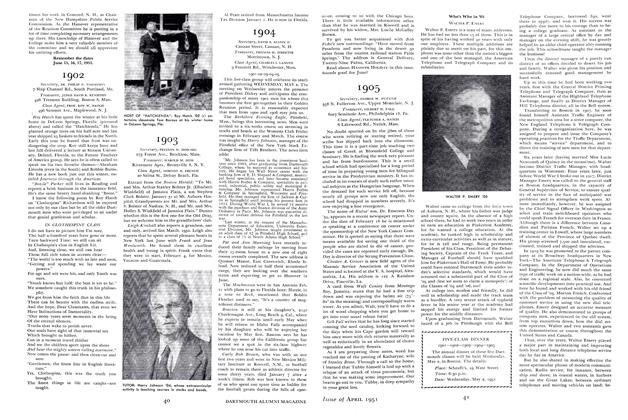
A HOLIDAY TRIP in the Pacific provided Harry T. Smith '05, his wife and daughter Josephine with pleasant memories of their stay in Honolulu.
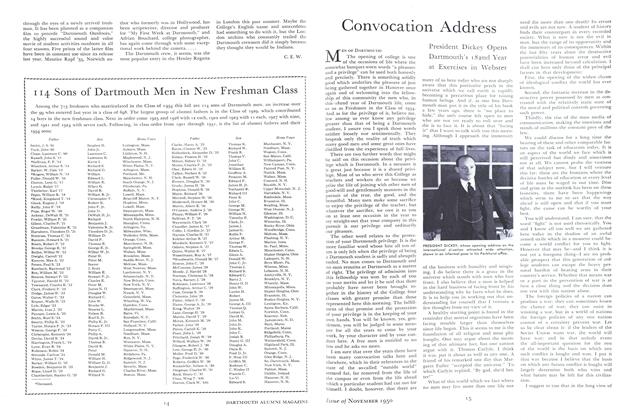
DR. E. E. DAY '05
Secretary, i sxB North Fullerton Ave., Upper Montclair, N. J. Treasurer, 8027 Seminole Ave., Philadelphia 18, Pa.