1910
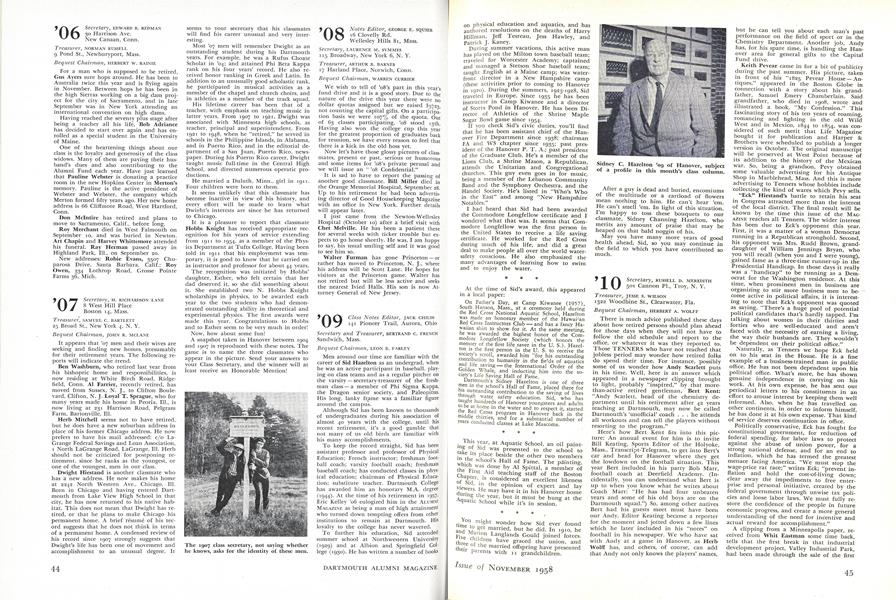
There is much advice published these days about how retired persons should plan ahead for those days when they will not have to follow the old schedule and report to the office, or whatever it was they reported to. Those TENNERS who have not reached that jobless period may wonder how retired folks do spend their time. For instance, possibly some of us wonder how Andy Scarlett puts in his time. Well, here is an answer which appeared in a newspaper clipping brought to light, probably "inspired," by that more-than-active retired gentleman, Bert Kent: "Andy Scarlett, head of the chemistry department until his retirement after 42 years teaching at Dartmouth, may now be called Dartmouth's 'unofficial' coach ... he attends all workouts and can tell the players without resorting to the program."
Here's how Bert Kent fits into this picture: An annual event for him is to invite Bill Keating, Sports Editor of the Holyoke, Mass., Transcript-Telegram, to get into Bert's car and head for Hanover where they get the lowdown on the football situation. This year Bert included in his party Bob Marr, football coach at Deerfield Academy. (Incidentally, you can understand what Bert is up to when you know what he writes about Coach Marr: "He has had four unbeaten years and some of his old boys are on the Dartmouth squad.") So, among other natives Bert had his guests meet must have been our Andy. Editor Keating became a reporter for the moment and jotted down a few lines which he later included in his "notes" on football in his newspaper. We who have sat with Andy at a game in Hanover, as Herb Wolff has, and others, of course, can add that Andy not only knows the players' names, but he can tell you about each man's past performance on the field of sport or in the Chemistry Department. Another job, Andy has, for his spare time, is handling the Hanover area for general gifts to the Capital Fund drive.
Keith Pevear came in for a bit of publicity during the past summer. His picture, taken in front of his "1825 Pevear House — Antiques," appeared in the Boston Globe in connection with a story about his grandfather, Samuel Emery Chamberlain. Said grandfather, who died in 1908, wrote and illustrated a book, "My Confession." This fascinating story of his ten years of roaming, romancing and fighting in the old Wild West and in Mexico, 1844 to 1854, was considered of such merit that Life Magazine bought it for publication and Harper & Brothers were scheduled to publish a longer version in October. The original manuscript will be preserved at West Point because of its addition to the history of the Mexican war. So, being a grandson, Pevy obtained some valuable advertising for his Antique Shop in Marblehead, Mass. And this is more advertising to Tenners whose hobbies include collecting the kind of wares which Pevy sells.
"Eck" Hiestand's battle to retain his seat in Congress attracted more than the interest of the local district. The final result will be known by the time this issue of the MAGAZINE reaches all Tenners. The wider interest has been due to Eck's opponent this year. First, it was a matter of a woman Democrat running in a Republican stronghold. Second, his opponent was Mrs. Rudd Brown, granddaughter of William Jennings Bryan, who you will recall (when you and I were young), gained fame as a three-time runner-up in the Presidential Handicap. In those days it really was a "handicap" to be running as a Democrat for the Washington residence. At this time, when prominent men in business are organizing to stir more business men to become active in political affairs, it is interesting to note that Eck's opponent was quoted as saying, "There's a huge pool of potential political candidates that's hardly tapped. I'm talking about women in their thirties and forties who are well-educated and aren't faced with the necessity of earning a living, the way their husbands are. They wouldn't be dependent on their political office."
Naturally, as Tenners we hope Eck held on to his seat in the House. He is a fine example of a business-trained man in public office. He has not been dependent upon his political office. What's more, he has shown genuine independence in carrying on his work. At his own expense, he has sent out periodical letters to his constituents in an effort to arouse interest by keeping them well informed. Also, when he has travelled on other continents, in order to inform himself, he has done it at his own expense. That kind of service deserves continuation in office.
Politically conservative, Eck has fought for constitutional government, for reduction of federal spending, for labor laws to protect against the abuse of union power, for a strong national defense, and for an end to inflation, which he has termed the greatest menace facing America. "We must stop the wage-price rat race;" writes Eck; "prevent inflation and hold the cost-of-living downclear away the impediments to free enterprise and personal initiative, created by the federal government through unwise tax policies and loose labor laws. We must fully restore the confidence of the people in future economic progress, and create a more general understanding of the need for incentive and actual reward for accomplishment."
A clipping from a Minneapolis paper, received from Whit Eastman some time back, tells that the first break in that industrial development project, Valley Industrial Park, had been made through the sale of the first parcel of land to the National Container Corp. This is the project which brought Whit back from retirement to become the executor director. It is a unique community-sponsored development which is being watched by many other groups of business men around the country.
What are you going to say to a Tenner who writes, "Through circumstances beyond my control, I was permitted to spend such a short time as a student at Dartmouth that I have always been a little reticent about coming to class reunions. Believe me, a fellow gets bitten with the Dartmouth bug and it stays with him for the remainder of. his days. It's a great school!" We get that kind of expression every so often from Tenners who do not seem to believe that the old slogan, "once a Tenner, always a Tenner," means just what it says. Some of the men in this same category have been convinced of our serious hope that they will join our group at reunions and, if these could talk with the doubters, we know more of them would come back. One way to test the Dartmouth Spirit is to get back with fellows who knew the College during the years when you were here.
Address changes: J. W. Bates, 1502 Philtower Bldg., Tulsa, Okla.; W. H. Eastman, Tanager Hill, 7000 Valley View Rd., Minneapolis 24, Minn.; C. H. Kent, 37 East St., South Hadley, Mass.; E. W. Stryker, 5701 Bway, Oakland 18, Calif.; J. S. Wilson, 1332 Woodbine St., Clearwater, Fla.; R. L. Woodcock, 927 Tremont, Menlo Park, Cal.
Secretary, 501 Cannon Pl, Troy, N. Y.
Treasurer, 1322 Woodbine St., Clearwater, Fla.
Bequest Chairman,
More From This Issue
-
 Feature
Where Are the Silver Cornets? or Twenty Versts to Nizhni Novgorod
November 1958 -
 Feature
How Firm a Foundation?
November 1958 -
 Feature
Five Wishes for America
November 1958 -
 Feature
A Community of Learning
November 1958 -
 Feature
Dorms for Learning and Living
November 1958 -
 Feature
Class of 1962
November 1958