1909
Bushway - Early High Flier
How many guys around our time were flying planes as early as 1912? I don't recall any in the classes we contacted during the four years we were on campus, but recently I have learned of one man, J. Howard Bushway '10, who aviated in those early days. His flying record is impressive. Howard left Hanover after his freshman year.
With a partner, J. Chauncey Redding, Bushway started the Howard Airplane Company in 1912. Redding was the first flyer to be licensed in Massachusetts, and their old Wright was the first plane. In those days, exhibition flying was a lucrative business. It would be interesting if some statistician had figured out how many flies were caught by spectators standing around with open mouths.
Howard, who acted as business manager, but also did flying, booked many engagements during the years 1912-1916 from Maine to Florida and as far west as Illinois. In 1913, at an Illinois fair, their 1912 Curtiss Pusher gave the first parachute drop. They kept a Wright and a Curtiss moving around to fill contracts that Howard secured. Sometimes he towed the planes sideways on a platform attached to his 1911 Cadillac.
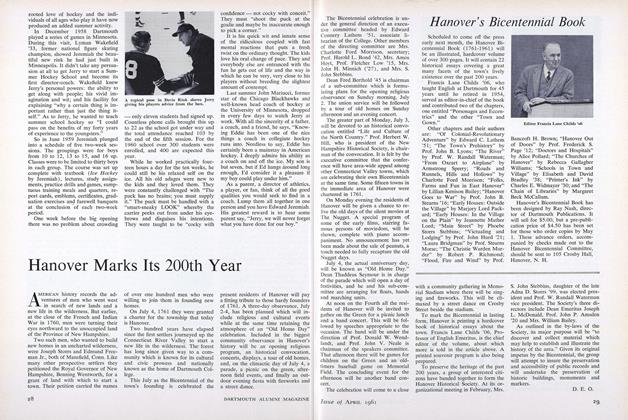
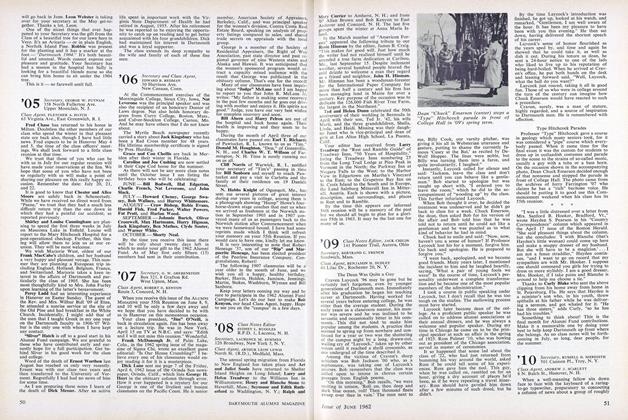
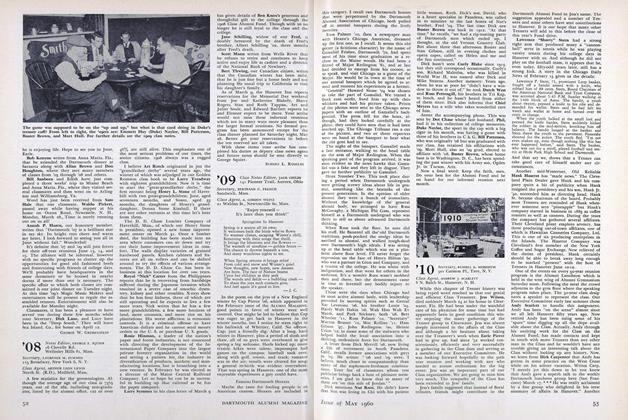
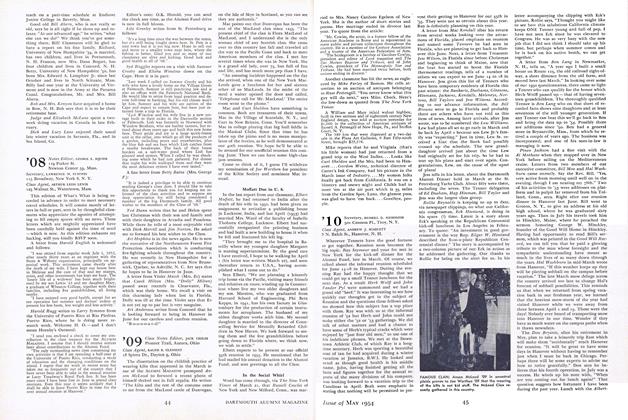
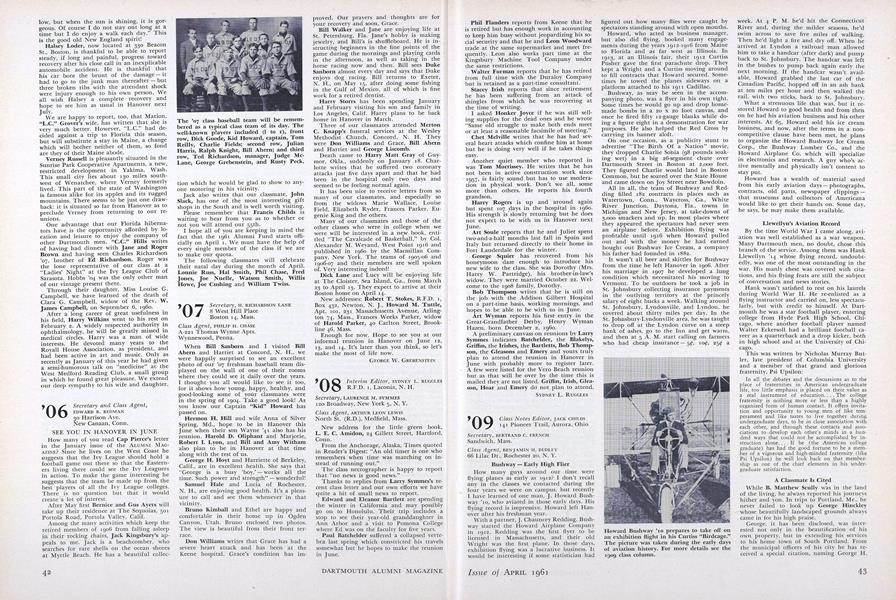
Bushway, as may be seen in the accompanying photo, was a flyer in his own right. Some times he would go up and drop homemade bombs in a 20 x 20 foot canvas, and once he fired fifty 12-gauge blanks while doing a figure eight in a demonstration for war purposes. He also helped the Red Cross by carrying its banner aloft.
On one occasion, as a publicity stunt to advertise "The Birth Of a Nation" movie, they dropped Charlie Sonia (98 pounds soaking wet) in a big 26-segment chute over Dartmouth Street in Boston at 2,000 feet. They figured Charlie would land in Boston Common, but he soared over the State House and came down on Joy Street near Bowdoin.
All in all, the team of Bushway and Redding filled 182 contracts in places such as Watertown, Conn., Waycross, Ga., White River Junction, Daytona, Fla., towns in Michigan and New Jersey, at take-downs of 3,000 smackers and up. In most places where they appeared the spectators had never seen an airplane before. Exhibition flying was profitable until 1916 when Howard pulled out and with the money he had earned bought out Bushway Ice Cream, a company his father had founded in 1882.
It wasn't all beer and skittles for Bushway from the time he left Hanover in 1906. After his marriage in 1907 he developed a lung condition which necessitated his moving to Vermont. To be outdoors he took a job in St. Johnsbury collecting insurance payments in the outlying territory at the princely salary of eight bucks a week. Walking around St. Johnsbury, Lyndonville, and Lyndon, he covered about thirty miles per day. In the St. Johnsbury-Lyndonville area, he was taught to drop off at the Lyndon curve on a steep bank of ashes, go to the Inn and get warm, and then at 5 A. M. start calling on farmers who had cheap insurance - 5¢ 10¢ 25¢ a week. At 4 P. M. he'd hit the Connecticut River and, during the milder seasons, he'd swim across to save five miles of walking. Then he'd light a fire and dry off. When he arrived at Lyndon a railroad man allowed him to take a handcar (after dark) and pump back to St. Johnsbury. The handcar was left in the bushes to pump back again early the next morning. If the handcar wasn't available, Howard grabbed the last car of the Canadian Pacific, hopped off in an ash bank at ten miles per hour and then walked the rail, with two sticks, back to St. Johnsbury.
What a strenuous life that was, but it restored Howard to good health and from then on he had his aviation business and his other interests. At 65, Howard sold his ice cream business, and now, after the terms in a noncompetitive clause have been met, he plans to organize the Howard Bushway Ice Cream Corp., the Bushway Lumber Co., and the Howard Airplane Co. which will specialize in electronics and research. A guy who's active mentally and physically isn't content to stay put.
Howard has a wealth of material saved from his early aviation days - photographs, contracts, old parts, newspaper clippings - that museums and collectors of Americana would like to get their hands on. Some day, he says, he may make them available.
Llewellyn's Aviation Record
By the time World War I came along, aviation was well established as a war weapon. Many Dartmouth men, no doubt, chose this branch of the service. Among them was Hank Llewellyn '14 whose flying record, undoubtedly, war. His manly chest was covered with citations, and his flying feats are still the subject of conversation and news stories.
Hank wasn't satisfied to rest on his laurels during World War 11. He re-enlisted as a flying instructor and carried on, less spectacularly, but with credit to himself. At Dartmouth he was a star football player, entering college from Hyde Park High School, Chicago, where another football player named Walter Eckersoll had a brilliant football career as a quarterback and a drop kicker, both in high school and at the University of Chicago.
This was written by Nicholas Murray Butler, late president of Columbia University and a member of that grand and glorious fraternity, Psi Upsilon:
In all the debates and the discussions as to the place of fraternities in American undergraduate life, too little emphasis is placed on their value as a real instrument of education. . . . The college fraternity is nothing more or less than a highly organized form of human contact. It offers invitation and opportunity to young men of like temperament and like tastes to live together during undergraduate days, to be in close association with each other, and through these contacts and associations to develop each other's minds in a hundred ways that could not be accomplished by instruction alone. ... If he (the American college graduate) has had the good fortune to be a member of a vigorous and high-minded fraternity (like Psi Upsilon) he will look back on that membership as one of the chief elements in his undergraduate satisfaction.
A Classmate Is Cited
While B. Matthew Scully was in the land of the living, he always reported his journeys hither and yon. In trips to Portland, Me., he never failed to look up George Hinckley whose beautifully landscaped grounds always came in for his high praise.
George, it has been disclosed, was interested not only in the beautification of his own property, but in extending his services to his home town of South Portland. From the municipal officers of his city he has received a special citation, naming George H. Hinckley as an "exemplary devotee to civic betterment" after terminating "his many fruitful, dedicated years of service both as a member and as chairman of the South Portland Park and Recreation Commission."
George is also cited as the "father" of the Commission in bringing about through his efforts legislation which created it and then spending "countless arduous hours to beautify this city." The original citation in the form of a scroll was presented to George and a copy of same was spread on the records of the Council.
Nice going, George. See you next June at '09's informal reunion.
And now, dear readers, in the name of Ben Dudley, our head class agent, let me commend to you your active support in the Alumni Fund campaign which has gotten under way this very month.
Howard Bushway '10 prepares to take off onan exhibition flight in his Curtiss "Birdcage."The picture was taken during the early daysof aviation history. For more details see the1909 class column.
Class Notes Editor, 141 Pioneer Trail, Aurora, Ohio
Secretary, Sandwich, Mass.
Class Agent, 66 Lilac Dr., Rochester 20, N. Y.