1951
By now all of you have received the first mailing on this year's Alumni Fund campaign. Last fall you received a mailing about the College's Third Century Fund with its $51,000,000 goal.
Some of you may be wondering just how the two fit together, particularly if you recall that the Alumni Fund was for all practical purposes suspended during the College's capital gifts campaign in the late '50's. The College learned its lesson last time; the two campaigns do fit together.
Let me analogize the situation to that of your local church or synagogue. Each week you put so much into the collection plate to pay the preacher's salary, to pay for heat and light, etc. If the weekly collections are stopped, the institution very rapidly finds itself grinding to a halt.
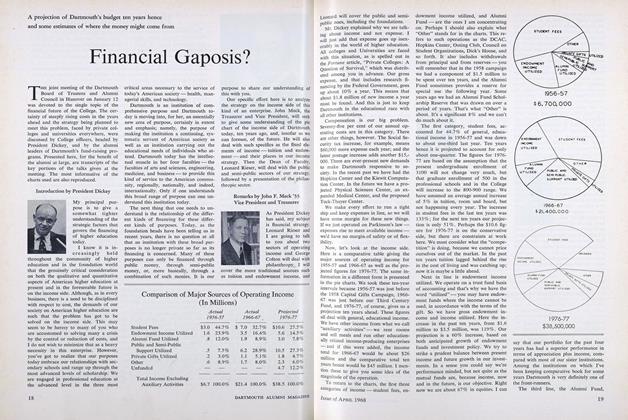
Every year the Alumni Fund provides about one-eighth of Dartmouth's operating budget. Suddenly to eliminate over $2,000,000 in receipts would have an obvious and immediate impact on faculty compensation, scholarships, the operations of the library and Hopkins Center, and so on. Therefore the Alumni Fund must continue at its present rate if Dartmouth is not to fall hopelessly behind where it now is.
Let's return to my analogy to your local house of worship. The old sanctuary is about to collapse; either expensive drastic repairs or a new building is in order. The congregation and the church program have grown; more building is required to accommodate them. If you can raise the capital to pay for at least a large part of it now, it's much cheaper in the long run than carrying a heavy mortgage.
That's what Dartmouth's Third Century Fund is about, with one very major difference. As you know if you read the story in last October's ALUMNI MAGAZINE, comparatively little is sought for buildings. Most of the funds are intended for endowment for faculty salaries, scholarships, and library operations.
Not only is it cheaper in the long run to pay for the rapidly increasing costs of operating a private educational institution through increased endowment, but also I know of no lending institution which will lend the money to endow faculty chairs or student scholarships to be repaid, with interest, out of future annual giving.
What does all of this mean to you? The Alumni Fund comes first. During the Third Century Fund, Dartmouth will each year need at least as much as was raised by last year's Alumni Fund to maintain its operating budget.
The Third Century Fund concerns what, if anything, you can afford to do over and above your annual Alumni Fund contribution. For some of you, that will be nothing because you subsist only on earned income, may be undercompensated, may have a large family, or may be faced with unusual medical or other personal and family expenses.
For many, if not most of you, the answer should be different. Many have investments, a portion of which you might be willing to have work for Dartmouth from here on. (Some of those can result in a very healthy tax deduction compared to your investment cost.) Many of you are now also earning enough to be in a position to be investing and could make an investment for the College instead of for yourself for a few years.
Obviously, the Third Century Fund, just like the Alumni Fund, involves a value judgment on your part. You contribute both because you understand the financial crisis facing private higher education and because you either believe deeply in its value, wear green underwear, or both.
The financial crisis has been written up many times in recent years, including in national publications such as Time and Fortune. The presentations I have heard in Hanover over the past few years convince me, if anything, that the Third Century Fund's goal is too modest.
The question therefore seems to me to boil down to one of the depth of your commitment to continuing a viable system of high quality private higher education in this country and to Dartmouth as a place where it should be continued.
I have devoted so much of this column to the question of financing higher education not because of any dearth of news - but because I regard it as important that every classmate fully understand just how the Alumni Fund and the Third Century Fund interrelate and sincerely hope that each member of the Class will do some soul-searching as to what he is able to do for both.
Sometimes the news gets ahead of me. In February, I reported that Tom Trolle was headed from General Motors Sweden to GM Brazil, with a short stop at corporate headquarters in New York in between. It seems that Tom got deflected in New York, left GM the end of last year, and joined Xerox in Rochester, N. Y., as Manager of Corporate Accounting.
M.D. Al Holt has left Tigertown for Bath, Me., where he is full-time anaesthesiologist on the staff of Bath Memorial Hospital. Al was graduated from the Dartmouth Medical School, earned his M.D. from Cornell, served his internship in Danville, Pa., and his residency at the Maine Medical Center in Portland.
Following service with the Navy, Al returned to Dartmouth as an instructor in anaesthesia from 1959 to 1962. He served on the staff at Mary Hitchcock and later at Princeton, N. J., Hospital. He is a member of the American Society of Anaestheologists and board certified. He and wife Maria have five children.
BANKING BRIEFS. ... Joe Baker, executive vice president of Garden City Trust Company, Newton, Mass., elected to the bank's Board of Directors. ... Jim Culberson named senior vice president of Wachovia Bank and Trust Co. in Morganton, N. C.
PROFESSIONAL BRIEFS Berl Bernhard appointed general counsel of the Democratic Senatorial Campaign Committee. ... "Jock" McIntyre promoted to administrator of Meriden, Conn., Hospital.
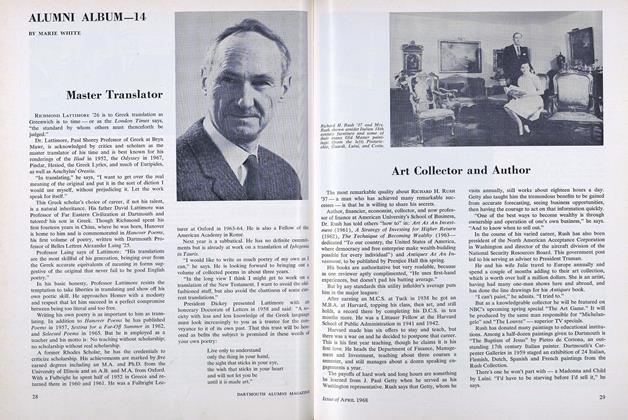
Bob Pack, associate professor and poet in residence at Middlebury (Vt.) College, recently traveled to the University of Arkansas in Fayetteville to read his poems. Bob did graduate work at Columbia and received both a Fulbright Fellowship and a grant from the National Institute of Arts and Letters. He taught at both the New School and Barnard College in New York before going to Middlebury.
Bob has published four volumes of poetry and has a fifth, "The Last Will and Testament of Art Evergreen," in the works. He has also authored a critical study of Wallace Stevens' poetry, two children's books, two anthologies of contemporary poetry, and translated Italian poetry and the librettos of five Mozart operas. He and wife Patricia have two children, Erik, 4½, and Pamela, 6 months.
Bob Hopkins recently returned East as manager of sales development for Avon Products. He was promptly elected a trustee of the Thomas School in Rowayton, Conn. He, wife Joan, and three children live in Darien. Warren Stearns is now with Brett, Andersen & Burke, Inc., doing management consulting out of Princeton, N. J.
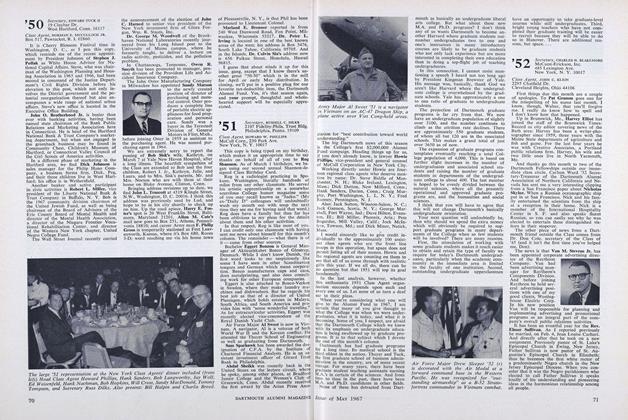
Air Force Major Al Sweet has ended a year-long tour of duty in Vietnam with the highest individual record of combat flying hours logged in his AC-47 Dragonship squadron. He had more than 1,050 air hours during 249 combat missions as a navigator aboard the gunship.
Al is a rated master navigator with more than 5,200 hours of flying time in all, 450 combat hours, some of which go back to 44 missions in the South Pacific in World War 11. A 24-year service veteran, he received the Distinguished Flying Cross in Vietnam, holds 11 additional awards of the Air Medal for heroic and outstanding aerial skill, and has received the Air Medal 16 times for superior airmanship. He is scheduled for reassignment to Robins AFB, Ga., as a staff development engineer.
We don't know the outcome, but lawyer Ben Sykes recently ran for re-election as town moderator of Walpole, Mass. He served in the Navy for four years as flag secretary to an admiral and as assistant chief of staff for the Commander of the military sea transportation service. Ben also served as defense counsel for general courts martial, as a member of the court of military appeals, and taught law at the Navy Justice School and the U.S. Naval War College.
Secretary, 2107 Fidelity Bldg. Philadelphia, Penna. 19109
Class Agent, McCall Corp., 230 Park Ave. New York, N. Y. 10017