1955
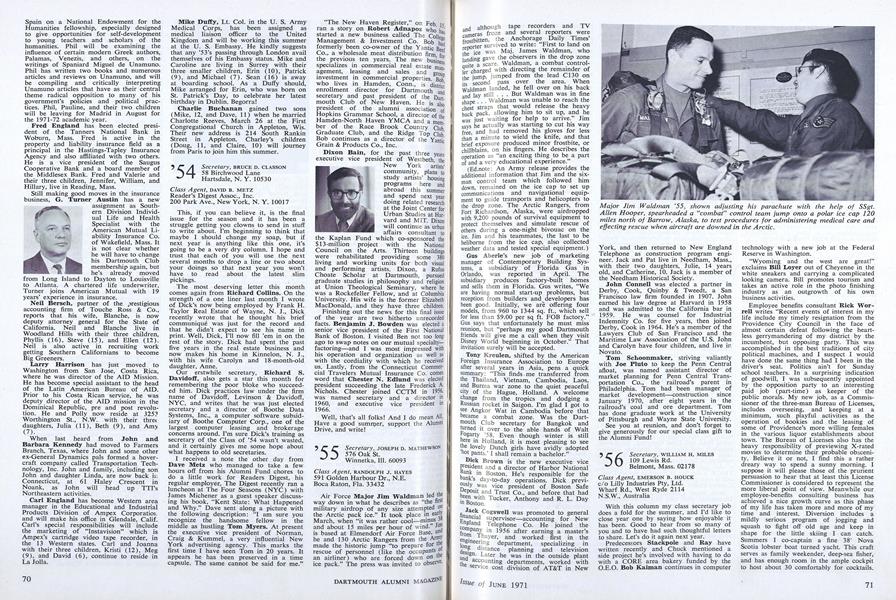
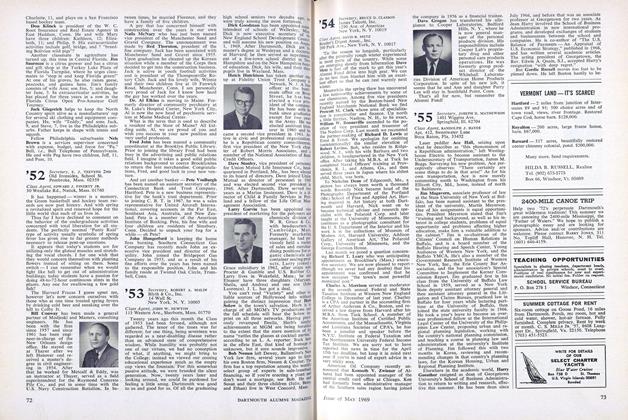
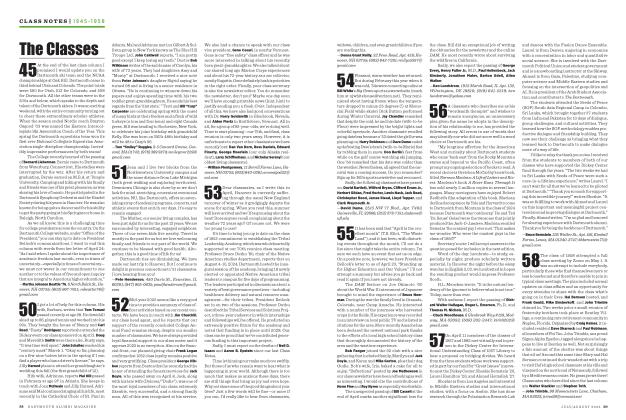
Air Force Major Jim Waldman led the way down in what he describes as "the first military airdrop of any size attempted on the Arctic pack ice." It took place in early March, when "it was rather cool—minus 38 and about 15 miles per hour of wind." Jim is based at Elmendorf Air Force Base, and he and 130 Arctic Rangers from the Army made the historic jump "to prepare for the rescue of personnel (like the occupants of an airliner) who are forced down on the ice pack." The press was invited to observe and although tape recorders and TV canmeras froze and several reporters were frostbitten, the Anchorage Daily Times' renorter survived to write: "First to land on the ice was Maj. James Waldman, who ding gave the observers in the drop zone quite a scare. Waldman, a combat controller charged with directing the remainder of he jump, jumped from the lead C130 on its second pass over the area. When Waldman landed, he fell over on his back and lay still... But Waldman was in fine shape... Waldman was unable to reach the chest straps that would release the heavy back pack, allowing him to sit up, and he was just waiting for help to arrive." Jim says he actually was starting to cut his way free, and had removed his gloves for less than a minute to wield the knife, and that brief exposure produced minor frostbite, or chillblains, on his fingers. He describes the operation as "an exciting thing to be a part of and a very educational experience."
(Ed.note: An Army release provides the additional information that Jim and the six-man control team which followed him down, remained on the ice cap to set up communications and navigational equipment to guide transports and helicopters to the drop zone. The Arctic Rangers, from Fort Richardson, Alaska, were airdropped with 9,200 pounds of survival equipment to protect themselves and simulate rescue of others during a one-night bivouac on the ice. Jim and his teammates, the last to be heliborne from the ice cap, also collected weather data and tested special equipment.)
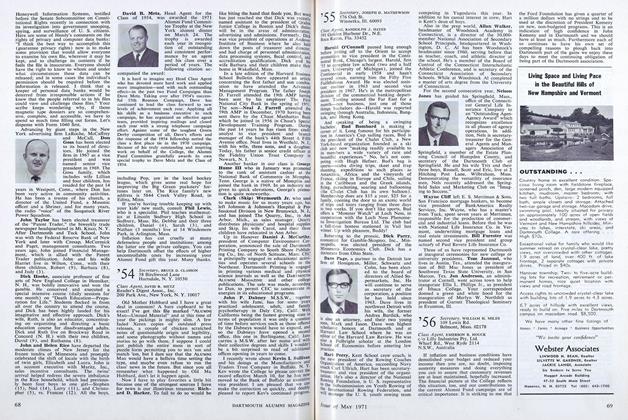
Gus Aberle's new job of marketing manager of Contemporary Building Systems, a subsidiary of Florida Gas in Orlando, was reported in April. The subsidiary produces factory-built homes and sells them in Florida. Gus writes, "We are having normal start-up problems, but reception from builders and developers has been good. Initially, we are offering four models, from 960 to 1344 sq. ft., which sell for less than $9.00 per sq ft. FOB factory." Gus says that unfortunately he must miss reunion, but "perhaps my good Dartmouth friends will give me a call when they visit Disney World beginning in October." That invitation surely will be accepted.
Tony Kreulen, shifted by the American Foreign Insurance Association to Europe after several years in Asia, pens a quick summary: "This finds me transferred from the Thailand, Vietnam, Cambodia, Laos, and Burma war zone to the quiet peaceful city of the Hague, Holland. A welcome change from the tropics and dodging a Russian rocket in Saigon. I'm glad I got to see Angkor Wat in Cambodia before that became a combat zone. Was the Dartmouth Club secretary for Bangkok and turned it over to the able hands of Walt Fogarty '58. Even though winter is still fere in Holland, it is most pleasing to see the lovely Dutch girls have avidly adopted hot pants.' I shall remain a bachelor."
Dick Brown is the new executive vice president and a director of Harbor National Bank in Boston. He's responsible for the bank's day-to-day operations. Dick previously was vice president of Boston Safe Deposit and Trust Co., and before that had been with Tucker. Anthony and R. L. Day in Boston.
Jack Cogswell was promoted to general financial supervisor—accounting for New England Telephone Co. He joined the company in 1956 after earning a master's from Thayer, and worked first in the engineering department, specializing in long distance planning and television design. Later he was in the outside plant and accounting departments, worked with the service cost division of AT & T in New York, and then returned to New England Telephone as construction program engineer. Jack and Pat live in Needham, Mass., with their two daughters, Julie, 14 years old, and Catherine, 10. Jack is a member of the Needham Historical Society.
John Connell was elected a partner in Derby, Cook, Quinby & Tweedt, a San Francisco law firm founded in 1907. John earned his law degree at Harvard in 1958 and was admitted to the California bar in 1959. He was counsel for Industrial Indemnity Co. for five years, then joined Derby, Cook in 1964. He's a member of the Lawyers Club of San Francisco and the Maritime Law Association of the U.S. John and Carolyn have four children, and live in Novato.
Tom Schoonmaker, striving valiantly with Joe Pluto to keep the Penn Central afloat, was named assistant director of market planning for Penn Central Transportation Co., the railroad's parent in Philadelphia. Tom had been manager of market development—construction since January 1970, after eight years in the railroad's coal and ore department. Tom has done graduate work at the University of Pittsburgh and Wayne State University.
See you at reunion, and don't forget to give generously for our special class gift to the Alumni Fund!
Major Jim Waldman '55, shown adjusting his parachute with the help of SSgt.Allen Hooper, spearheaded a "combat" control team jump onto a polar ice cap 120miles north of Barrow, Alaska, to test procedures for administering medical care andeffecting rescue when aircraft are downed in the Arctic.
Secretary, 576 Oak St. Winnetka, Ill. 60093
Class Agent, 591 Golden Harbour Dr., N.E. Boca Raton, Fla. 33432