1932
"The tension under which Americans live, and its impact on their health is frightening." So wrote Dr. Wally Modarelli, physician and spiritual counselor to the Class, 15 years ago at the time of our 25th reunion. With the 40th coming up we queried the good doctor for an updated report on the stress scene. He writes:
"I am working on my income tax with my accountant and feel very tense! This reminded me to drop you a note. Things are getting worse instead of better, and the sale of tranquilizers and consumption of martinis has increased three-fold since my last note. I see where some people from Queechee, Vt. are moving back to Brooklyn and Hoboken to get away from those noisy skimobiles that are plaguing the North Country. Also, all the birds are moving to Capistrano, even the snow birds. I still think cirrhosis of liver is better than the 'Zombie Tranquilizer state', so will stick to alky."
Additional clinical note on Butch's own anxiety syndrome: He sealed the stamped, self-addressed postcard on which he had written in an 8 (8c-stamped envelope, first writing across the address side of the card: "Was afraid some incompetent mail man might get the front of this wet and spoil the whole bit."
That was a sloppy job of reading the sports pages we did the morning of February 18, because we missed the big '32-story-of-the-month, hence failing to bring it to you in the last issue. On February 17 Bill Morton was one of ten football greats named to the National Football Foundation's college football Hall of Fame. Among the others: Mai Aldrich of Yale, and former Heisman trophy winners Angelo Bertelli of Notre Dame and the late Bruce Smith of Minnesota.
The following week one more honor was bestowed on our old Fayerweather bunkie, Dr. George Hahn, when the Philadelphia Contionental Chapter of the Sons of the American Revolution presented him with its Gold Good Citizenship Medal. The medal, which goes annually "to an outstanding American," has been given in the past to President Hoover, Generals Eisenhower, Patton, and Bradley, Admiral Byrd, and Senator McClelland.
Another recently honored man of medicine is Dr. Barney Todd, consultant physician in medicine and cardiology, who became the first voting physician elected to the Board of directors of the Beverly (Mass.) Hospital in its 84-year history.
George Blaesi writes from American Samoa, where he is doing a 2-year stint as Counsel to the legislature: "Still have our home in Vermont, but we may forsake the cold north for a more sunny clime when we return. This place is great, but immigration is restricted to those who come here to work only. Island is too small (3 miles by 18) to support population growth for any but indigenous people. Sorry that I will have to miss the 40th, my only miss since graduation. We will be glad to greet anyone, day or night, who may be passing through here or better yet may be arriving for a visit."
Alice (Mrs. John) Zimmerman sends the sad news that Gus Zimmerman's wife Isabele died last Xmas Day. We offer the belated sympathy of the Class to Gus. Alice writes that she and John will be at Reunion.
Which reminds us that we all have PaulFox's all's-copacetic report on the plans for that Great Event, and that it behooves him and her who possibly can to Be There.
You also have Bob Ackerberg's guardedly optimistic bulletins on progress toward our $100,000 Reunion Fund Gift goal. Excelsior!
From Berryville, Va., comes a card from Leon Warner, he and Mary just back from a European trip that included two weeks of skiing at St. Christoph and Zermatt, and planning to be in Hanover in June. Leon interprets Bill Levi's '32 valedictory commentary as a version of the modern theme of "blaming school, college, government, parents, business, etc. for many of the problems we have incurred ourselves."
"I'd like to hear Bill Levi's own 1972 views" writes Howie Wile from Washington. "When we were young, things tended to be absolute, solutions were simple and usually surgical, and we were unhampered by experience. After 40 years we are perhaps too conservative, the best judgment having fallen in the between years, when we were too busy to do much. Fortunately some of our classmates were able to contribute some positive thinking." Howie concludes, "suspect we all are in favor of slowing down our own particular carousels." Then adds a postscript: "Sorry, can't make Reunion. Have appointment with carousel."
From Max Wolff: "As for Levi's words, I have some very definite thoughts on the matter, which words I prefer to speak among friends when we meet in Hanover in June." And still on the same subject, we have a longish letter from John Keller that defies synopsis, but we give you his final paragraph:
"Given the usual cultural lag of an educational institution—I have heard it is 50 years—Bill Levi analyzed pretty well. Just another impatient youth. If we could induce him to give another valedictory in 1982 (two years before the Orwellian apocalypse and our 50th reunion) he might say something so controversial and so stimulating that 40 years later—at our 90th in 2022 A. D.—we would all return to 'rap' about it (a nostalgic expression that returned just after the start of the 21st century)."
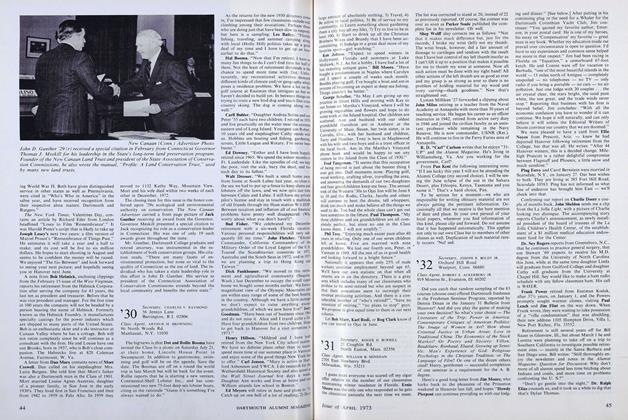
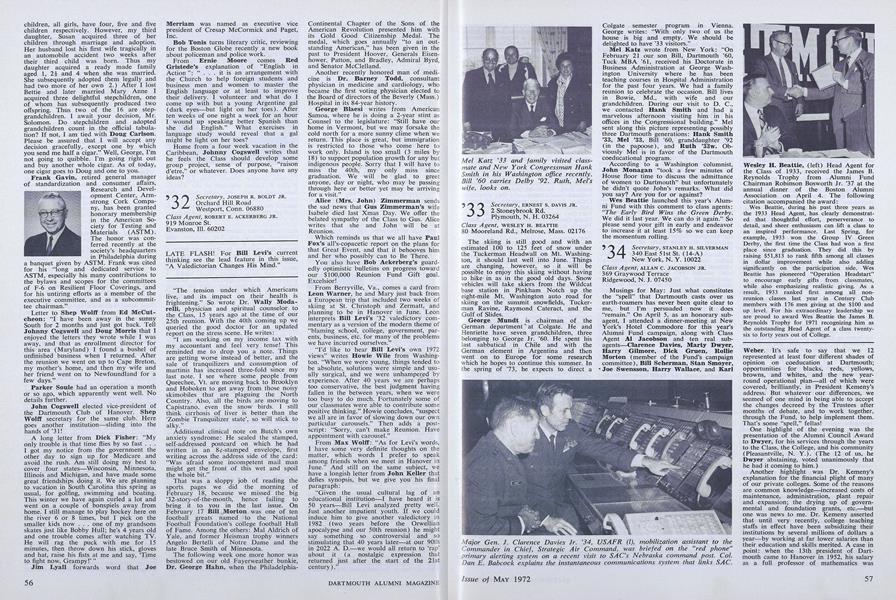
Mel Katz '33 and family visited classmate and New York Congressman HankSmith in his Washington office recently.Bill '6O carries Delby '92. Ruth, Mel'swife, looks on.
Secretary, Orchard Hill Road Westport, Conn. 06880
Class Agent, 919 Monroe St. Evanston, Ill. 60202
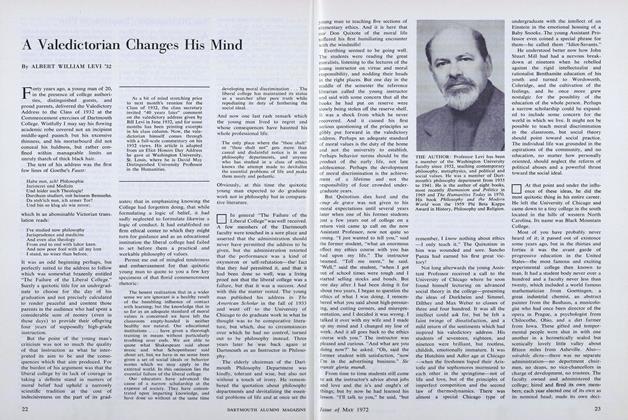
LATE FLASH! For Bill Levi's current thinking see the lead feature in this issue, "A Valedictorian Changes His Mind."