1932
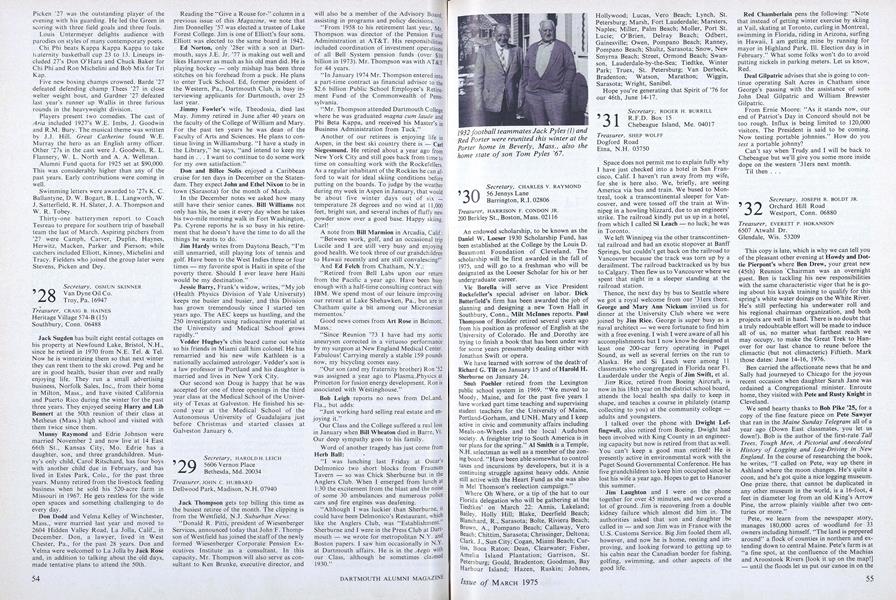
This copy is late, which is why we can tell you of the pleasant other evening at Howdy and Dottie Pierpont's where Ben Drew, your great new (45th) Reunion Chairman was an overnight guest. Ben is tackling his new responsibilities with the same characteristic vigor that he is going about his kayak training to qualify for this spring's white water doings on the White River. He's still perfecting his underwater roll and his regional chairman organization, and both projects are well in hand. There is no doubt that a truly redoubtable effort will be made to induce all of us, no matter what farthest reach we may occupy, to make the Great Trek to Han- over for our last chance to reune before the climactic (but not climacteric) Fiftieth. Mark those dates: June 14-16, 1976.
Ben carried the affectionate news that he and Sally had journeyed to Chicago for the joyous recent occasion when daughter Sarah Jane was ordained a Congregational minister. Enroute home, they visited with Pete and Rusty Knight in Cleveland.
We send hearty thanks to Bob Pike '25, for a copy of the fine feature piece on Pete Sawyer that ran in the Maine Sunday Telegram all of a year ago (Down East classmates, you let us down!). Bob is the author of the first-rate TallTrees, Tough Men, A Pictorial and AnecdotedHistory of Logging and Log-Driving in NewEngland. In the course of researching the book, he writes, "I called on Pete, way up there in Ashland where the moon changes. He's quite a coon, and he's got quite a nice logging museum. One prize there, that cannot be duplicated in any other museum in the world, is a 16-foot, 4 feet in diameter log from an old King's Arrow Pine, the arrow plainly visible after two centuries or more."
Pete, we learn from the newspaper story, manages 180,000 acres of woodland for 33 owners including himself. "The land is peppered around" a flock of counties in northern and extending down to central Maine. Pete's farm is at "a fine spot, at the confluence of the Machias and Aroostook Rivers [look it up on the map!] - until the floods let us put our canoe in on the doorstep and paddle right up to the main road." Read along with us:
"We manage our lands on a continuing crop basis with a diameter limit on cutting. We have a policy of leaving large and stately trees near roads for the public enjoyment. Some monumental trees are worth far more as scenery that at the mill. However, those trees are lightning rods, hit very often because they absorb water and conduct electricity.
"You can harvest woodlands sensibly with machines as long as the machine operator goes along with you. But some operators have bought their machines on time - and they're expensive - and want to get it paid off in a hurry. They tend to destroy a lot of young trees in the process of making themselves a little extra cash. Sometimes you have to ask them to leave. They've lost all concern for the future.
"Our land for the most part has been cut and recut. For much of it this is the fifth cutting, and it can be continued with careful management. "I changed the cutting practices very little from the traditional style of my greatgrandfather. I did increase the diameter limit somewhat. If you examine the cross-section of a spruce or pine you'll notice in the heart of the tree within six or eight inches the growth rings are very close together. You've waited a great many years for that much size. If you cut then, before the tree has grown through its best years of maturity - after it has gotten its head through the forest roof and starts putting on growth in short order - why then you've destroyed your principal. Your tree will go from 6 to 12 inches in half the time it went from one to 6 inches, and its volume has increased by four. You've waited 40 years for 12 inches of diameter and in another 20 you'll get four times that growth. It's one of nature's bargains, just as simple as that." (To be continued.)
Dr. George Hahn "had a fine trip to Yugoslavia in June and July as a director of the Yugoslavian-United States Medical Association. English is superseding other languages as the medical tongue." George had the successive misfortunes of stumbling on a stone in Dubrovnik and rupturing his left gastrocnemius (calf to you) muscle and then back in Philadelphia rupturing his left Achilles tendon. While still on crutches, he had "received many challenges to play tennis - I am keeping a list!"
From Ev Hokanson's dues-paying mail - Carlos Baker: "Scribner's is probably going to publish my book of short stories in the fall of '75." Al Boncutter: "Heading for Guadalajara for our eighth season." Fritz Browning: "Still working at Bay Pines [Fla.] VA Hospital. Play tennis at all opportunities." Al McLaughlin: "We have fully retired now - spending the winter at Tucson and will return to Ontario this summer." Alice (Mrs. John) Zimmerman: "John retires from GMAC as of 12/31/74. When he gets his breath after the first of the year, he'll probably let you know what he is up to." Mike Cardozo: "Sy Rogers stopped to see us on the way back to Greensboro; we're both still among those who have not chosen 'early retirement' - like Nelson Rockefeller, who will soon be our neighbor." Don Allen (from Churchill College, Cambridge): "On sabbatical from Eisenhower College in an effort to infuse our World Studies program with more science. Am focusing especially on the history and philosophy of science. The Cambridge people have really rolled out the red carpet for us. Have delightful quarters in the Overseas Fellows Flats. By way of recreation am also attending Archibald Cox's lectures on American Constitutional Law. Glad to hear from '32ers who come to Cambridge."
Secretary, Orchard Hill Road Westport, Conn. 06880
Treasurer, 6507 Atwahl Dr. Glendale, Wis. 53209
More From This Issue
-
 Feature
"He could Have talked Satan into abandoning hell"
March 1975 -
 Feature
"How Ya Gonna Keep 'Em Down on the Farm?"
March 1975 -
 Feature
Another Day, Another Dollar
March 1975 -
 Feature
A Renaissance of Slashers and Bashers
March 1975 -
 Article
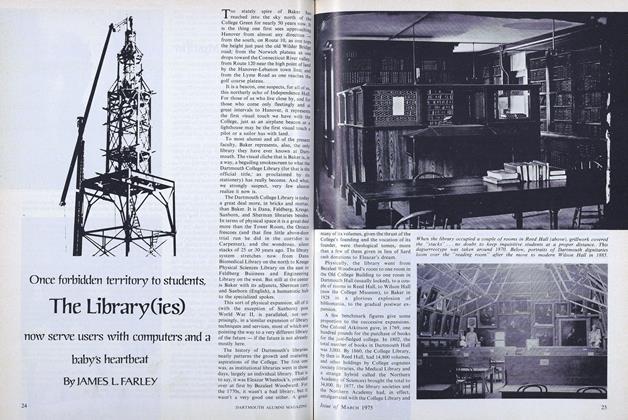
Once forbidden territory to students, The Library(ies)
March 1975 -
 Class Notes
1959
March 1975