Memories
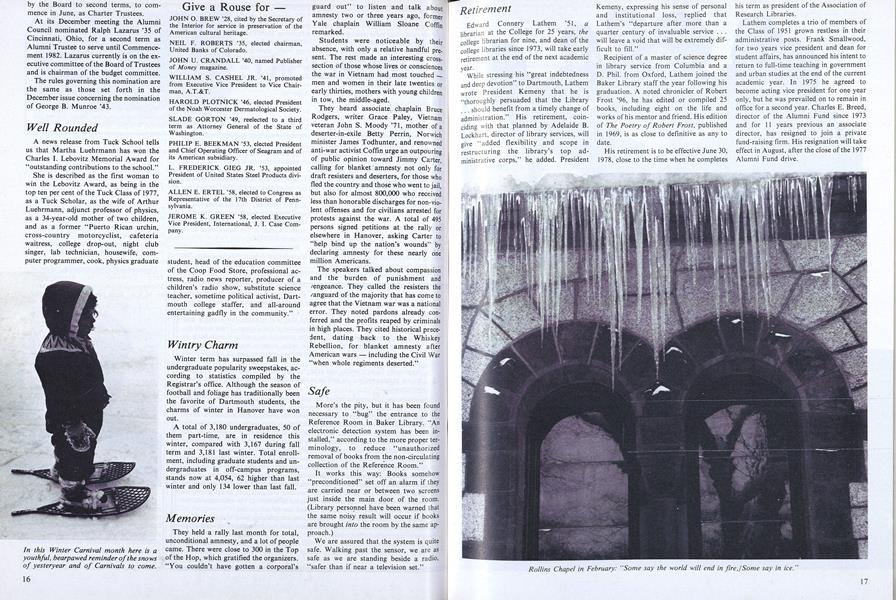
They held a rally last month for total, unconditional amnesty, and a lot of people came. There were close to 300 in the Top of the Hop, which gratified the organizers. "You couldn't have gotten a corporal's guard out" to listen and talk about amnesty two or three years ago, former Yale chaplain William Sloane Coffin remarked.
Students were noticeable by their absence, with only a relative handful present. The rest made an interesting crosssection of those whose lives or consciences the war in Vietnam had most touched — men and women in their late twenties or early thirties, mothers with young children in tow, the middle-aged.
They heard associate chaplain Bruce Rodgers, writer Grace Paley, Vietnam veteran John S. Moody '71, mother of a deserter-in-exile Betty Perrin, Norwich minister James Todhunter, and renowned anti-war activist Coffin urge an outpouring of public opinion toward Jimmy Carter, calling for blanket amnesty not only for draft resisters and deserters, for those who fled the country and those who went to jail, but also for almost 800,000 who received less than honorable discharges for non-vio- lent offenses and for civilians arrested for protests against the war. A total of 495 persons signed petitions at the rally or elsewhere in Hanover, asking Carter to "help bind up the nation's wounds" by declaring amnesty for these nearly one million Americans.
The speakers talked about compassion and the burden of punishment and vengeance. They called the resisters the vanguard of the majority that has come to agree that the Vietnam war was a national error. They noted pardons already conferred and the profits reaped by criminals in high places. They cited historical precedent, dating back to the Whiskey Rebellion, for blanket amnesty after American wars — including the Civil War "when whole regiments deserted."
More From This Issue
-
 Feature
A simple mental technique... A simple mental tech... A simple mental... A simple...
February 1977 -
 Feature
Never Let Go
February 1977 -
 Feature
Twelve legs, six imaginations, one soul Pilobolus
February 1977 -
 Feature
Composite Artist
February 1977 -
 Article
Stepping Out with a Bounder
February 1977 -
 Article
Gray Is Beautiful
February 1977