1943
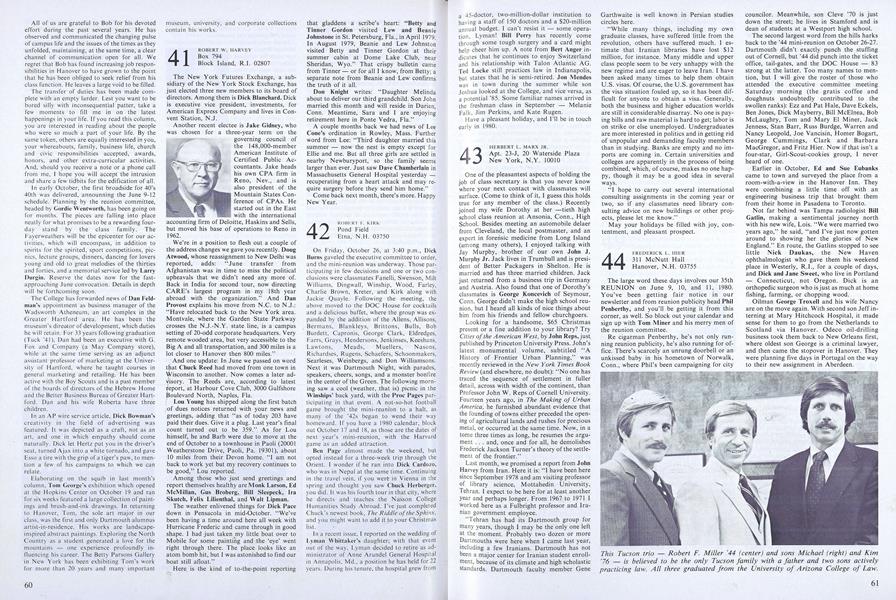
One of the pleasantest aspects of holding the job of class secretary is that you never know where your next contact with classmates will surface. (Come to think of it, I guess this holds true for any member of the class.) Recently joined my wife Dorothy at her — tieth high school class reunion at Ansonia, Conn., High School. Besides meeting an automobile delaer from Cleveland, the local postmaster, and an expert in forensic medicine from Long Island (among many others), I enjoyed talking with Jay Murphy, brother of bur own John J. Murphy Jr. Jack lives in Trumbull and is president of Better Packagers in Shelton. He is married and has three married children. Jack just returned from a business trip in Germany and Austria. Also found that one of Dorothy's classmates is George Koncevich of Seymour, Conn. George didn't make the high school reunion, but I heard all kinds of nice things about him from his friends and fellow churchgoers.
Looking for a handsome, $65 Christmas present or a fine addition to your library? Try Cities of the American West, by John Reps, just published by Princeton University Press. John's latest monumental volume, subtitled "A History of Frontier Urban Planning," was recently reviewed in the New York Times BookReview {and elsewhere, no doubt): "No one has traced the sequence of settlement in fuller detail, across with width of the continent, than Professor John W. Reps of Cornell University. Fourteen years ago, in The Making of UrbanAmerica, he furnished abundant evidence that the founding of towns either preceded the opening of agricultural lands and rushes for precious metal, or occurred at the same time. Now, in a tome three times as long, he resumes the argument . . . and, once and for all, he demolishes Frederick Jackson Turner's theory of the settlement of the frontier."
Last month, we promised a report from John Harvey from Iran. Here it is: "I have been here since September 1978 and am visiting professor of library science, Mottahedin University, Tehran. I expect to be here for at least another year and perhaps longer. From 1967 to 1971 I worked here as a Fulbright professor and Iranian government employee.
"Tehran has had its Dartmouth group for many years, though I may be the only one left at the moment. Probably two dozen or more Dartmouths were here when I came last year, including a few Iranians. Dartmouth has not been a major center for Iranian student enrollment, because of its climate and high scholastic standards. Dartmouth faculty member Gene Garthwaite is well known in Persian studies circles here.
"While many things, including my own graduate classes, have suffered little from the revolution, others have suffered much. I estimate that Iranian libraries have lost $12 million, for instance. Many middle and upper class people seem to be very unhappy with the new regime and are eager to leave Iran. I have been asked many times to help them obtain U.S. visas. Of course, the U.S. government has the visa situation fouled up, so it has been difficult for anyone to obtain a visa. Generally, both the business and higher education worlds are still in considerable disarray. No one is paying bills and raw material is hard to get; labor is on strike or else unemployed. Undergraduates are more interested in politics and in getting rid of unpopular and demanding faculty members than in studying. Banks are empty and no imports are coming in. Certain universities and colleges are apparently in the process of being combined, which, of course, makes no one happy, though it may be a good idea in several ways.
"I hope to carry out several international consulting assignments in the coming year or two, so if any classmates need library consulting advice on new buildings or other projects, please let me know."
May your holidays be filled with joy, contentment, and pleasant prospect.
Apt. 23-J, 20 Waterside Plaza New York, N.Y. 10010
More From This Issue
-
 Feature
An extremely small malfunction ... and then something terrible happened
December 1979 -
 Feature
The Medical Legacy of August 1945
December 1979 -
 Feature
Giving and Getting
December 1979 -
 Article
An Old-fashioned Mutant
December 1979 -
 Books
BooksThe Country Remembers
December 1979 -
 Article
The Five-Year Plan
December 1979