1945
Pat and Ted Smith came out to the island one warm Sunday last July. (Perhaps I should explain here that Shirley and 1 live on an island on Lake Winnepesaukee from early May through the end of October. Our "winter quarters1' are in Seabrook, while this column is headed by my business address.) The Smiths brought a delicious luncheon, topped by fresh strawberries, in addition to the various records and trappings of the office of class secretary. Between swims on this warm afternoon we had a sort of informal change of the watch for this office.
To ease my duties some, Ted will continue to prepare obituaries, a duty which we all hope will be very light. Unfortunately, however, this duty does continue, as we recently received word of the untimely passing of Frederic H.Kilner. Fred was with the class for three semesters before enlisting to become a naval aviator. This points up again the undeniable fact that we represent the war class, having matriculated only some 11 weeks prior to Pearl Harbor.
Back in the spring the New York Times carried a review of the movie Return of theSecaucus Seven, which was being shown at the Museum of Modern Art in joint sponsorship with the Film Society of Lincoln Center. This lucid critique was written by Vincent C'anby, who managed to maintain an impartial approach despite the fact that no less than four Dartmouth graduates were involved in the production, including the co-producer, both the male and female leads, and the cinematographer, Austin deBesche '68. The first name is a coincidence, but Austin was brought up in Atkinson, where he was a childhood companion of my older sons. And at least partially through my encouragement he went to Exeter and Dartmouth.
Harry Figgle continues to pop up in the financial news. Harry is president of A-T-O Inc., a multinational conglomerate, and is often described as a person of "gentle demeanor but with a glint of steel in his eyes."
In going over the responsibilities of a class secretary and his relationship to the Alumni Records Office, one begins to gain a somewhat different perspective of Dartmouth. There is, of course, the College as anyone can see or remember it the campus, the buildings, the study of past and current knowledge. But there is a larger Dartmouth College, a nationwide or even worldwide organization (for lack of a better word, as it is not organized in the usual sense of the word). It is the larger, nebulous, but real Dartmouth. We each become a part of it the moment we matriculate and never cease being a part of it, contributing our undergraduate accomplishments and our deeds and accomplishments, whether great or small, in later life, and perhaps beyond our own lives through our children and our endowments.
When I was asked to accept the office of secretary, I was told that some wise but unnamed classmate had stated that it was "time to tap my talents." Since then I have been wondering just what those talents are supposed to be and how I am going to put them whatever they may be to use. I am hoping that perhaps in some small way I may help the members of the Dartmouth class of 1945 to feel a little closer to each other and to strengthen their ties to the College.
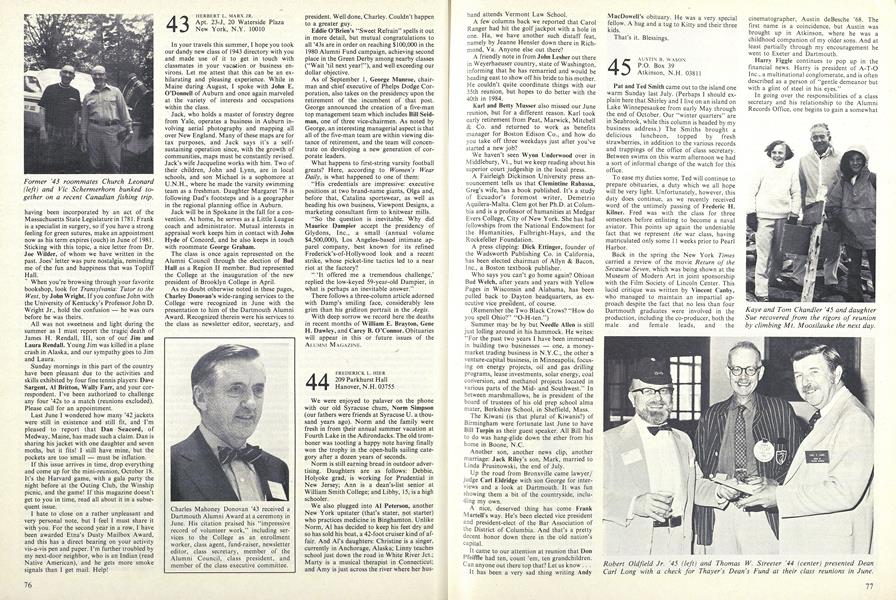
Kaye and Tom Chandler '45 and daughterSue recovered from the rigors of reunionby climbing Mt. Moosilauke the next day.
Robert Oldfield Jr. '45 (left) and Thomas W. Streeter '44 (center) presented DeanCarl Long with a check for Thayer's Dean's Fund at their class reunions in June.
P.O. Box 39 Atkinson, N.H. 03811