1934
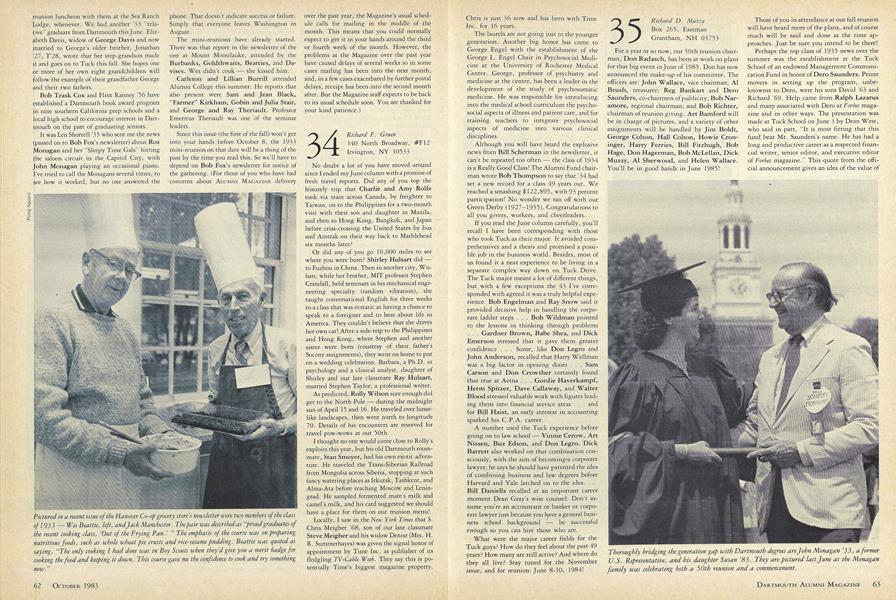
No doubt a lot of you have moved around since I ended my June column with a promise of fresh travel reports. Did any of you top the leisurely trip that Charlie and Amy Rolfe took via train across Canada, by freighter to Taiwan, on to the Philippines for a two-month visit with their son and daughter in Manila, and then to Hong Kong, Bangkok, and Japan before criss-crossing the United States by bus and Amtrak on their way back to Marblehead six months later?
Or did any of you go 10,000 miles to see where you were born? Shirley Hulsart did to Fuzhou in China. Then in another city, Wuhan, while her brother, MIT professor Stephen Crandall, held seminars in his mechanical engineering specialty (random vibration), she taught conversational English for three weeks to a class that was ecstatic at having a chance to speak to a foreigner and to hear about life in America. They couldn't believe that she drives her own car! After a side-trip to the Philippines and Hong Kong, where Stephen and another sister were born (courtesy of their father's Socony assignments), they went on home to put on a wedding celebration. Barbara, a Ph.D. in psychology and a clinical analyst, daughter of Shirley and our late classmate Ray Hulsart, married Stephen Taylor, a professional writer.
As predicted, Roily Wilson sure enough did get to the North Pole during the midnight sun of April 15 and 16. He traveled over lunarlike landscapes, then went north to longitude 70. Details of his encounters are reserved for travel pow-wows at our 50th.
I thought no one would come close to Rolly's exploits this year, but his old Dartmouth roommate, Stan Smoyer, had his own exotic adventure. He traveled the Trans-Siberian Railroad from Mongolia across Siberia, stopping at such fancy watering places as Irkutsk, Tashkent, and Alma-Ata before reaching Moscow and Leningrad. He sampled fermented mare's milk and camel's milk, and his card suggested we should have a place for them on our reunion menu!
Locally, I saw in the New York Times that S. Chris Meigher '68, son of our late classmate Steve Meigher and his widow Denise (Mrs. H. R. Summerhayes) was given the signal honor of appointment by Time Inc. as publisher of its fledgling TV-Cable Week. They say this is potentially Time's biggest magazine property. Chris is just 36 now and has been with Time Inc. for 16 years.
The laurels are not going just to the younger generation. Another big honor has come to George Engel with the establishment of the George L. Engel Chair in Psychosocial Medicine at the University of Rochester Medical Center. George, professor of psychiatry and medicine at the center, has been a leader in the development of the study of psychosomatic medicine. He was responsible for introducing into the medical school curriculum the psychosocial aspects of illness and patient care, and for training teachers to integrate psychosocial aspects of medicine into various clinical disciplines.
Although you will have heard the explosive news from Bill Scherman in the newsletter, it can't be repeated too often the class of 1934 is a Really Good Class! The Alumni Fund chairman wrote Bob Thompson to say that '34 had set a new record for a class 49 years out. We reached a smashing $122,895, with 93 percent participation! No wonder we ran off with our Green Derby (1927-1935).. Congratulations to all you givers, workers, and cheerleaders.
If you read the June column carefully, you'll recall I have been corresponding with those who took Tuck.as their major. It avoided comprehensives and a thesis and promised a possible job in the business world. Besides, most of us found it a neat experience to be living in a separate complex way down on Tuck Drive. The Tuck major meant a lot of different things, but with a few exceptions the 43 I've corresponded with agreed it was a truly helpful experience. Bob Engelman and Ray Snow said it provided decisive help in handling the corporate ladder steps . . . Bob Wildman pointed to the lessons in thinking through problems . . . Gardner Brown, Babe Shea, and Dick Emerson stressed that it gave them greater confidence . . . Some, like Don Legro and John Anderson, recalled that Harry Wellman was a big factor in opening doors . . . Sam Carson and Don Crowther certainly found that true at Aetna . . . Gordie Haverkampf, Herm Spitzer, Dave Callaway, and Walter Blood stressed valuable work with figures leading them into financial service areas . . . and for Bill Haist, an early interest in accounting sparked his C.P.A. career.
A number used the Tuck experience before going on to law school Vinnie Cerow, Art Nissen, Buz Edson, and Don Legro. Dick Barrett also worked on that combination consciously, with the aim of becoming-a corporate lawyer; he says he should have patented the idea of combining business and law degrees before Harvard and Yale latched on to the idea. . . Bill Daniells recalled at an important career moment Dean Gray's wise counsel: Don't assume you're an accountant or banker or corporate lawyer just because you have a general business school background 4 be successful enough so you can hire those who are.
What were the major career fields for the Tuck guys? How do they feel about the past 49 years? How many are still active? And where do they all live? Stay tuned for the November issue, and for reunion: June 8-10, 1984!
140 North Broadway, #F12 Irvington, NY 10533
More From This Issue
-
 Feature
Doubt and Passion: Notes on Contemporary American Novelists
October 1983 -
 Feature
Artists in Residence
October 1983 -
 Feature
40 Years at the Helm
October 1983 -
 Feature
Rudolph Ruzicka's Two Dartmouth Medals
October 1983 -
 Feature
Meet Ted Leland
October 1983 -
 Feature
The Widmayer Touch
October 1983