1947
We're looking forward to November, when we'll be reading this column. November is mid-season here in New Hampshire, being bleak, but sometimes breathless still, after the colorful autumn with clear blue skies and before the long white winter afternoons, the twilight glow.
I've decided to make these columns non-current-news oriented how can they be too current anyway when the writer's deadline is two months early by going to non-time-frame content, by highlighting various of our classmates. What's happening, where are we, what do we value? I have this feeling that as a group we are at an age where it is timely to write about accomplishments. We all have come 40-odd years from the posthigh school crucible of college in some cases service and school both were our crucibles. All of us have arrived somewhere, made marks, large or small, and done things differently from any other person. I will hasten to explain that I feel that creating a more comfortable (to the bird) birdhouse, or being the best boy scout master on your entire street, or guiding a corporate entity through financial problems, or doing surgery on human systems or on tree limbs, or becoming the most admired conversationalist in barber chair number four, or being a father or husband, or neither of these they are all of the same interest value in the eyes of our column. What matters is that you got from there to here, and how was it, and how does it look to you now?
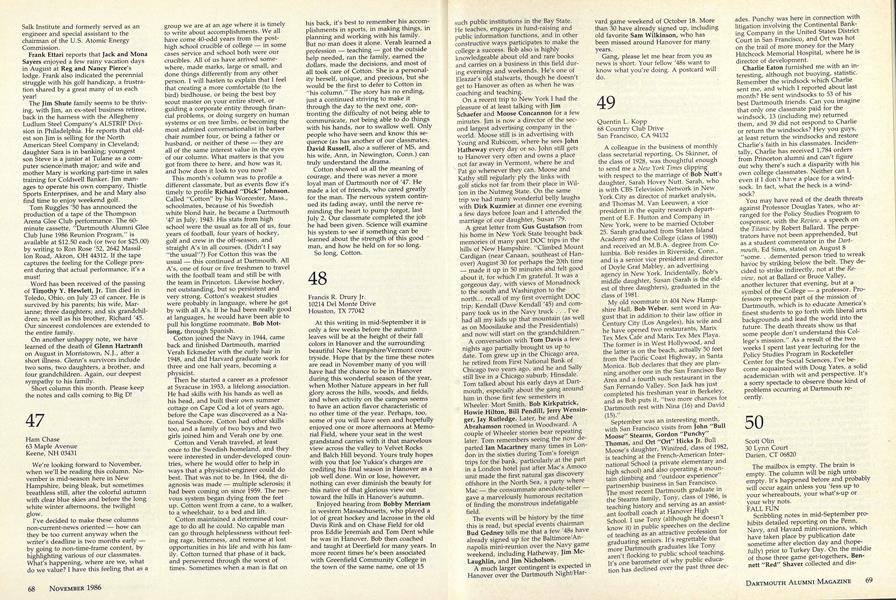
This month's column was to profile a different classmate, but as events flow it's timely to profile Richard "Dick" Johnson. Called "Cotton" by his Worcester, Mass., schoolmates, because of his Swedish white blond hair, he became a Dartmouth '47 in July, 1943. His stats from high school were the usual as for all of us, four years of football, four years of hockey, golf and crew in the off-season, and straight A's in all courses. (Didn't I say "the usual"?) For Cotton this was the usual this continued at Dartmouth. All A's, one of four or five freshmen to travel with the football team and still be with the team in Princeton. Likewise hockey, not outstanding, but so persistent and very strong. Cotton's weakest studies were probably in language, where he got by with all A's. If he had been really good at languages, he would have been able to pull his longtime roommate, Bob Motlong, through Spanish.
Cotton joined the Navy in 1944, came back and finished Dartmouth, married Verah Eckmeder with the curly hair in 1948, and did Harvard graduate work for three and one half years, becoming a physicist.
Then he started a career as a professor at Syracuse in 1953, a lifelong association. He had skills with his hands as well as his head, and built their own summer cottage on Cape Cod a lot of years ago, before the Cape was discovered as a National Seashore. Cotton had other skills too, and a family of two boys and two girls joined him and Verah one by one.
Cotton and Verah traveled, at least once to the Swedish homeland, and they were interested in under-developed countries, where he would offer to help in ways that a physicist-engineer could do best. That was not to be. In 1964, the diagnosis was made multiple sclerosis; it had been coming on since 1959. The nervous system began dying from the feet up. Cotton went from a cane, to a walker, to a wheelchair, to a bed and lift.
Cotton maintained a determined courage to do all he could. No capable man can go through helplessness without feeling rage, bitterness, and remorse at lost opportunities in his life and with his family. Cotton turned that phase of it back, and persevered through the worst of times. Sometimes when a man is flat on his back, it's best to remember his accomplishments in sports, in making things, in planning and working with his family. But no man does it alone. Verah learned a profession teaching got the outside help needed, ran the family, earned the dollars, made the decisions, and most of all took care of Cotton. She is a personality herself, unique, and precious, but she would be the first to defer to Cotton in
"his column." The story has no ending, just a continued striving to make it through the day to the next one, confronting the difficulty of not being able to communicate, not being able to do things with his hands, nor to swallow well. Only people who have seen and know this sequence (as has another of our classmates, David Russell, also a sufferer of MS, and his wife, Ann, in Newington, Conn.) can truly understand the drama.
Cotton showed us all the meaning of courage, and there was never a more loyal man of Dartmouth nor of '47. He made a lot of friends, who cared greatly for the man. The nervous system continued its fading away, until the nerve reminding the heart to pump forgot, last July 2. Our classmate completed the job he had been given. Science will examine his system to see if something can be learned about the strength of this good man, and how he held on for so long.
So long, Cotton.
63 Maple Avenue Keene, NH 03431
More From This Issue
-
 Feature
A Reaffirmation of Mission
November 1986 -
 Feature
How "Eleazar" Pulled It Off
November 1986 -
 Feature
The New England Review and Bread Loaf Quarterly
November 1986 -
 Article
Dartmouth Authors
November 1986 -
 Article
Tony-winner Jerry Zaks '67: "...in the first place"
November 1986 -
 Article
David O. Hooke '84: Chubber's Boswell
November 1986