1993
Ah, remember spring in Hanover, way back when?
Jocelyn Bonnes Bowne and her husband, Frederic, sent news of their soon-to-be-L-yearold son, Frederic Henry, born on July 23 last year.
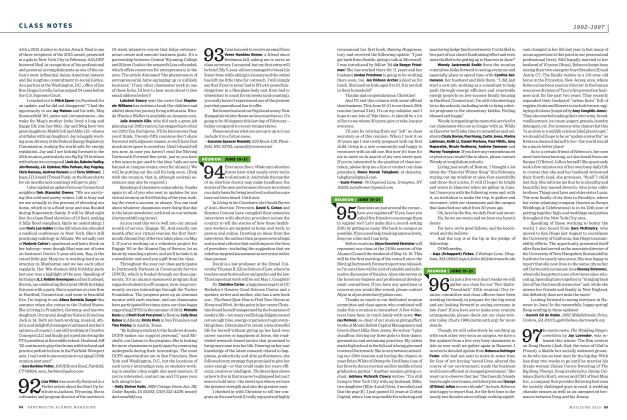
Here I'm going to turn it over to Stephen Leake, who is now back in Atlanta and working as the managing director of a money management and private equity firm called Incentive Capital Management. Stephen spent 15 months in Iraq, primarily in Falluja, as the director of reconstruction for Anbar Province.
"I worked for the government managing the $468 million U.S. reconstruction program for Anbar Province. It's a massive program of infrastructure projects covering all the major categories of public works and government services: power, water, sewage, education, health care, transportation, telecom, public safety and defense.
"I was a civilian U.S. government employee assigned to the Department of the Army. My rank was GS-15, which is the civil service equivalent of a colonel and just below a one-star gen- eral. My headquarters was in Falluja and from there I ran the western third of Iraq.
"The program I managed for Anbar was the regional portion of the larger U.S. program in Iraq, consisting of approximately $7 billion in construction and $6 billion in procurement projects. It was the largest reconstruction initiative since the Marshall Plan. As appropriated dollars, the funds are assigned to specific projects, have strict rules regarding their use (as all appropriated money does) and require highlevel embassy approval to be shifted from one project to another.
"I worked with civil affairs, combat engineers, USACE, State Department as well as frontline combat units (primarily U.S. Marines) on a daily basis to coordinate reconstruction activity and drive the program forward under difficult circumstances.
"Anbar Province is assigned to the U.S. Marines, and I worked very closely with them on a day-to-day basis to drive the reconstruction program. In military parlance, the Marines own the dirt' throughout all of Anbar. I share information and coordinate with the military to keep project work moving because they secure the ground and provide the umbrella of stability and security under which my projects get done. They know that reconstruction is important—a better life for Iraqis means more trust in coalition forces and less violence. Because of this tremendous cooperation from the Marines, contractors are able to work here.
"I've been mortared, rocketed, attacked with IEDs and shot at with small-arms fireup to but just shy of returning fire. Twice I've had rockets land within 12 yards of me, fortunately, on the other side of a structure that absorbed the damage. In the cases where it was appropriate to return fire, we couldn't do so because the enemy retreated and their direction of withdrawal was obscured or too close to noncombatants.
"I've also gone house-to-house conducting clearing operations with the Marines in Falluja using my tactical team experience from the Fulton County Sheriff's Office. Other Marine units were clearing houses and engaging bad guys about 300 meters south of our position. We entered the houses as a team just as SWAT teams do, moving room to room and house to house sweeping away from the job site. We encountered no resistance but found evidence of recent occupancy, including supplies, drug paraphernalia, insurgent literature, non-U.S. shell casings and half-full cups of tea.
"The range of experiences within the same day could be astounding. You ride into town on the way to work like just another Marine rifleman, jump off a Humvee, pull out a laptop, do eight hours of corporate finance/project work, then grab your rifle and jump back on a Humvee at the end of the day for the ride home."
Whatever we all feel about Iraq, it's great to know that guys like Stephen are working hard to make life better. He writes that he's been considering collaborating on a book covering his experiences. I'd love to read more about his work.
33 Johnson Lane, Eliot, ME 03903; chrisonken@hotmail.com