THE NEW SELECTIVE PROCESS
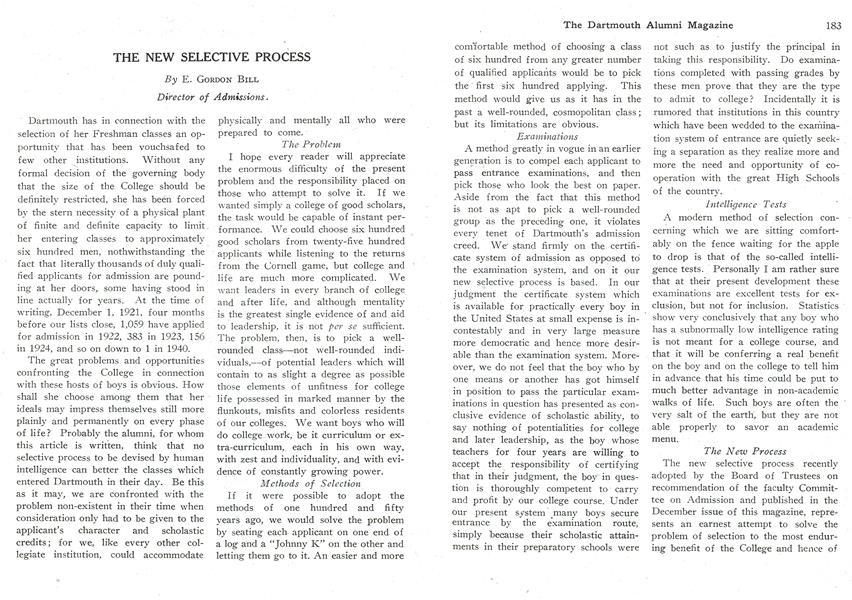
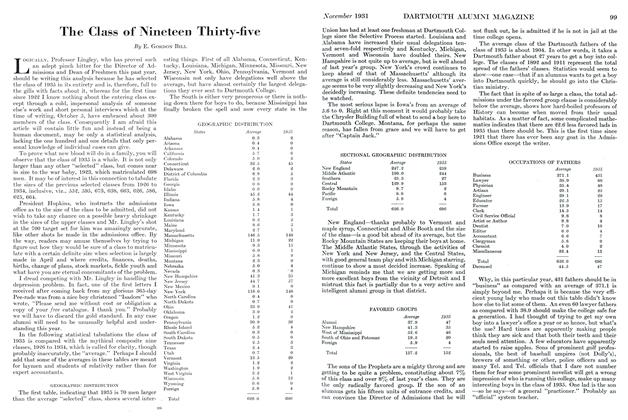
Dartmouth has in connection with the selection of her Freshman classes an opportunity that has been vouchsafed to few other institutions. Without any formal decision of the governing body that the size of the College should be definitely restricted, she has been forced by the stern necessity of a physical plant of finite and definite capacity to limit her entering classes to approximately six hundred men, nothwithstanding the fact that literally thousands of duly qualified applicants for admission are pounding at her doors, some having stood in line actually for years. At the time of writing, December 1, 1921, four months before our lists close, 1,059 have applied for admission in 1922, 383 in 1923, 156 in 1924, and so on down to 1 in 1940.
The great problems and opportunities confronting the College in connection with these hosts of boys is obvious. How shall she choose among them that her ideals may impress themselves still more plainly and permanently on every phase of life? Probably the alumni, for whom this article is written, think that no selective process to be devised by human intelligence can better the classes which entered Dartmouth in their day. Be this as it may, we are confronted with the problem non-existent in their time when consideration only had to be given to the applicant's character and scholastic credits; for we, like every other collegiate institution, could accommodate physically and mentally all who were prepared to come.
The Problem
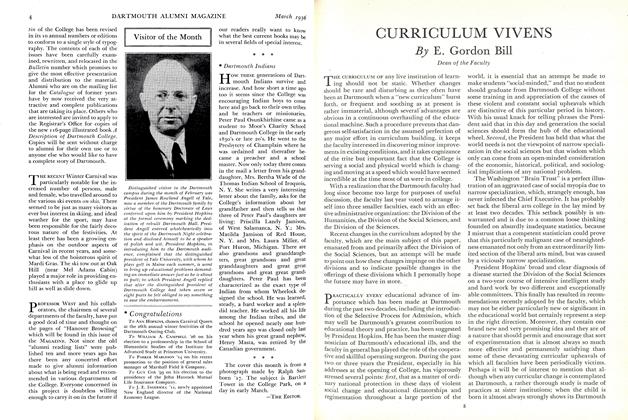
I hope every reader will appreciate the enormous difficulty of the present problem and the responsibility placed on those who attempt to solve it. If we wanted simply a college of good scholars, the task would be capable of instant performance. We could choose six hundred good scholars from twenty-five hundred applicants while listening to the returns from the Cornell game, but college and life are much more complicated. We want leaders in every branch of college and after life, and although mentality is the greatest single evidence of and aid to leadership, it is not per se sufficient. The problem, then, is to pick a wellrounded class—not well-rounded individuals, — of potential leaders which will contain to as slight a degree as possible those elements of unfitness for college life possessed in marked manner by the flunkouts, misfits and colorless residents of our colleges. We want boys who will do college work, be it curriculum or extra-curriculum, each in his own way, with zest and individuality, and with evidence of constantly growing power.
Methods of Selection
If it were possible to adopt the methods of one hundred and fifty years ago, we would solve the problem by seating each applicant on one end of a log and a "Johnny K" on the other and letting them go to it. An easier and more comfortable method of choosing a class of six hundred from any greater number of qualified applicants would be to pick the first six hundred applying. This method would give us as it has in the past a well-rounded, cosmopolitan class; but its limitations are obvious.
Examinations
A method greatly in vogue in an earlier generation is to compel each applicant to pass entrance examinations, and then pick those who look the best on paper. Aside from the fact that this method is not as apt to pick a well-rounded group as the preceding one, it violates every tenet of Dartmouth's admission creed. We' stand firmly on the certificate system of admission as opposed to the examination system, and on it our new selective process is based. In our judgment the certificate system which is available for practically every boy in the United States at small expense is incontestably and in very large measure more democratic and hence more desirable than the examination system. Moreover, we do not feel that the boy who by one means or another has got himself in position to pass the particular examinations in question has presented as conclusive evidence of scholastic ability, to say nothing of potentialities for college and later leadership, as the boy. whose teachers for four years are willing to accept the responsibility of certifying that in their judgment, the boy in question is thoroughly competent to carry and profit by our college course. Under our present system many boys secure entrance by the examination route, simply because their scholastic attainments in their preparatory schools were not such as to justify the principal in taking this responsibility. Do examinations completed with passing grades by these men. prove that they are the type to admit to college? Incidentally it is rumored that institutions in this country which have been wedded to the examination system of entrance are quietly seeking a separation as they realize more and more the need and opportunity of cooperation with the great High Schools of the country.
Intelligence Tests
A modern method of selection concerning which we are sitting comfortably on the fence waiting for the apple to drop is that of the so-called intelligence tests. Personally lam rather sure that at their present development these examinations are excellent tests for exclusion, but not for inclusion. Statistics show very conclusively that any boy who has a subnormally low intelligence rating is not meant for a college course, and that it will be conferring a real benefit on the boy and on the college to tell him in advance that his time could be put to much better advantage in non-academic walks of life. Such boys are often the very salt of the earth, but they are not able properly to savor an academic menu.
The New Process
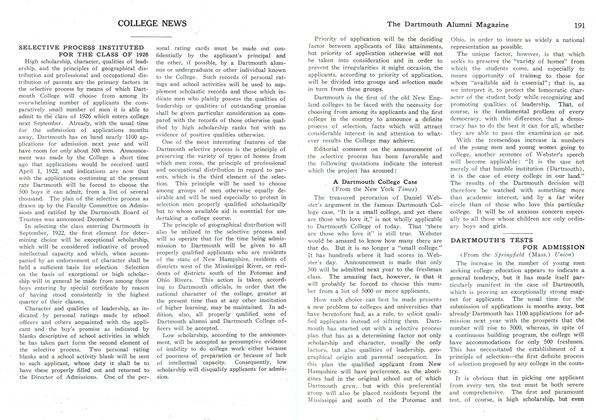
The new selective process recently adopted by the Board of Trustees on recommendation of the faculty Committee on Admission and published in the December issue of this magazine, represents an earnest attempt to solve the problem of selection to the most enduring benefit of the College and hence of the country. Let us analyze briefly the fundamental principles on which it is based.
Scholarship
The first vital premise of the new selective process is that real scholastic attainment in preparatory work is prima facie evidence of potentialities for those qualities of leadership both in undergraduate and after life that the College wishes to develop. It is held moreover that although a man with not only high but exceptional scholarship may possess qualities we do not personally care to emulate, such a man always has it within himself to be an inspiration to the College, to profit enormously by contact with a college faculty and his more likable fellow students, and to bring the most lasting of all renown to his Alma Mater. In this connection the writer is possessed with the feeling that the most striking benefits to the human race have often been performed by scholars who with no time to learn the pleasant amenities of human contacts, have not been known, except to their immediate intimates, to possess many of those personal qualities which tend to popularity as undergraduates and to press notices in later life. So the new process states first definitely and positively that, whenever we can be assured by actual achievement that a boy is possessed of exceptional scholarship, he will be chosen. Secondly, if an applicant be known to have shown even high scholarship, e.g., to rank in the highest quarter of his class, thereby entering by our special certificate without conditions, he will be selected unless he be necessarily excluded because of the selection of some boy of lower scholarship but possessed of exceptional character or other exceptional promise of leadership. Finally, distinctly low scholarship shall exclude men. It invariably means low mentality or superficiality or the possession of qualities which college freedom will only aggravate. Nothing is gained by admitting these men who after a few short moons must return to the tepees of their fathers. A college of Dartmouth's type and aspirations is not meant for them and can do as little for them as they for her.
Character
The next element in the selective process is character as shown by personal ratings of the applicant by those who know him and in whose judgment we place confidence. Information relative to this subtle and complex quality will be obtained confidentially on blanks similar to those perfected and used at Columbia University. The boy will be rated by his school principal and also by some alumnus or undergraduate or other man known both to the boy and to us, as to whether he is markedly, distinctly or doubtfully above or below the average in such qualities as intellectual interest, individuality, native ability, industry and faithfulness, originality, integrity, straight-forwardness, clean-mindedness, fair play, school spirit, interest in fellows, and leadership. These ratings will come to us confidentially and direct and will not be made known to the applicant. The value of this information will depend entirely on the conscientious integrity of the man who gives it and the alumni have here a golden opportunity to do their college another great benefit by realizing the responsibility and consequent opportunity the filling out of these personal rating blanks places upon them.
Promise
The alumni will be glad to know that we are still convinced of the value to the College of a fair sized sprinkling of those boys who have shown actual leadership in various lines of extra-curriculum activity. To obtain the information we desire about such matters each applicant will submit personally a blank enumerating such school and outside activities as school publications, musical and other organizations, athletics, debating, offices, prizes and honors, remunerative employment or work for parents, religious and other organizations, and outside reading. These records will often discover to us a boy possessing just the leavening qualities we want in college, a boy not necessarily a ranking scholar, but a leader among his compeers.
Priority
Priority of application which in the past has been up to a certain point logically the all-conquering element, will still count, in that if one only of two boys of apparently equal merit may be chosen, that one will be he who applied first. The net list of bona fide applicants on April 1, when our list will, be closed, will be divided into suitable groups, perhaps two hundred each, chosen according to priority of application. Selection will then be made from these in turn. Thus, although priority of application will never of itself necessitate a boy's selection, it will always be an important asset to him.
Social
The principle of occupational distribution of parents will operate in connection with selection. Dartmouth believes that it is desirable from every viewpoint that the student body shall represent a social cross-section of the country. This Can be accomplished with some degree of accuracy by the use of the principle of occupational distribution. As the Trustees have phrased it, the new selective process shall contain "the principle of preserving the variety of types of homes from which men come by attention to professional and occupational distribution in regard to parents." Thus if ten men are to be chosen from fifty otherwise equally desirable applicants, we would select so as to insure as many walks in life as possible.
Geographical
The larger our clientele has become, the more convinced we have been of the worth of boys who are willing to travel great distances to attend college among the New Hampshire hills and who are often spirit kinsmen of Eleazar Wheelock. So the principle of geographical distribution will be , used in making selection. In particular, for the time being, all properly qualified boys who apply before April 1 from west of the Mississippi or from south of the Potomac and Ohio Rivers will be admitted. It is unnecessary to add that we do not forget that Dartmouth is situated in New Hampshire and bound to that State by pleasant historical bonds since the days of Governor John Wentworth, and that hence all New Hampshire boys who meet our formal requirements will be chosen.
Sons of Dartmouth
It is needless to say, moreover, that the I rustees are neither unaware of the quality and potency of the established blood lines of the College nor unmindful of the debt the College owes her alumni. So long as there is no danger from inbreeding and so long as her alumni do not become too prolific, the properly qualified sons of Dartmouth alumni and Dartmouth College officers will be admitted with open arms. Incidentally why not offer a cup at Commencement to the class having the most boys in the graduating class?
Rooms
Finally a necessary consequence of the basic principles of the new process is that the entire class entering must be chosen in advance, (in April), according to the general principles outlined above, and that no one will be admitted at that time or later simply because he has obtained rooming accommodations in town. The old practice of admitting any formally qualified boy who had a room was unfair both to boys who had no opportunity to obtain such accommodations and particularly to the College, as it meant very often that applicants with the very minimum qualifications could be got in by interested parties who would obtain rooms for them, whilst hundreds of high-class boys had long since been told that our lists had been closed by reason of lack of accommodations. Obviously the new selective process which at least sets the ideal of selecting boys by merit, could not tolerate the triumph of bedrooms over attainments.
So finally, our confession of admission faith is something like this: We wish to select men capable of development in qualities of leadership; we believe in the certificate system of admission because it rests on a knowledge of the boy, because it is available for every boy at small expense, and because we are proud of the fact that our present freshman class of 600 has representatives of three hundred and fifteen different secondary schools; we believe high scholarship is the greatest single evidence of capacity for leadership; we want boys of character and promise even if their scholarship is not exceptionally high; and finally we want to keep Dartmouth a college national both in its geographical and social distribution of students.
With the above explanations, it is hoped that the great ideals of the future of the College which we hope to approximate by the new selective process, will be clearly defined to the alumni whose help and inspiration we confidently expect in the administration of this new selective venture.
E. GORDON BILL Director of Admissions.
More From This Issue
-
 Article
The question raised by Mr. Keyes' recent article in the Boston
January 1922 -
 Article
THE COLLEGE AND THE CHURCH
January 1922 -
 Article
PURE DEMOCRACY AND THE COLLEGES
January 1922 -
 Sports
FOOTBALL
January 1922 -
 Class Notes
CLASS OF 1911
January 1922 -
 Article
SELECTIVE PROCESS INSTITUTED FOR THE CLASS OF 1926
January 1922