1925
By the time this is read, a full month after its writing, the days will be drawing out again, and perhaps a few of you will have emerged from post-holiday lassitude with a brief note, wherewith to amplify and justify this column. Meanwhile, space permitting and because some of you may have missed it, there follows in abstract a note that appeared in the December Roundup.
The members of the executive committee, at their November meeting, agreed that it was a legitimate interest of the Class to concern itself with any of its members who had run into misfortune, and who were willing to discuss their problems with friends who might help them to help themselves. It was also agreed that such discussions should never be begun except at the express request of the individual concerned, and should, of course, be conducted in strict confidence. But it was hoped that such requests might be made without embarrassment and with the certain knowledge that they would be met not as an obligation but as a privilege. And it was further agreed that the secretary be authorized - act as the agent through whom such contacts might be arranged, and that he might properly offer his services in this capacity when such situations came to his attention, doing nothing further until and unless the offer were accepted.
The next item, also byway of repetition, is a last-minute reminder of the annual Parents Sons reunion on February 18 and 19, details of which appeared in the December Roundup and in the January issue of this MAGAZINE.
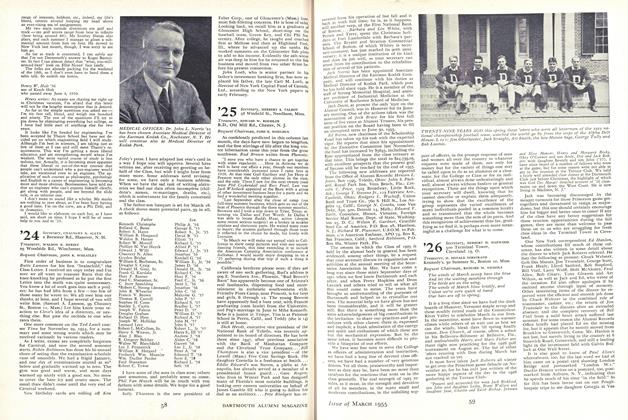
Jim Martin started the New Year right with a very welcome letter dated January 2. He reports that, having lived in Phoenix for ten years, Kit is healthier and lovelier than ever. Their two older sons, Jim Jr. and Bill, have completed their hitches in the Navy, and Paul is a junior in high school. Jim is chief engineer for the J. R. Porter Construction Co. and was in charge of a recent undertaking which was probably a record of its kind, pouring a single block of concrete 60 by 200 feet and weighing 750 tons, and lifting it into place as the roof slab for the new office of the Farm and Home Insurance Co. in Phoenix. The snapshot on the next page shows Jim watching with understandable interest as the lifting began. Apparently it might have stuck, but it didn't.
Ken Sullivan has been elected treasurer of the Phoenix Mutual Life Insurance Co. of Hartford, with which he has been associated since 1931. Ken and Rosaline live at 221 Tunxis Road, West Hartford, and have two daughters, Sally Vincent, 16, and Elizabeth Dean, 14.
Continuing with the insurance business, Judd and Parsons and Parker, of Springfield, Mass., of which Bob Palmer is now sole owner, is about to merge with the Kinney Insurance Agency, bringing together two of the oldest agencies in western Massachusetts. Bob came to his concern, which was founded in 1871, in 1926; became a partner in 1931, and the top man in 1941. He is active also in many community enterprises.
Jock Brace is a principal participant in a series of seminars, the "Citizens Seminars on the Fiscal, Economic, and Political Problems of Boston," being conducted by the college of business administration of Boston College. Alex Laing's new novel Jonathan Eagle is on the press and should be out soon. It deals with the period of the Alien and Sedition Acts.... Recently registered at the Hanover Inn were George Scott and George Sprague.
The decision of the executive committee to recommend specific and immediate action toward securing funds for increases in faculty salaries, as published here in December, was promptly followed by an announcement that blanket increases of $1000 were to be granted next year to professors and associate professors on tenure - at Princeton. Almost simultaneously, the General Electric Company announced its "Corporate Alumnus Program" under which it will match, up to $1000, any gift made this year by one of its employees to the college from which he graduated. Two things are .now certain: first, that Dartmouth and other colleges must soon follow Princeton in trying to provide for their teachers the dignity and security of adequate compensation, and second, that other great corporations will follow General Electric in the effort to keep our institutions of higher learning strong and independent. Nor is this merely a reflection of their need for technically trained personnel, for the General Electric announcement pointedly mentions that, although more than 70% of its college people have technical or engineering degrees, yet in most recent years close to 45% of those hired have been non-technical.
In The New York Times Book Review recently, there was a quotation from Many aGood Crusade by Barnard's great dean, Virginia Gildersleeve, that probably describes as well as any few words could the type of people the country now needs:
"The ability to think straight, some knowledge of the past, some vision of the future, some skill to do useful service, some urge to fit that service into the well-being of the community - these are the most vital things education must try to produce. If we can achieve them in the citizens of our land, then, given the right to knowledge and the free use thereof, we shall have brought to America the wisdom and the courage to match her destiny."
By a curious coincidence (or was it?), the announcement of the General Electric program appeared as a two-page advertisement in the January Atlantic Monthly in which, a few pages farther on, was printed an ardent defence of academic freedom and a call to action against its enemies by Harvard's Zechariah Chafee Jr. Both are well worth careful reading, and their juxtaposition is of particular interest. For the rules governing the Corporate Alumnus Program make no mention of discrimination of any sort regarding the receiving institutions, nor of any passing of judgment as to their eligibility or worthiness. The forward-looking men behind it are apparently prepared to agree with Professor Chafee that, "We need to make our fellow citizens realize that freedom is not safety, but opportunity."
All of this is scarcely to be classified as news about 1925, which is, unhappily, a scarce commodity at the moment. But surely it is news of interest to 1925, and especially because of the activity of one of our own classmates in stimulating this notion of corporate giving. A few years ago, Milt Emerson, who was then Class Agent, worked long and hard to promulgate this then still novel idea. His success is to be measured not in the sums he collected, although they were not negligible, but in his zealous development of the concept which, while not his alone, owes much to his intelligent and energetic evaluation. It has snowballed since then and we may hope it will continue to do so, and others have amplified it and spread it into echelons of resources beyond his modest reach, for an enterprise like this may seem so logical and grow so fast that we forget how recently and familiarly it began. But Milt was one of the pioneers, for which he may take credit and we may be proud.
FOR OUTSTANDING SERVICE: Lt. Col.Morris Fiterman '24 (I) recently received anOak Leaf Cluster to his Bronze Star medal formeritorious service with the 3d Medical Battalion, 3d Infantry Division, in Korea, fromCol. Henry A halt, Regional Camp CrawfordCommander in Japan.
Secretary, 58 Winfield St., Needham, Mass.
Treasurer, R.D., Old Mill Rd., Chester, N. J.
Bequest Chairman,