1963
We open this month with an item that should make everyone feel appropriately mature, if not downright old. Steve Swirsky's oldest son Seth (or at least I hope it's his oldest son) has matriculated as a member of the Class of 1982. Seth is, as nearly as I can tell, the first son or daughter of a member of the Class to enter the College - but presumably not the last.
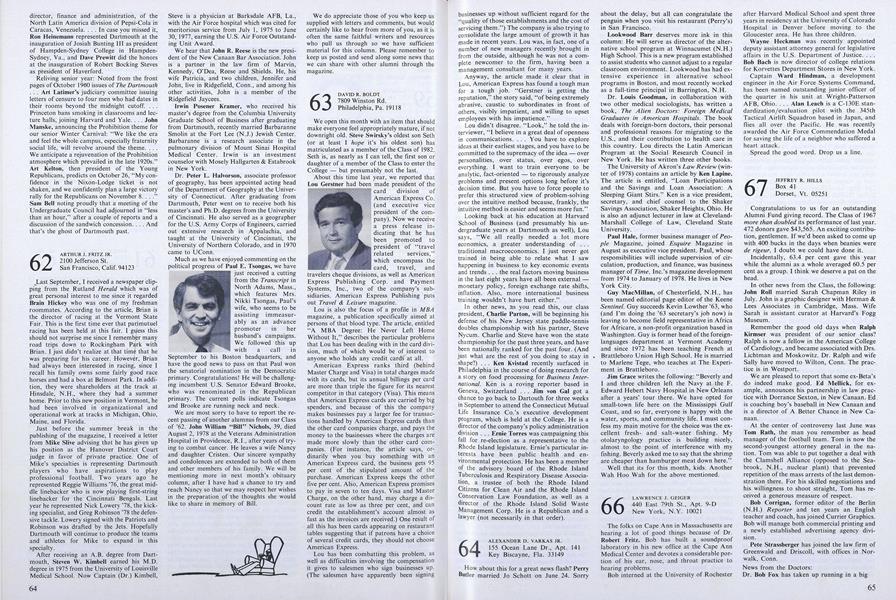
About this time last year, we reported that Lou Gerstner had been made president of the card division of American Express Co. (and executive vice president of the company). Now we receive a press release indicating that he has been promoted to president of "travel related services," which encompass the card, travel, and travelers cheque divisions, as well as American Express Publishing Corp. and Payment Systems, Inc., two of the company's subsidiaries. American Express Publishing puts out Travel & Leisure magazine.
Lou is also the focus of a profile in MBA magazine, a publication specifically aimed at persons of that blood type. The article, entitled "A MBA Degree: He Never Left Home Without It," describes the particular problems that Lou has been dealing with in the card division, much of which would be of interest to anyone who holds any credit cards at all.
American Express ranks third (behind Master Charge and Visa) in total charges made with its cards, but its annual billings per card are more than triple the figure for its nearest competitor in that category (Visa). This means that American Express cards are carried by big spenders, and because of this the company makes businesses pay a larger fee for transactions handled by American Express cards than the other card companies charge, and pays the money to the businesses where the charges are made more slowly than the other card companies. (For instance, the article says, ordinarily when you buy something with an American Express card, the business gets 95 per cent of the stipulated amount of the purchase. American Express keeps the other five per cent. Also, American Express promises to pay in seven to ten days. Visa and Master Charge, on the other hand, may charge a discount rate as low as three per cent, and can credit the establishment's account almost as fast as the invoices are received.) One result of all this has been cards appearing on restaurant tables suggesting that if patrons have a choice of several credit cards, they should not choose American Express.
Lou has been combatting this problem, as well as difficulties involving the compensation it gives to salesmen who sign businesses up. (The salesmen have apparently been signing businesses up without sufficient regard for the "quality of those establishments and the cost of servicing them.") The company is also trying to consolidate the large amount of growth it has made in recent years. Lou was, in fact, one of a number of new managers recently brought in from the outside, although he was not a com- plete newcomer to the firm, having been a management consultant for many years.
Anyway, the article made it clear that in Lou, American Express has found a tough man for a tough job. "Gerstner is getting the reputation," the story said, "of being extremely abrasive, caustic to subordinates in front of others, visibly impatient, and willing to upset employees with his impatience."
Lou didn't disagree. "Look," he told the interviewer, "I believe in a great deal of openness in communications. ... You have to explore ideas at their earliest stages, and you have to be committed to the supremacy of the idea — over personalities, over status, over egos, over everything. I want to train everyone to be analytic, fact-oriented — to rigorously analyze problems and present options long before it's decision time. But you have to force people to prefer this structured view of problem-solving over the intuitive method because, frankly, the intuitive method is easier and seems more fun."
Looking back at his education at Harvard School of Business (and presumably his undergraduate years at Dartmouth as well), Lou says, "We all really needed a lot more economics, a greater understanding of ... traditional macroeconomics. I just never got trained in being able to relate what I saw happening in business to key economic events and trends ... the real factors moving business in the last eight years have all been external — monetary policy, foreign exchange rate shifts, inflation. Also, more international business training wouldn't have hurt either."
In other news, as you read this, our class president, Charlie Parton, will be beginning his defense of his New Jersey state paddle-tennis doubles championship with his partner, Steve Nycum. Charlie and Steve have won the state championship for the past three years, and have been nationally, ranked for the past four. (And just what are the rest of you doing to stay in , shape?) ... Ken Kvistad recently surfaced in Philadelphia in the course of doing research for a story on food processing for Business International. Ken is a roving reporter based in Geneva, Switzerland ... Jim von Gal got a chance to go back to Dartouth for three weeks in September to attend the Connecticut Mutual Life Insurance Co.'s executive development program, which is held at the College. He is a director of the company's policy administration division ... Ernie Torres was campaigning this fall for re-election as a representative to the Rhode Island legislature. Ernie's particular interests have been public health and environmental protection. He has been a member of the advisory board of the Rhode Island Tuberculosis and Respiratory Disease Association, a trustee of both the Rhode Island Citizens for Clean Air and the Rhode Island Conservation Law Foundation, as well as a director of the Rhode Island Solid Waste Management Corp. He is a Republican and a lawyer (not necessarily in that order).
7809 Winston Rd. Philadelphia, Pa. 19118