1940
Isn't it amazing how 800 people can affect one's life, especially if the people are football players who are striking their management? I am keenly aware of how something just over half that number affects my life because I try to write about them each month. This month, however, I find myself enjoying the luxury of plinking at the keys days in advance of the MAGAZINE'S deadline instead of making my usual frenzied, last-minute dash to ready the column for mailing to Hanover. I happen to enjoy watching a well-played pro football game; however, until play resumes, I can feel almost human on Tuesday mornings, and Sundays are directed to more meaningful pursuits.
As reported several weeks ago in the "Indian Drum," Bill Mercer has retired as chairman of the board and chief executive officer of New England Telephone, ending a career that began with Western Electric 35 years ago. On the 31st of last month, Bill turned the reins of management over to his successor, to begin his self-initiated retirement 14 months before the company's mandatory retirement age. Commenting on the subject, he said, "It is advantageous for the company that the person who will lead New England Telephone after divestiture be in place now," and he anticipated that this continuity of leadership before and after divestiture will enhance the company's future viability and growth. In retirement, Bill will not be wanting for things to do, being a member of the board of overseers, a director, or a trustee for no fewer than four colleges (Tuck School included), an insurance company, banks, museums, hospitals, and civic organizations. A big "Wah-Hoo-Wah," Bill, for the past accomplishments. Surely the future holds many fresh challenges for you.
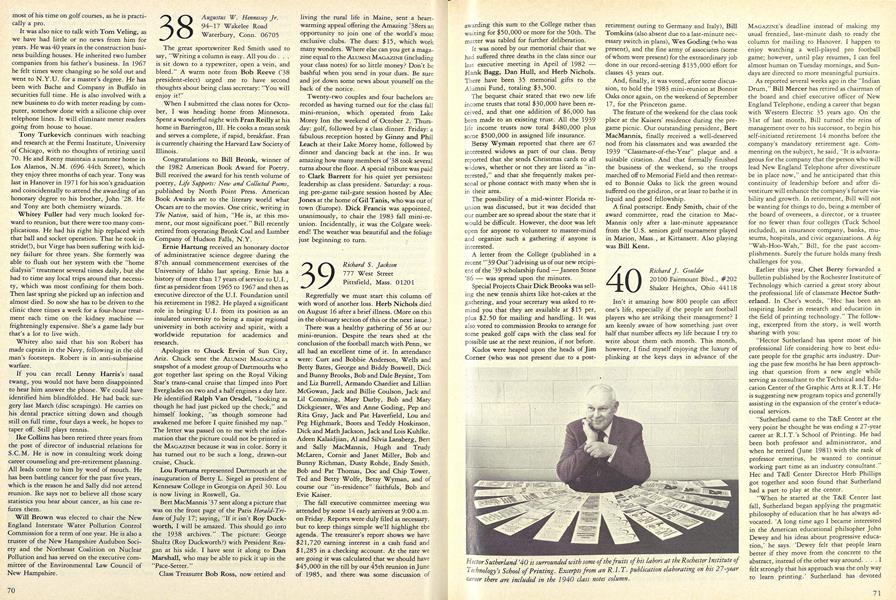
Earlier this year, Chet Berry forwarded a bulletin published by the Rochester Institute of Technology which carried a great story about the professional life of classmate Hector Sutherland. In Chet's words, "Hec has been an inspiring leader in research and education in the field of printing technology." The following, excerpted from the story, is well worth sharing with you:
"Hector Sutherland has spent most of his professional life considering how to best educate people for the graphic arts industry. During the past few months he has been approaching that question from a new angle while serving as consultant to the Technical and Education Center of the Graphic Arts at R.I.T. He is suggesting new program topics and generally assisting in the expansion of the center's educational services.
"Sutherland came to the T&E Center at the very point he thought he was ending a 27-year career at R.l.T.'s School of Printing. He had been both professor and administrator, and when he retired (June 1981) with the rank of professor emeritus, he wanted to continue working part time as an industry consultant." Hec and T&E Center Director Herb Phillips got together and soon found that Sutherland had a part to play at the center.
"When he started at the T&E Center last fall, Sutherland began applying the pragmatic philosophy of education that he has always advocated. 'A long time ago I became interested in the American educational philsopher John Dewey and his ideas about progressive education,' he says. 'Dewey felt that people learn better if they move from the concrete to the abstract, instead of the other way around....I felt strongly that his approach was the only way to learn printing.' Sutherland has devoted much of his career to promoting Dewey's ideas, which he finds well suited to the philosophy of R.l.T.'s School of Printing."
Hec earned his B.A. at Dartmouth with a major in history. "Later he received an M.A. in vocational education from N.Y.U. His teaching career started at the same junior high where he had firs become excited about printing. He taught there for four years, served four years in the military during World War II, and taught printing for six years at West Virginia Tech.
"In 1954 Sutherland came to R.I.T.'s School of Printing. Because of a faculty shortage, he taught everything from labor relations to newspaper production. He became assistant administrator of the program and worked on scheduling, records, and job placement for students. He stressed the importance of the school's laboratories and the primacy of hands-on work.
"When the director of the printing school retired, Sutherland was appointed director, a position he held for six years, and then went back to teaching. 'I've always enjoyed teaching more than administration,' he says. 'But being the director gave me concrete experience I needed to teach industrial relations, my favorite course.'
Hec and wife Martha Jane live in Pittsford, N.Y. Son James is an advertising account executive in Rochester; daughter Janet lives in Connecticut, is in the banking business, and is mother of the Sutherlands' granddaughter. Winter activities include the Rochester Curling Club, both on the ice and in organizing "spiels" (meets, I am told). They also do some cross-country skiing. Summer finds their activities centered around their cottage in the Thousand Island area of the St. Lawrence River. They have traveled extensively in the U.S.A., Canada, and Europe and anticipate more of the same in the future only at a more leisurely, pace. Martha Jane and Hec plan to maintain their home base in the Rochester area, where their roots are deep and they're among friends.
20100 Fairmount Blvd., #202 Shaker Heights, Ohio 44118