1947
63 Maple Avenue Keene, NH 03431
April in Hanover is springing to life this yearv as for so many years gone by, over 200 of them. A trio of new dorms has risen since last spring, and across the street, a new athletic center has taken shape over the space which was Davis Rink and tennis courts. You'll all be able to see these in June as we convene for our 40th Class Reunion.
Even with all the new buildings since our own day, I'm sure we'll all have no problem recollecting many familiar landmarks.
One such would be the dorms Topliff and New Hampshire. They appear about the same from the street, but change is evident from the rear, as social rooms with kitchen facilities, a reading room, and a sunny patio have tied these dorms together in a cluster. Our class shares in this improvement to student life, as we voted in 1985 to fund a variety of social programs from music to food, from art to discussion. This has been our way to continue involvement in Dartmouth today. Spearheaded by President Townes Harris and your executive board, and watched over and guided by VP Don Evans over the past two years, the program has indeed brought many of our class into closer contact with today's students. The students seem to like it, too.
But for new building accomplishments, it would be hard for any institution to match the Hopkins 1923-30 era (as described in Hopkins of Dartmouth by Charles Widmayer), which saw the construction of Baker Library; Sanborn House; Carpenter Fine Arts Building; residence halls Gile, Streeter, Lord, Ripley, Woodward, Smith, and Russell Sage; Dick's House Infirmary; the President's House; and Memorial Field - in all 18 buildings in seven years, 12 of them built with funds given by alumni and friends of the College. The Davis Rink and Varsity Field House came in that time also. The chapter makes fascinating reading.
The best example of what Mr. Hopkins could do was the story of Mr. Baker asking the president what Dartmouth College could do with $25,000. "Not much." was the reply. Mr. Baker was surprised, and expressed the thought that he felt anyone could use $25,000. "Yes, they could," Mr. Hopkins replied, "but that wouldn't provide the sort of memorial that would be worthy of your uncle, or you." The following day, the story goes, Mr. Baker sent Dartmouth College a check for $100,000.
President Hopkins was unafraid of, in fact, relished, opportunities to speak his feelings, especially on education. He became the most-often quoted of college presidents, and was known as the best spokesman for a liberal education.
He took an early stand in opposition to Prohibition.
He said in a major speech in Chicago that "the College must be ever watchful that it stand for freedom of thought - and freedom of speech." He added that if Lenin or Trotsky were available he would be glad to have them come and speak to Dartmouth students. What a ruckus followed that, but he stuck to his guns.
President Hopkins took the lead in transforming and strengthening the relationship of the alumni body to the College. He once remarked that if he were given a choice of one million dollars in endowment or an alumni body keenly interested in education, he would choose the latter, because such support in the long run would become a living endowment.
On the question of athletics, he expressed the College's genuine interest in intercollegiate athletics, but said he "would never lift a finger to help a man into Dartmouth solely for his athletic ability." We will compete, we wrote, "on the basis of our teams being made up of Dartmouth men incidentally in athletics,rather than athletes incidentally being in Dartmouth College."
And he sought with equal fervor to depart from the typical Ivy admission standards based purely on scholastic scores. He resisted faculty control over admissions and he himself defined the new Selective Process for Admission: "The
College unreservedly holds that definite evidence of intellectual capacity is indispensable, but it believes that, after such evidence is established, positive qualities of character, wide range of interests and capable performance in school activities should operate as determining factors in selection."
This selective process, after initial attack, had a profound effect on other Ivy schools and came to be adopted broadly.
The flavor of President Hopkins character is best brought out in a chapter called "Dartmouth Personified." This charismatic leader had changed the educational thinking of a nation of higher institutions and carried Dartmouth to the heights of pre-eminence among sister colleges. This was about where we came in, the summer. of 1943, and thereafter.
It's hard to grasp any more than a glimpse of the book in an 800-word column, but I can recommend it for your reading. It gives me the feeling we've been led to the edge of another great era in our history. The wisdom of the search committee is vital, and our own participation most necessary.
Meanwhile, we have a reunion date this June. See you in two months.
Director of Alumni Affairs Michael Choukas Jr. '54, far left, looks on as Vermont Academy Directorof Development Peter Riegelman and Headmaster Robert Long unveil the plaque designating theVermont Academy hockey rink as the Michael Choukas Jr. Skating Rink. Choukas is an alumnus ofthe Academy, taught and coached there, and served as headmaster from 1966 to 1977, when he joinedthe Dartmouth staff.
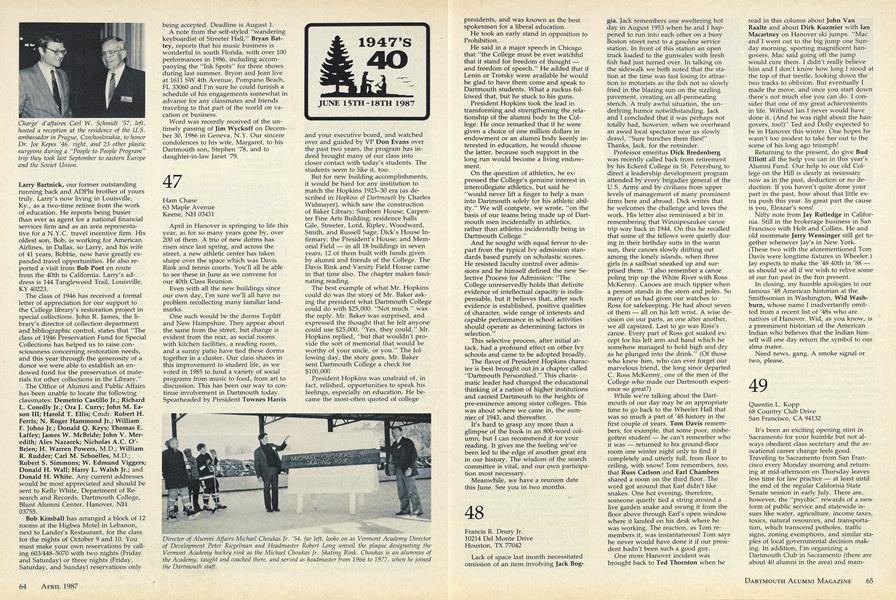
1947'S 40 JUNE 15TH-18TH 1987
More From This Issue
-
 Feature
For the Love of Dal Bat
April 1987 -
 Cover Story
Should The College Change Its Tune?
April 1987 -
 Feature
Wish You Were Here
April 1987 -
 Feature
The Debate Over Safe Sex Lands Dartmouth on "Donahue"
April 1987 -
 Cover Story
ALL TOGETHER NOW ...
April 1987 -
 Article
Robert Kaiser '39: Economic expertise is his planned gift to Dartmouth
April 1987