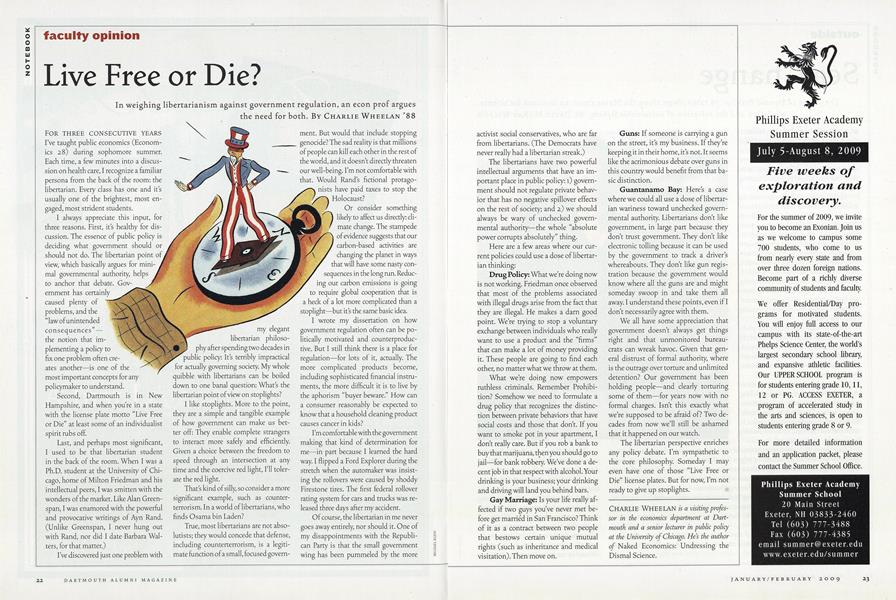
Live Free or Die?
In weighing libertarianism against government regulation, an econ prof argues the need for both.
In weighing libertarianism against government regulation, an econ prof argues the need for both.
In weighing libertarianism against government regulation, an econ prof argues the need for both.
FOR THREE CONSECUTIVE YEARS I've taught public economics (Economics 28) during sophomore summer. Each time, a few minutes into a discussion on health care, I recognize a familiar persona from the back of the room: the libertarian. Every class has one and it's usually one of the brightest, most engaged, most strident students.
I always appreciate this input, for three reasons. First, it's healthy for discussion. The essence of public policy is deciding what government should or should not do. The libertarian point of view, which basically argues for minimal governmental authority, helps to anchor that debate. Government has certainly caused plenty of problems, and the "law of unintended consequences" the notion that implementing a policy to fix one problem often creates another—is one of the most important concepts for any policymaker to understand.
Second, Dartmouth is in New Hampshire, and when you're in a state with the license plate motto "Live Free or Die" at least some of an individualist spirit rubs off.
Last, and perhaps most significant, I used to be that libertarian student in the back of the room. When I was a Ph.D. student at the University of Chicago, home of Milton Friedman and his intellectual peers, I was smitten with the wonders of the market. Like Alan Greenspan, I was enamored with the powerful and provocative writings of Ayn Rand. (Unlike Greenspan, I never hung out with Rand, nor did I date Barbara Walters, for that matter.)
my elegant libertarian philosophy after spending two decades in public policy: It's terribly impractical for actually governing society My whole quibble with libertarians can be boiled down to one banal question: What's the libertarian point of view on stoplights? I've discovered just one problem with
I like stoplights. More to the point, they are a simple and tangible example of how government can make us better off: They enable complete strangers to interact more safely and efficiently. Given a choice between the freedom to speed through an intersection at any time and the coercive red light, I'll tolerate the red light.
That's kind of silly, so consider a more significant example, such as counterterrorism. In a world of libertarians, who finds Osama bin Laden?
True, most libertarians are not absolutists; they would concede that defense, including counterterrorism, is a legitimate function of a small, focused government. But would that include stopping genocide? The sad reality is that millions of people can kill each other in the rest of the world, and it doesn't directly threaten our well-being. I'm not comfortable with that. Would Rand's fictional protagonists have paid taxes to stop the Holocaust?
Or consider something likely to affect us directly: climate change. The stampede of evidence suggests that our carbon-based activities are changing the planet in ways that will have some nasty consequences in the long run. Reducing our carbon emissions is going to require global cooperation that is a heck of a lot more complicated than a stoplight—but it's the same basic idea.
I wrote my dissertation on how government regulation often can be politically motivated and counterproductive. But I still think there is a place for regulation—for lots of it, actually. The more complicated products become, including sophisticated financial instruments, the more difficult it is to live by the aphorism "buyer beware." How can a consumer reasonably be expected to know that a household cleaning product causes cancer in kids?
I'm comfortable with the government making that kind of determination for me—in part because I learned the hard way. I flipped a Ford Explorer during the stretch when the automaker was insisting the rollovers were caused by shoddy Firestone tires. The first federal rollover rating system for cars and trucks was released three days after my accident.
Of course, the libertarian in me never goes away entirely, nor should it. One of my disappointments with the Republican Party is that the small government wing has been pummeled by the more activist social conservatives, who are far from libertarians. (The Democrats have never really had a libertarian streak.)
The libertarians have two powerful intellectual arguments that have an important place in public policy: 1) government should not regulate private behavior that has no negative spillover effects on the rest of society; and 2) we should always be wary of unchecked governmental authority—the whole "absolute power corrupts absolutely" thing.
Here are a few areas where our current policies could use a dose of libertarian thinking:
Drug Policy: What we're doing now is not working. Friedman once observed that most of the problems associated with illegal drugs arise from the fact that they are illegal. He makes a darn good point. We're trying to stop a voluntary exchange between individuals who really want to use a product and the "firms" that can make a lot of money providing it. These people are going to find each other, no matter what we throw at them.
What we're doing now empowers ruthless criminals. Remember Prohibition? Somehow we need to formulate a drug policy that recognizes the distinction between private behaviors that have social costs and those that don't. If you want to smoke pot in your apartment, I don't really care. But if you rob a bank to buy that marijuana, then you should go to jail—for bank robbery. We've done a decent job in that respect with alcohol. Your drinking is your business; your drinking and driving will land you behind bars.
Gay Marriage: Is your life really affected if two guys you've never met before get married in San Francisco? Think of it as a contract between two people that bestows certain unique mutual rights (such as inheritance and medical visitation). Then move on.
Guns: If someone is carrying a gun on the street, it's my business. If they're keeping it in their home, it's not. It seems like the acrimonious debate over guns in this country would benefit from that basic distinction.
Guantanamo Bay: Here's a case where we could all use a dose of libertarian wariness toward unchecked governmental authority. Libertarians don't like government, in large part because they don't trust government. They don't like electronic tolling because it can be used by the government to track a driver's whereabouts. They don't like gun registration because the government would know where all the guns are and might someday swoop in and take them all away. I understand these points, even if I don't necessarily agree with them.
We all have some appreciation that government doesn't always get things right and that unmonitored bureaucrats can wreak havoc. Given that general distrust of formal authority, where is the outrage over torture and unlimited detention? Our government has been holding people—and clearly torturing some of them—for years now with no formal charges. Isn't this exactly what we're supposed to be afraid of? Two decades from now we'll still be ashamed that it happened on our watch.
The libertarian perspective enriches any policy debate. I'm sympathetic to the core philosophy. Someday I may even have one of those "Live Free or Die" license plates. But for now, I'm not ready to give up stoplights.
CHARLIE WHEELAN is a visiting profes-sor in the economics department at Dart-mouth and a senior lecturer in public policyat the University of Chicago. He's the authorof Naked Economics: Undressing the Dismal Science.
More From This Issue
-
 Cover Story
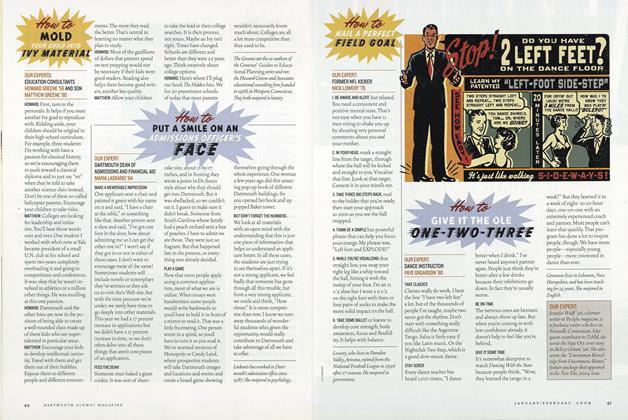
HOW TO PUT A SMILE ON AN ADMISSIONS OFFICER'S FACE
January | February 2009 -
 Cover Story
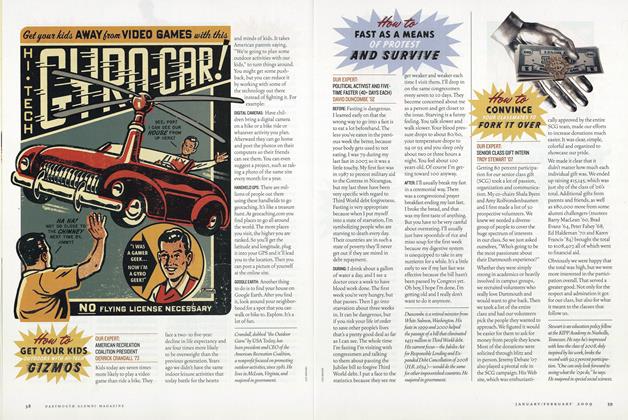
HOW TO FAST AS A MEANS OF PROTEST AND SURVIVE
January | February 2009 -
 Cover Story
HOW TO LIVE A MORE MEANINGFUL LIFE AND DIE HAPPY
January | February 2009 -
 Cover Story
HOW TO RAISE HAPPY KIDS
January | February 2009 -
 Cover Story
HOW TO PREPARE CREDIBLE INTELLIGENCE
January | February 2009 -
 Cover Story
HOW TO SAVE CAPITALISM AND PREVENT THE DOWNFALL OF DEMOCRACY
January | February 2009
FACULTY OPINION
-
 FACULTY OPINION
Train The Brain
NOVEMBER | DECEMBER 2015 -
 FACULTY OPINION
The Perils of Innovation
Nov/Dec 2010 -
 FACULTY OPINION
Eggheads vs. Meatheads?
Nov/Dec 2005 -
 FACULTY OPINION
Slow Medicine
May/June 2009 -
 FACULTY OPINION
Speaking in Tongues
May/June 2006 -
 Faculty Opinion
Water Under Fire
July/August 2001

