1909
He Put "Umph" Into Wrestling
Among sports fans in general Gus Sonenberg '20 is best known, most likely, as the guy who put new life into the wrestling game, one of the oldest sports known to man. In Dartmouth circles Gus was known as a star tackle before and just after World War I during which conflict he served in the Navy. Only 5 feet 7 in height, his weight was around 200 pounds. He was extremely agile and his muscular strength was out of all proportion to his size. It was said of him that one of his tackling tactics was to run full speed into a ball carrier. That was as far as the lad with the pigskin got. On defense, nobody ever gained through Gus. Bill Cunningham '19, who played center on teams with Gus and who was line-backer behind Gus on defense, said he had about the softest job on the team.
Gus, who hailed from Marquette, Mich., was only 17 when he entered Dartmouth. After the war, he left before getting his degree, but he later studied at the University of Detroit during his spare time, acquired a degree, and taught in Detroit high schools. On the side he played professional football, later becoming a member of the "Steam Rollers" in Providence. It was only by accident that he entered into professional wrestling. The circumstances he explained to Bob Jackson '00 at a luncheon in Bob's Concord, N. H., home. At that time he was holder of the mythical title of World Heavyweight Champion, having tied it down in a match with Strangler Lewis in the new Boston Garden before a gate that brought in $71-000.
Prior to Gus' entrance into the wrestling game, contestants grappled with one another, scarcely changing holds or positions for several minutes, a dull procedure that had little attraction for public viewing. Gus was the guy who revolutionized the sport. Box explains how this happened:
"As a tackle on the Steamrollers, with a friend Gus took in a wrestling match that was slimly attended. During one of the matches he became bored with the lack of action and remarked to his friend, 'Let's get out of here. Those two are no good. I could throw either one of them myself.' Gus had a resonant voice and the promoter, who happened to be standing near by, told Gus, if he thought he was so good he'd give him a chance to prove it."
Arrangements were made for Gus to enter the ring the following week. He did take some instruction at the YMCA during the interim, but he was "strictly for green" when it came time for the match. Considerably outweighed by his opponent, an old pro, when the bell rang the two of them began the customary circling which continued to the displeasure of the crowd. By reason of his football training, it was instinctive for Gus to tackle his opponent. As it was explained, "He stiffened his backbone and neck to ramrod rigidity and, with arms outstretched, dove at the midriff of his opponent - a flying tackle and so unorthodox it took the pro completely by surprise who went down on his back and laid inert. Gus's victory came in a little over two minutes. Professional wrestling had been revitalized."
From then on, Gus was in great demand throughout New England. Finally, came the match with Ed (Strangler) Lewis for the world championship, a meeting where the grapplers "leveled" as the saying goes, each man doing his best to win. It lasted a long time with Lewis applying all the conventional holds, unable to pin his younger and more agile opponent, but managing to avoid the flying tackles. At last Gus got through with three or four "butts ' and Lewis was pinned. Gus was the new heavyweight champ.
The sports historian, Frank G. Menken, wrote that Gus Sonnenberg might be called the "revolutionizer" of modern wrestling. ... "He introduced football tactics into the sport and that was the first deviation from the old order of things." Gus lost his world title to Don George in 1931, but continued in the sport until 1939 when he was forced to retire because of his weakened condition.
After a match at Phoenix Hall in Concord, N. H., Gus came to grips with Cuddy Murphy '2l, who has been referred to in a previous 'O9 column. The two of them tried hand grips across a luncheon table and Cuddy proved to be the more powerful of the two. Gus remarked at the time that Cuddy might have been a champ, had he taken up wrestling.
What few remember about Gus is that he was a better than average violinist. "Fundamentally," comments Bob Jackson, "he was always a simple, trusting boy who would rather have been a virtuoso on the violin than a wrestling champion. Cuddy Murphy, who might have become a surgeon, gave up all hope of that when he left college. Gus took the path that led to a pecuniary fortune that eventually wrecked his life."
When World War II started, Gus tried to enlist in the Navy for active duty but was turned down because of a heart condition. Finally, however, he went in with Gene Tunney's hand-to-hand combat instructors, serving as a Navy Chief Specialist at Great Lakes, Ill., and at Bainbridge, Md. Eight months before his death, Gus was confined at the Naval Hospital in Bethesda, Md., where he died on September 12, 1944 at the age of 44.
Although Gus's death was ascribed to leukemia, doubt exists as to the actual disease, for the best doctors in the Navy didn't know exactly what his trouble was, nor how to prescribe for it. "Before his death," Bill Cunningham wrote, "Gus made the decision that deserves to be remembered when Sonnenberg is remembered. He resigned all claims on life and gave his living body to the Navy Medical Corps to experiment with as it would. ... I never cared much about wrestling, but somehow or other, I always cared a lot for Sonnenberg. ... His life had its ups and likewise its downs, but ... I'm proud of the way it ended. He truly signed off 'all America.'"
Before signing off, let me remind you folks to make this Alumni Fund drive another All-America affair and hit the goal line for a million and a quarter bucks!
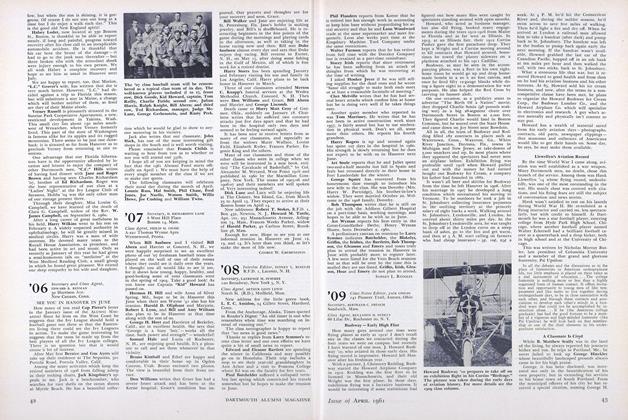
Wally Ross '09 (l), retired secretary ofthe Tech Christian Association atis still an ardent squash player at 75, andso is his opponent, Dr. Lyman Richardsof the Medical Department, who is 69.Ross, who retired in 1953, is secretaryof the TCA advisory board and givesmuch time to the Student ChristianMovement in New England.
Class Notes Editor, 141 Pioneer Trail, Aurora, Ohio
Secretary, Sandwich, Mass.
Class Agent, 66 Lilac Dr., Rochester 20, N. Y.