Drinking
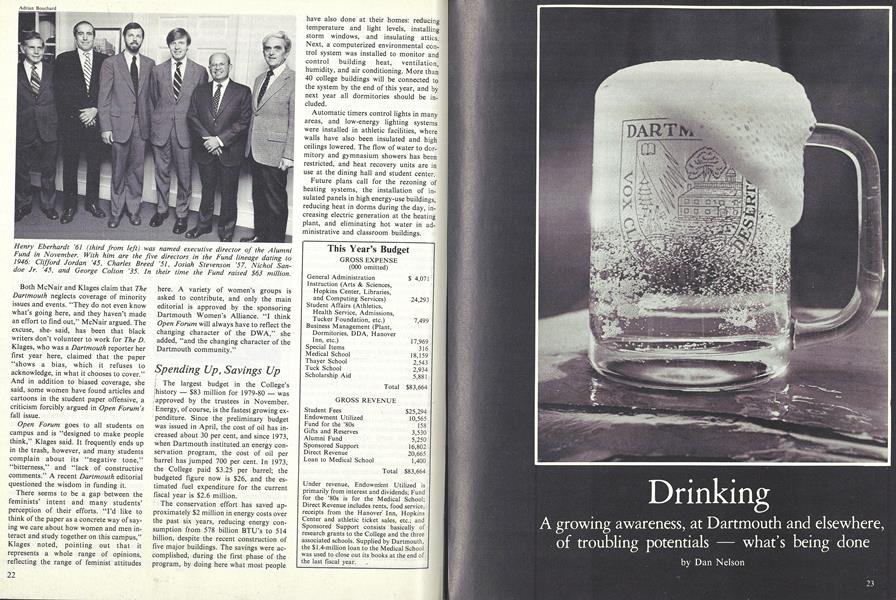
A growing awareness, at Dartmouth and elsewhere, of troubling potentials what's being done
THE intoxicated student retching over the front-porch railing of the Hanover Inn, the sophomore rushed to the emergency room because he tried to punch his fist through a glass door, the keg thrown through a dormitory window, someone "booting" into a band member's tuba at a football game, the young woman passed out on a fraternity floor, an alumnus and his wife exchanging blows at a reunion these are not the basic reasons for concern about abuse of alcohol at Dartmouth. Although such incidents relate to the excessive consumption of alcohol, they are, however unfortunate or deplorable, not the most significant symptoms of the most serious problems.
Conversations with students, alumni, professors, administrators, trustees, and health specialists suggest that the real problems have to do with the many ways that social life here is focused on drinking (frequently heavy drinking), the ways drinking affects personal relationships (including relationships between the sexes), and the ways uninformed, irresponsible, and uncontrolled drinking disrupts people's lives. And despite the myths we cultivate, drinking at Dartmouth is hot much different from drinking at other colleges and universities, which share a problem with the rest of American society and its estimated 15 to 20 million alcoholics.
Alcohol abuse and alcoholism are hazy terms, and there does not seem to be much agreement about the accuracy of, or even the necessity for, definitions. Alcoholics Anonymous describes, an "obession of the mind, coupled with a compulsion of the body." In an informative book called simply Drinking, Jack Weiner defines an alcoholic as "the person whose drinking interferes with health, job, or studies, relations with his family, community or social relationships and yet he, or she, continues to drink." By any definition, it is not just the drunks on skid row a minority of alcoholics who have a problem; it is an unhealthy number of the rest of us, including what some sources say is almost one out of five of the nation's doctors. Five years ago, Time magazine reported some startling statistics: 500,000 people are injured and disabled and 30,000 are killed yearly in alcohol-related traffic accidents; half the homicides and one quarter of the suicides in the country are alcohol-related; and the dollar cost of alcoholism, including costs to employers for lost time and productivity, is estimated at $15 billion a year. There are, in fact, alcoholic Dartmouth students, and many who statistically seem likely to become alcoholics. Most of the concern here, however, is directed at ignorance about alcohol and what is perceived as alcohol abuse, not the disease of alcoholism.
IN May of 1976, Norman Carpenter '53, a Minneapolis attorney, wrote an essay for the ALUMNI MAGAZINE'S "Vox" column about being an alcoholic, about his drinking experience at Dartmouth, and about what he saw as the College's respon- sibility to educate students about chemical dependency: "While I do not blame the College for anything that happened to me nor is there any hard evidence to suggest that anything different would have happened to me had I gone to Haverford or Harvard the journey back through my earlier years and the alcohol there presently led me to Hanover," he said. "Alcohol was a preoccupation, at least to an impressionable late teenager. . . . My modest proposal would be that some awareness of the problem be manifested by the College." Since Carpenter's article, signs of that awareness by the trustees and others and a commitment to do something about the problem at Dartmouth, have been forthcoming.
Carpenter pointed out that during his treatment for alcoholism he encountered a number of other alumni and their spouses who also had trouble with alcohol, an observation supported by the results of surveys conducted by several classes from the early 1940s for their 25th reunions. Out of approximately 350 alumni responding to the surveys from each of three classes, about 20 in each class said alcohol was "a major problem" for them. About 20 in each class said they consumed 26-40 drinks a week, six or seven said they had more than 40 drinks a week, and around 140 replied that they presently drank much more than when they were in college.
More recently, surveys have been made of drinking habits of Dartmouth students. A 1977 questionaire prepared by the Medical Foundation, Inc., of Boston, as part of a survey of drinking practices at 34 New England colleges, was answered by 230 Dartmouth students 150 men and 80 women a response rate of about 75 per cent. About ten per cent of the men and five per cent of the women reported that they used alcohol (beer seemed to be the beverage of choice) nearly every day, and 26 per cent of the men said that when they drank beer, they usually consumed the equivalent of a six-pack or more on each occasion. Asked how often they "got high," 28 per cent of the men and 18 per cent of the women said once or twice a week. About 13 per cent of the men and five per cent of the women reported getting drunk at least once a week and getting drunk, many more of them affirmed, was an important reason why they drank. Almost 70 per cent of both sexes said "getting high" was an important reason for drinking. The overall survey results, according to a UPI report on the study, indicated that drinking patterns were established in high school, that only five per cent of the respondents classified themselves as abstainers, and that the use of alcohol among high school and college students has risen dramatically since a similar survey in 1950.
The results of a Dartmouth survey last winter were similar, although the percentages of people reporting frequent and heavy drinking were slightly higher. The National Institute on Alcohol Abuse and Alocholism stated in 1976 that "what is most significant about campus drinking is not that most of our college students use alcohol, but that many use a significant amount at times, and that few consider the possible implications of their drinking behavior unless they get into trouble as a result of drinking." The Institute's report added that recent surveys show "the heavy consumption of alcohol on campuses to be no different from adult society at large." More interesting than all the statistics, however, are some perceptions and comments made by people at the College.
A tenured professor: "I'm not ashamed to admit that I'm an alcoholic and I don't care who knows it because I haven't had a drink in 20 years, but publishing my name might frighten someone who needs help but is scared to death of being identified. ... It seems to me that there has been a change in student drinking habits over the years that I have been here. I think it used to be that the heavy drinking occurred on weekends, but now there seems to be a good deal of heavy drinking during the week, and also more public drunkenness. I have students coming to class with bad hangovers, and I routinely see kids walking around campus with beers in their hands. I don't think I saw much of that until recently.
"Young people traditionally abuse alcohol as part of growing up, but I know students whose drinking habits are interfering with their personal and academic goals. Alcohol can have the benevolent aspect of 'greasing the wheels' of social functions, but I think students are depending on it for that. It becomes habitual, a substitute for the social skills they aren't learning. They can't face a social encounter without a drink in hand.
"There is an identifiable number of students and professors with an alcohol addiction and I know two students and five colleagues in Alcoholics Anonymous. There are five AA meetings a week in Hanover, by the way, plus meetings in nearby towns, all very well attended. When I came to Dartmouth, there weren't any meetings in Hanover. There are, however, many alcoholics in Hanover who, for various reasons, can't bring themselves to come to AA. Some awful things have happened in this town because of alcohol suicides, for example and there isn't much encouragement not to drink. The faculty is by no means immune, and although those who have a problem seem to meet their teaching obligations all right, they probably don't teach very well at times. The assumption that faculty members are sophisticated enough to help themselves is absolutely false."
ANNE MERROW, a certified alcohol counselor who has been presenting alcohol education programs in area grade schools: "There is lots of heavy drinking in Hanover not just at the College and the rate of alcoholism is right up there with the national average. Kids are using alcohol at a younger and younger age, and instead of using it as a steppingstone to adulthood, they are drinking specifically to get high. Tackling the alcohol problem at Dartmouth is bound to be a big job. The most popular drug is alcohol probably beer and people underestimate its dangers. It's sad and frightening that students seem to think that abusing alcohol is funny. When you talk about it, it's difficult to avoid coming across like a crusader because it's a very emotional subject. No matter what you say, people have an opinion, frequently misinformed."
BARNES BOFFEY, a lecturer in the Education Department who also has a private counseling practice: "I think many students see getting drunk as a legitimate recreational activity. The whole framework for looking at the concept of abuse is off because the frame of reference is oriented to the respectability of abusing alcohol. Blackouts, for example, are a consistent sign of real alcohol problems, but people accept blackouts as a normal part of drinking. Heavy drinking among young people is not particularly uncommon or dangerous. The problem is people whose lives are hurt by the use of alcohol and who need information or assistance."
A student overheard talking to a friend in the gym: "Hey I don't have any work to do tonight. What a bonus. I'm going to go out and get smashed."
FACULTY COMMITTEE ON FRATERNITIES, recommending that the houses institute a drinking policy: "The excessive consumption of alcoholic beverages is one of the most disturbing aspects of student life."
ROBERT MCEWAN, college proctor: "When a person is out of control or can't function, we consider that a medical problem first even if there is some property damage involved and we get him to Dick's House or the emergency room for assistance. Our biggest concern is safety people hurting themselves or others. On an average weekend, we make six to ten responses to calls having to do with an alcohol-related problem. We're very rarely called to fraternities; most of the problems there seem to be handled internally. The drinking thing is a problem everywhere, and not peculiar to Dartmouth.
"A lot of dorm damage is alcoholrelated, particularly when there are keg parties, and there seem to be more kegs in dorms than ever before. Enforcing the state drinking age since it was raised from 18 to 20 is a problem, too. We've increased our foot patrols, and we check ID's at keg parties. ... If a student is identified committing an infraction of some sort, he has to come see me. I inform him of the infraction, then send him to the Dean's Office. Of course, the person has to pay for any damage he's caused. We've been getting more complaint calls from students more and more of them are getting fed up with all this nonsense."
DR. RAYMOND JACKSON, director of the College Health Service: "We have varying degrees of problem-drinking at Dartmouth. We seem to see enclaves of students in a given living unit who think the way to have fun is to get drunk and punch a fist through the window. This happens often enough so that no one here is astonished. We also get some students but not many who come in complaining about problems related to the use of alcohol. More often, we see students so passed out that their friends bring them in, and we've had them intoxicated to the point that their basic functions had to be supported in the hospital.
"You might be interested to know that Sink Night has been quieter in recent years. When I came here in 1966, we assigned extra staff on big weekends. The behavior requiring that has died down. There still are times when the emergency room is busy with intoxicated students, but the practice of having an all-campus, all out Sink Night seems to have diminished.
"The issue we want to face is how to help people understand the difference between responsible and irresponsible drinking. The practice of getting drunk as a social activity is in itself an appalling comment on the ingenuity and attitudes of our students."
FEMALE STUDENT: "The assumption here seems to be that you drink to get drunk, and it is considered very much the norm to be drunk at a party. I depledged from a sorority because everything we did involved drinking. Since you drink so much at fraternities and sororities, you end up not going there if you don't want to drink. And if you want to drink, that's where you do go. I know a girl who alternates between binges and remorse. Drinking is everything or nothing for her. But lots of things are done to excess here there's lots of compulsive behavior drinking is just the most obvious example."
MALE STUDENT: "Drinking is one way people here assert themselves, and at the same time it makes it easy for them to fit in. Repeated, excessive drinking is something a lot of people here go through. It takes a while before you develop the self-confidence to say no. Most of the heavy drinking occurs on weekends, because so much of the social activity is weekend-oriented, but there is a lot of week-night drinking, too. I know a few people who drink regularly during the week. They'll start skipping classes the next morning, then make a big deal about going on the wagon, but then start up again. Drinking is also very tied in with the fraternities. Parties are organized around drinking with the purpose of getting people drunk. As a result, everything about drinking permeates the houses from the idea, to the smell, to the kinds of relationships that develop."
BEVERLIE CONANT, health educator at Dartmouth: "Some students have told me they drink heavily because there is nothing else to do but that isn't my impression of Dartmouth. Some also seem to feel there are not enough large-group activities that don't involve alcohol. ... I went to a student cocktail party recently and observed men and women trying to get acquainted. Within the space of two hours, individuals were falling on the floor and spilling beer on one another. I also observed what appeared to be heavy drinking at a reception for new medical faculty people seemed to be drinking rapidly to loosen up and feel comfortable in a social encounter. There wasn't so much overt intoxicated behavior, but alcohol was affecting people's behavior. There doesn't seem to be much difference in attitude between drinking on a student and adult level. It isn't just students, and it isn't just Dartmouth it's our culture. Drinking is institutionalized and a tradition. It doesn't have to be a bad tradition. It's a great thing to learn responsible social drinking. People come to Dartmouth and experience a great deal of freedom and availability of all sorts of things, including alcohol. We need to look at how we provide the sort of environment that teaches and reinforces responsibility. The use of alcohol here is part of a pattern involving all sorts of other behavior."
NORMAN CARPENTER '53: "... in the middle of 1974, I entered treatment for alcoholism. From that experience I can say that if anything was missing at Dartmouth, it was the hard facts about alcohol."
LAST year, in response to these kinds of observations, and at the request of some students, administrators, and professors who had expressed an interest in alcohol-related problems at Dartmouth, Larry Peiros '77, who was then an assistant dean, organized an alcohol concerns committee. The committee's functions, Peiros explained in a memo to the dean of students, John Hanson '59, would be to "make students aware of the extent and effects of alcohol use and abuse; to educate students about the simple facts concerning alcohol use; to encourage alternative social activities which promote responsible drinking; and to establish a referral network for those students with drinking problems."
Some of the goals outlined by this year's committee chairman, Steve Nelson, director of the Collis Student Center, include an analysis of the College's policy on alcohol use and an examination of the effect of the raised drinking age. Simple education about alcohol, perceived as the main object of the committee's work, also seems to be the most difficult job. "No matter what you do or say," Nelson admitted, "it's hard to avoid coming across as a do-gooder or as a prohibitionist, which isn't what we're about at all." Attendance at public lectures has been disappointing, and a student-produced "Alcohol Road Show" — a presentation to dormitories and fraternities, stressing responsible drinking and discussing facts and myths of alcohol use — has been slow getting off the ground.
Student reaction has been mixed, mostly indifferent. Many students don't perceive alcohol abuse to be a problem, and others find efforts to do something about it a convenient target. Beverlie Conant reported that some of the committee's brochures containing information about where to go for help with an alcohol problem and tips for dealing with emergencies were "ceremoniously burned" at some dorms and fraternities. She doesn't find the response particularly surprising. "Health behavior is difficult to affect," she pointed out, "although health knowledge is relatively easy to influence. That knowledge may even affect people's attitudes, but then asking that to change people's behavior is asking a tremendous amount." A change in drinking behavior can't be forced, Conant added, "but we can acknowledge the problem, attempt to raise consciousness, and provide information for people who are interested."
The committee has also sponsored the training of volunteer student "peer counselors." The rationale is that students are lively to be most comfortable talking about drinking behavior and attitudes with other Students, and the counselors' training emphasizes communications skills particularly how to ask the right sort of questions and factual information. Following about eight hours of training, the students are able to share information about the effects of alcohol, provide referrals to professional services, help other students evaluate personal drinking habits, and assist people concerned about the drinking problems of friends and family members. Some of the 20 participants in the program mentioned the value of learning "how to talk with people about a problem without being judgmental," "that you can have problems with alcohol without being an alcoholic," and "an awareness of my own attitudes and potentially dangerous drinking habits." The counselors have yet to be swamped with requests for help, but Barnes Boffee, who directed the training, claims that the real value of the program is the education of the people who have participated.
Students, of course, aren't the only people on campus who have difficulties with alcohol. The College has a voluntary (and confidential) Employee Assistance Program, designed to provide professional help to employees with a whole range of personal problems, including alcohol. The Personnel Department has contracted with Charlotte Sanborn, director of consultation and education at a local mental health center, to meet with employees and refer them, if they wish, to appropriate professional services. Sanborn said that about one third of the people who come to see her come with alcohol problems, not just their own but also family drinking problems and the "spin-offs" of spouse and child abuse. She also noted that the alcohol problem needs more attention than her half-day-per-week contract with the College provides, but she pointed out that "just to get what we have now took a fair amount of work." There is some talk of expanding the services available to employees perhaps through educational programs and an alcohol support group. One of the difficulties in dealing with personal problems among the staff, Sanborn said, is bucking a Yankee attitude of self-sufficiency.
The Medical School, with funding from the Kroc Foundation, has instituted Project Cork to integrate teaching about alcohol into all phases of medical education, and to develop a model curriculum for other schools. The project, directed by Dr. Peter Whybrow, is noteworthy because the medical profession has been criticized for its reluctance to come to grips with the disease of alcoholism, the nation's thirdranking health problem. In the education of most doctors, if alcohol-related health problems were considered at all, they tended to be discussed in a single lecture or elective course. The aim at Dartmouth is to "bombard" medical students with alcohol information, and there is also some talk of using some of the same material in science courses where some of the medical faculty instruct undergraduates.
THE latest institutional response to alcohol concerns was made by the Dartmouth trustees at their November meeting, when they unanimously passed the following resolution: "The Board of Trustees affirms its support for those programs now on campus leading to wider understanding of the use and abuse of alcohol. We encourage further educational efforts designed for those students and other members of the College community who seek to make informed choices where alcohol is involved. The board has instructed the administration to emphasize College policy that non-alcoholic beverages be available at all Collegesponsored functions, and hopes that this policy will be followed campus-wide. The board further asserts that the abuse of alcohol has no place in any valid Dartmouth tradition, nor has it made any positive contribution to the Dartmouth Spirit."
Norman McCulloch Jr. '50, the sponsor of the resolution, explained in a recent conversation that "the whole purpose of our statement was to show every Dartmouth constituency that there is support at the highest institutional levels for alcoholeducation efforts and concern about abuses." The trustees spent a considerable part of their annual summer retreat talking about alcohol problems at Dartmouth, he said, and their active concern started two years ago when the board began addressing itself to fraternity conduct and standards. "We realized that abuses were taking place, that there was lots of alcohol-related Animal House behavior going on, and we simultaneously began to worry about the whole quality of student life on campus. The deteriorated situation in the fraternities, some of the problems relating to student life, and the kinds of abuses reported in the press all related to misuse of alcohol. We were convinced that we should at least inform ourselves about what was going on with alcohol education, and to what extent the abuses were real. The result of that, and of our summer discussion, is this resolution, which we consider extremely important, and which has the enthusiastic backing of the administration."
Some of the trustees say they are disappointed that their statement has not had more public impact. But the importance of the resolution, as McCulloch pointed out in a memo to the board last August, is that it provides the strongest institutional endorsement of efforts to address the problem of alcohol abuse, and some muscle behind what previously was often an ignored or unknown College policy.
President Kemeny has also spoken out about alcohol abuse and has expressed his support of efforts to combat it. "A critical element in the solution of a problem is its recognition, and for that reason I have been very pleased to learn about the activities of the College Committee on Alcohol Concerns and the efforts of others in the College community to deal openly and rationally with one of the serious problems of our society," he said recently. "There is no reason for Dartmouth to be exempt from a problem that affects the whole nation," he added, "and I have a strong conviction shared by the entire Board of Trustees that the College has an obligation to bring to the study of this question the very best resources we have available." Kemeny also said he was encouraged by the cooperation of students, faculty, and administrators in dealing with the problem, and that the "interest and assistance of knowledgeable alumni" would be welcomed.
Two important questions come to mind about the College's efforts to do something about alcohol abuse. The answer to the first Will any of this activity make any difference? seems to be a qualified maybe. Maybe requiring that there be an alternative to alcoholic beverages at College-sponsored events will make it easier for someone who doesn't want or need a drink to say no. Maybe students will learn something about the chemical effect of alcohol on human physiology, and realize why, for example, a chugging contest might not be a good idea. And maybe someone with a drinking problem will become aware of where to go for help. But the larger problems of accepting intoxication as a legitimate purpose of social activities, of the difficulty some people have in achieving more than drinking-buddy relationships, and of the disruption of institutional purposes and people's lives. are probably beyond the reach of an alcohol concerns committee or a dean enforcing the drinking policy. Those larger issues have something to do with the spirit of an institution the way its members approach education and community life. It is encouraging to note that there are people here, including members of a recently formed Committee on the Quality of Student Life, actively addressing those issues.
The second question concerns why a college today should even care about its students' attitudes toward the use of alcohol. Several answers seem to make particular sense: Professor David Lemal, chairman of the student life committee, said that "one of the things we've recognized is that alcohol abuse is a serious problem here, and one that ought to be met head on. I was pleased to see that the trustees agree. It is enough of a problem in society at large that we ought to be doing everything we can about it at Dartmouth. I've reached the stage in life where I have friends who are dying because their livers no longer work, which makes the whole issue especially significant for me."
The professor who has successfully come to grips with his own alcoholism argued that if a college's main responsibility is to educate its students, then anything that interferes with students' education should be dealt with. McCulloch said that "the abuse of alcohol on campus is sufficiently widespread as to threaten the quality of the Dartmouth educational experience." Another professor stressed the importance of non-cognitive education. Besides the responsibility for conveying information, he claimed, a college has an obligation to encourage students to discover their identity and place in the world. Providing information about alcohol, as well as help to people who are floundering, is part of that obligation, he said.
Dean John Hanson said the College's commitment is consistent with its approach to broadly defined education and fostering learning beyond the classroom. He also said Dartmouth has an interest in preserving order and protecting students from the abusive behavior of others. Until recently, he pointed out, scientific knowledge about chemical dependency, particularly among young people, was rudimentary, but now that the potential for alcohol addiction among students is better understood, the College has recognized an obligation. "Intimate aquaintance with the lives of alcoholics reinforces the value of any efforts we can make," he added.
In his fall-term "broadside," an address to the community about moral concerns in education, the dean of the Tucker Foundation, Warner Traynham '57, wrote, "The provost has said that the focus of this institution is the life of the mind. That life is surely broader than simply the power to analyze and reflect, the capacity to discover and imbibe knowledge. It is also a function of the mind to appreciate, to apprehend significance, to commit to purpose, to perceive obligation, and to care." Traynham was not talking specifically about alcohol abuse, and the people trying to do something about alcohol abuse are bending over backwards to keep moral judgments apart from their activities, but it seems reasonable to suggest that the kind of institution Dartmouth claims to be does indeed have an obligation to care about the attitudes and behavior associated with uninformed or irresponsible drinking.
. . . the abuse of alcohol has no place in any validDartmouth tradition, nor has it made any positive contribution to the Dartmout the trustees
More From This Issue
-
 Feature
SCORE!
January | February 1980 -
 Feature
Liberal Arts, yes 'Core of Knowledge,' no Changing the Calendar, maybe
January | February 1980 -
 Feature
They Don't Even Filch the Silver Here
January | February 1980 -
 Article
A Matter of Directness
January | February 1980 -
 Class Notes
1948
January | February 1980 -
 Article
The Undergraduate Chair
January | February 1980
Dan Nelson
-
 Feature
Stalking the Student Athlete
MARCH 1978 -
 Article
A Journey: Five days to Big Rapids
September 1978 -
 Feature
'A hell of a lot of life gone by'
November 1978 -
 Feature
Temples, Turtles and Fat Boys
September 1979 -
 Feature
Life in High Places
April 1980 -
 Feature
Men and Women: What's the Difference?
OCT. 1977