1930
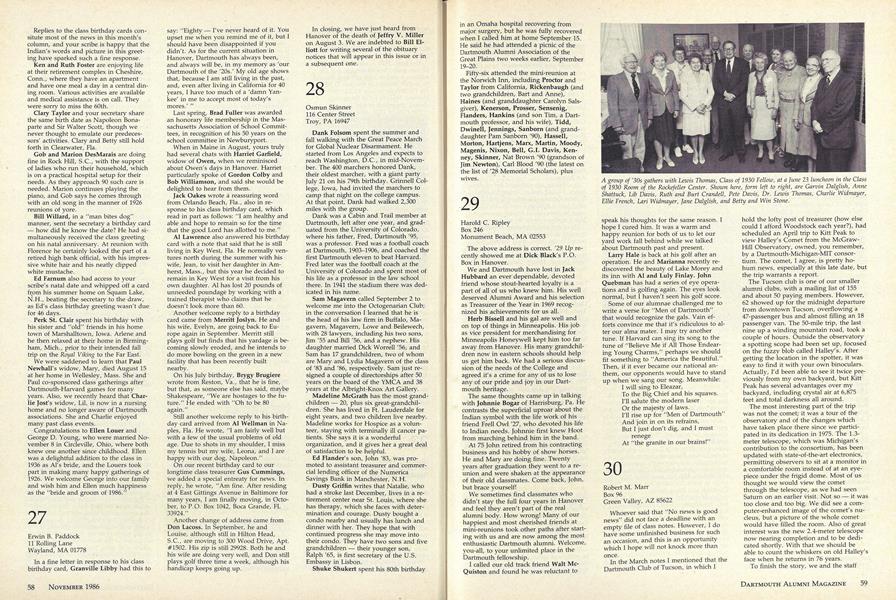
Whoever said that "No news is good news" did not face a deadline with an empty file of class notes. However, I do have some unfinished business for such an occasion, and this is an opportunity which I hope will not knock more than once.
In the March notes I mentioned that the Dartmouth Club of Tucson, in which I hold the lofty post of treasurer (how else could I afford Woodstock each year?), had scheduled an April trip to Kitt Peak to view Halley's Comet from the McGrawHill Observatory, owned, you remember, by a Dartmouth-Michigan-MIT consort ium. The comet, I agree, is pretty hohum news, especially at this late date, but the trip warrants a report.
The Tucson club is one of our smaller alumni clubs, with a mailing list of 155 and about 50 paying members. However, 62 showed up for the midnight departure from downtown Tucson, overflowing a 47-passenger bus and almost filling an 18 passenger van. The 50-mile trip, the last nine up a winding mountain road, took a couple of hours. Outside the observatory a spotting scope had been set up, focused on the fuzzy blob called Halley's. After getting the location in the spotter, it was easy to find it with your own binoculars. Actually, I'd been able to see it twice previously from my own backyard, but Kitt Peak has several advantages over my backyard, including crystal air at 6,875 feet and total darkness all around.
The most interesting part of the trip was not the comet; it was a tour of the observatory and of the changes which have taken place there since we partici- pated in its dedication in 1975. The 1.3- meter telescope, which was Michigan's contribution to the consortium, has been updated with state-of-the-art electronics, permitting observers to sit at a monitor in a comfortable room instead of at an eye- piece under the frigid dome. Most of us thought we would view the comet through the telescope, as we had seen Saturn on an earlier visit. Not so it was too close and too big. We did see a computer-enhanced image of the comet's nucleus, but a picture of the whole comet would have filled the room. Also of great interest was the new 2.4-meter telescope now nearing completion and to be dedic ated shortly. With that we should be able to count the whiskers on old Halley's face when he returns in 76 years.
To finish the story, we and the staff had a buffet breakfast and took off for the scenic trip back in the sunrise. Home at 7:00 a.m., I slept a couple of hours then and ten solid hours that night.
I must report that, once again, 1930 is without a representative in Tucson. Tucson residents Don Howard died in 1969, Carlos Nestler in 1973, and Jerry Howard in 1974, and then there were none until Hank Bishop arrived in 1981. Sadly, Hank died unexpectedly on August 18, 1986. An obituary will follow, but I'd like to comment here that, in spite of the accident which almost completely immobilized him in mid-1985, Hank never lost his spirit, interest, and sense of humor.
Elsewhere in Arizona we still have Messrs. Christman and Guilfoy in Sun City, Conklin in Scottsdale, part-timer Haffenreffer in Tubac, and part-time newcomer John F. Rich in Mesa. Also Norma Lowery in Mesa, Susan Long in Sun City, and Louella (Jerry) Howard and Mildred (Nestler) Morrison in Tucson. Unfortunately we can't claim Margaret(Kelsea) Moore, though someone must have told Charlie Widmayer that Las Cruces, where she lives, is in Arizona.
Greetings.
Box 96 Green Valley, AZ 85622
More From This Issue
-
 Feature
A Reaffirmation of Mission
November 1986 -
 Feature
How "Eleazar" Pulled It Off
November 1986 -
 Feature
The New England Review and Bread Loaf Quarterly
November 1986 -
 Article
Dartmouth Authors
November 1986 -
 Article
Tony-winner Jerry Zaks '67: "...in the first place"
November 1986 -
 Article
David O. Hooke '84: Chubber's Boswell
November 1986