A Bunch Of Characters
WRITING A NOVEL AND NEED A MANIPULATIVE/P.G./ SGHOLARLY/OUTDOORSY/NICE YOUNG MALE PROTAGONIST? HAVE HIM GRADUATE FROM DARTMOUTH.
One early indication that I would fail my progenitors by going to Dartmouth and becoming a Yankee was my obsession with Lisa Birnbach's The Preppy Handbook. If that book was a church, Ms. Birnbach was my intellectual pastor. I knelt my head in its madras-bound pews, devouring her details about the Ivy League and the entitled lifestyle.
I was always a big reader. Afternoons while my mother had her roots done at the Virginia School of Cosmetology, I would hunker my plump pre-teen self down in the neon-lit West End Public Library to pore through the guide and study up on what the news weeklies later called The Yuppie. That reading alone was very unSouthern of me. Social striving down South is conducted two generations before your birth—thus making you a born loser if you're not christened in the villa where your grandpap cow-tipped and Grandma debbed. But as I read through the Handbook, I developed ideas about how a Pose of Preppiness could lift me from my strange and twisted roots. I would gaze up into the library's fluorescent lights and hear voices: As God is my witness, I will never livehere again, just like Scarlett O'Hara
Ms. Birnbach's characters, like the residents of Faulkner's Yoknapatawpha County and the crazed Manning family in Ellen Gilchrist's many fictions, showed me my new New England etiquette. How to dress: androgynously. What to read: Salinger. How to take things for granted: often, and by not thanking anyone too enthusiastically. Where to own on Nantucket.
There were even tips about colleges. Strangely, Dartmouth wasn't one of Ms. B's top picks, but it became mine, for preppy criteria: the campus's L.L. Bean chic, good humanities, nice-looking men and dogs, and distance from Dixie. I fantasized about going there, then went there, then realized that "there" was a fantasy made believable by a book. I have to wonder: What did that book do to me over the long run? Schools like Dartmouth agonize over their reputation in journals of record, but what about their treatment in the long-standing Canon of fiction and fantasy? When authors ranging from Tom Clancy to Saul Bellow, from Ann Beattie to Armistead Maupin, are making their characters Dartmouth grads, we loyal alumni should arm ourselves with critical inquiry.
So step into my parlor. Call the lab and grab a cardigan. Jeeves, tell them we'll be in the library... and bring my old Dartmouth friend another hot toddy. We've got a long night ahead of us.
BAD THINGS FIRST: STEREOTYPES. These include a character I'll call The Male Manipulator. The University Press of New England could start an imprint for this broad genre of Frat guys, liars, and Wall Streeters. These fatally narcissistic men are muses for authors who write books like Men Who HateWomen and the Women Who Love Them. Their mothers adored them and they love themselves too; their fathers were manipulators and if the sons don't do a Manipulator Jr. then they'll grow up to become ever-catharting P.C. Scholar-Writers, but we'll get to them in a minute. The Latin key-word for these boys is hubris. Their Tarot card: The Devil. Their sign: Gemini. Their income: seven figures before age 30.
The Manipulator is exemplified by Harrison Ford's character in Working Girl, a man named Jack Trainer who's a Dart mouth alum. We often meet him either conning a nubile female co-worker or conning some innocent. The Manipulator, in a slightly more foolish and innocent form, also occurs as the hubris-ridden Player. The Player usually has his life laid out for him early on; he has the ironic world view that comes from looking out at the world from inside a sheltered one. Players are usually in their 20s. Take hotshot Duane a Wall Street weenie inJayMclnerney's Brightness Falls. (Mr. Mclnerney is a Williams grad.) He's always giving anorexic banker Corrine the moves down on Wall Street, but Corrine has this to say about him: "The problem with Duane, it seemed to her, was that someone had once told him that he was dashingly handsome, and he'd taken it to heart. There was a kind of self-consciousness to his insouciant gestures and his attention to dress that made him seem comic. Maybe it was just youth. He was almost five years younger, having arrived here straight out of Dartmouth—all the kids rushing headlong into professions they'd chosen in the cradle. Whatever happened to trying things out?"
Then we have Ted Fell in Dale Brown's Storming Heaven, a book that manages to blend international terrorism and airport bombings with the minutiae of downtown deal making. Ted (Dartmouth, Harvard M.B.A.), is "one of the few people, in fact the only one, who could really talk" straight to his boss. "You need eighteen million dollars by close of business today. If I had even three days, I could get that for you at eight-point-five." We can see why other people don't talk to the boss that way.
BUT THE PLAYER CAN GRADUATE from just about any top college. Our own College's most distinctive character is its own version of the Marlboro Man: the Dartmouth Outdoor Man. Outdoor Man is pretty easy to recognize, because he often ends up as a film. He uses guns, spears, and women. He sweats, bleeds, and gravitates toward extremities of temperature (deserts, the Arctic).
At the cusp between Player and Outdoor Man is James Michener's character Jeb Keeler who appears in the last chapter of Alaska. Jeb is lured to the far north by the chance to kill Arctic wildlife. A lawyer who advises firms on government policy, he is pulling in $1 million a year by 30. He is wrapped up in the Old Boy Network—most Players are, for the OBN is at the heart of the game. Jeb gets a little help from the Old Boys even when he hunts walrus on the ice floes. Two co-workers shoot the animal at the exact moment Jeb does, but "Jeb was unaware that the other two had fired, and when he ran up to the fallen beast he exalted as if he alone had slain this admirable specimen." And therein lies the hubris.
Tom Clancy produces a Dartmouth Outdoor Man, desert subspecies, in Clear and Present Danger. Clark, a.k.a.J.T. Williams, a.k.a. just about anything he wants on his passport, drives a Subaru around the Colombian desert while planning schemes to save the world from drug trafficking. His "full head of black hair" surmounts "a lantern jaw that hinted at his ancestry" and the requisite "blue eyes that twinkled when he wanted them to, and burned when he did not." Even his shoulders are remarkably articulate: they "spoke volumes about his exercise program." Clark himself is fluent in six languages, though the dialogue seems to show that English is not one of his better ones. "Not everybody can take on a hopeless mission and keep at it," he consoles a pilot.
Robert Ludlum's The Rhinemann Exchange introduces us to a more sophisticated James Bondian version of the Outdoor Man in World War II superagent David Spaulding. David's voice is "middeep, incisive, heavily accented" whenever he wants it to be. But he speaks only half the languages of Clancy's Clark. Spaulding's parents "maintained three residences" in Germany, Portugal, and London. The boy went to Andover and then Dartmouth against the objections of his mother, who was a bit of a snob toward American education.
The Dartmouth Out-door Man, in short, is an educated savage.
His ANTITHESIS is a kind of indoor person I'll call The P.C. Scholar-Writer, as outlined in Michael Dorris and Louise Erdrich's Crown of Columbus, Wallace Stegner's Crossing to Safety, and Anne Beattie's PicturingWill In the case of Dorris-Erdrich and Ms. Beattie, this character is a bad, sappy writer all the more touching for the attempt. Sage Mr. Stegner spares us the scribblings of his Dartmouth Scholar-Writer, letting us know instead where he's been published and tenured.
Ms. Beattie's character, Mel, is a serious but sensitive yuppie art dealer who likes wearing Charivari suits. "Being a graduate of Dartmouth was a great embarrassment to him," we are informed, "but he covered for it by being the first to bring it up, shaking his head and saying that he had turned down Yale... because he had only wanted to ski." Mel spends much of his time in internal monologues that describe the thumb-sucking behavior of his girlfriend's son. "In the darkroom, every night, Mel ruminates, "our last whispered words are always—and only—'Good night.'" Now that's sensitive, in bucketfuls. What redeems shaky passages like this one is the deep significance of the Dartmouth male as a closet sentimentalist with attractive maternal instincts.
Similarly ruminative is the Dartmouth male professor in Crown of Columbus. He runs to long intellectual poetry which he stores on a disk in the pocket of his fancy-branded Oxford shirt. His heroic challenge is losing this disk in a Caribbean melee involving spear guns, coral reefs, and sharks. In his desolation and loneliness he recites his entire Columbus epic, including: I do not know myself. No more, than the threadwoven in the field of clothknows the pattern. No more than the patternapprehends the mind that devised it, or the handthat threw the shuttle or the strengththat bent and pegged the wooden loom.No more than the garmentknows its purpose, its maker,do I know Columbus.
This Vox Clamantis in Academia has a sub-genre: the Conservative Scholar-Writer—and why not! A real-life Dinesh D'Souza '82 is just as valid a Dartmouth representative as Ann Beattie's mushy Mel. Saul Bellow weighs in on the D'Souza side with a middle-aged University of Chicago administrator in The Dean's December. Protagonist Albert Corde is "a Midwesterner flattened by the prairies, a journalist and lousy college dean." His schooling is uncertain—there are allusions to Grinnell—but he has "never forgotten the long, charmed years in a silent Dartmouth attic, where he had read Plato and Thucydides, Shakespeare. Wasn't it because of this Dartmouth reading that he gave up the Trib and came back from Europe? What attic? Does Dartmouth even have an attic?
A MIDDLE DISTANCE between these outdoor and indoors characters is the Nice Young Man. He is uncluttered with Dean Corde's politics of privilege because he usually works with his hands or in a more concrete vocation. The Nice Young Man is perhaps better covered by F. Scott Fitzgerald, Geoffrey Wolff, or his brother Tobias Wolff, because these writers all favor Princeton-groomed boys. Nice Young Man is a pioneer, willing to take odd jobs and do them well to get through a summer or semester, and good things tend to befall him in this world. Mothers want their daughters to marry him. (My own mother would pull "why, he's such a sweet boy from her lexicon of Dixie dotage to describe him. But then, that's what she said about the Columbia Grad who dumped me six months ago in the Temple Bar as if I were a tramp circa 42 nd Street before Disney, but for his character see The Male Manipulator.)
The Nice Young Man appears in the movie version of ARiver Runs Through It, in the form of the writer-narrator, Norman Maclean '24, who studies at Dartmouth. A good guy, he is preoccupied with saving his alcoholic brother Paul, a reporter in Helena, Montana, from trouble. "We also held in common the knowledge we were tough, he says in the book version. Although this moving tale of fishing, faith, and family is ostensibly fiction, author Maclean really did go to Dartmouth, and he really did have a brother Paul, who really did die in a drunken brawl.
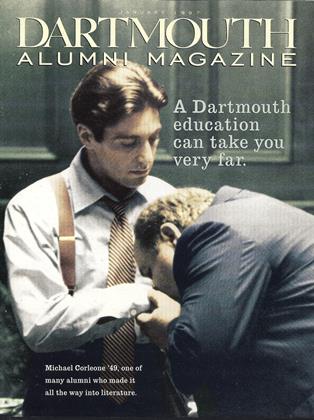
Which leads us to The Nice Young Man in Crisis: a carnival barker in katherine Dunn's Geek Love, described as "The yellow-haired boy from Dartmouth." Another version of N.Y.M. in C. is in Mario Puzo's The Godfather. The Don's youngest son, Michael Corleone, defies, at first, a life of knuckle-breaking and Caddie-driving. "He did not have the heavy, Cupid-shaped face of the other children, and his jet-black hair was straight rather than curly," Puzo writes of Michael. "His skin was a clear olivebrown that would been called beautiful in a girl. He was handsome in a delicate way. Indeed, there had been a time when the Don had worried about his son's masculinity." But, when Michael is 17, the Don stops worrying: The boy leaves his childhood home for the first time to go to Dartmouth.
Tied not to the Mob but to women is N.Y.M. in C. Brian Hawkins, an erstwhile pickup artist with a heart of gold in Armistead Maupin's Tales of the City trilogy. An ex-attorney (George Washington U. Law School) who once represented Good Causes, burned-out Brian works double shifts at a cafe in San Francisco. In the third book, Further Tales ofthe City, he goes to a joint called the Dartmouth Social Club, where a cloying acquaintance comments of the restaurant: "You went to Dartmouth, didn't you? This must be like old home week or something." Trying to pickup poor Brian, she points to a plateglass window emblazoned with a gold-leaf Dartmouth Indian. "Once upon a time, Brian realized with a twinge of nostalgia, Brian would have insisted on calling it the Dartmouth Native American." In the end, though, Brian is faithful to his girlfriend Mary Ann, a go-go broadcast journalist. And that's why he's a Nice Young Man.
Aged to maturity, the Nice Young Man may also appear as a Random Professional who walks through stories like a pair of khakis in the Central Park crowd. He. fills a necessary, mild role in a drama's closet of tricks: predictability, that job the Greek chorus often has in reminding the more flighty characters what the audience already ascertains. This is the role played by lawyer Wendell Bye in Rosellen Brown's Before and After. He advises parents of a child-murderer against the cover-up they orchestrate. Bye is introduced to us as king of the yuppie lawyers, whose careful guardianship of his fellow townsfolk's modest assets has by now bought him a Jacuzzi, a 32 -foot boat, and a neat camp in the woods where he murders deer but does it sentimentally."
Of COURSE, with the advent 25 years ago of extra X chromosomes at Big Green, some authors are giving the fair sex Dartmouth degrees or narrating women onto campus in other ways.
This is how the Cute Young Thing got written into the canon. Cute Young Things tend to be sporty, watching sports events, or writing about sports. That's because they have to be good sports.
The Collected Stories of John Cheever features a story called "AMiscellany of Characters that Won't Appear in my Next Story" which provides one of the earlier examples of CYTs. This "Miscellany" is a catalog of characters Cheever claims are not worthy of birthing into print. One such misfit character, Florrie, perkily lurks on the sidelines of a Dartmouth-Princeton game smiling and being shy and, oops, catching the ball.
Pulitzer Prize-winning author Richard Ford introduces us to his version of the Cute Young Thing, Catherine Flaherty, in The Sportswriter. (Mr. Ford's sequel to this long-winded New Jersey Song of My Mid-life Crisis is the actual prize winner: Independence Day). Toward the end of the book, The Sportswriter decides he's got warm fuzzies for Catherine, a Sports Illustrated intern. This Dartmouth gal is cranking copy for a few months en route to law school. The Sportswriter imagines that Catherine's "type" usually dates "some thick-necked Dartmouth Dan, with whom she is sharing an efficiency on the Upper East Side, taking their 'term off together to decide if a marriage is the wise decision." Catherine's character offers a Nabokovian arm-hair fetish reference, that pedophilic look at "pale blond skim of
hair on her arm, which at the moment she is rubbing lightly with her palm." But the fact that she's "healthy as a kayaker, Boston brogue, 'experienced' already in ways you can only dream about, is a sight for mean eyes." Not only that, but "she is a woman who can be both chatty and challenging." Lord, don't I know it. That's why Dartmouth Dan doesn't exist—he doesn't like his C.Y.T,'s that way.
VARIED AS THESE CHARACTERS ARE, their Dartmouth degrees all serve as a literary shortcut: Have someone graduate from the College, and you provide that person with a patina of Old Money, connections, outdoorsy athleticism, and a touch of brains. You throw in Dartmouth if your character is not quite geeky enough for Yale, not snooty enough for Harvard, not urban enough for Columbia, not "blooded enough for Princeton. And you make him go to Dartmouth if he s a tad maler than other schools' alums.
But if you yourself went to Dartmouth, you are probably reluctant to stick the degree on your characters. Most of the authors I have mentioned did not themselves attend Dartmouth. Note that Norman Maclean even wrote himself into his novel without mentioning the College. It is far more fun to pull in another school, especially if you're not terribly fond of the character. I am working on a novel in which a Virginian is off to a New England college. She was going to be a Dartmouth gal but I decided to send her to Harvard, thinking there would be more options for humor mileage. But maybe I should think twice about that decision. Maybe all the writers who send their women characters to college should do the same it might just change the canon.
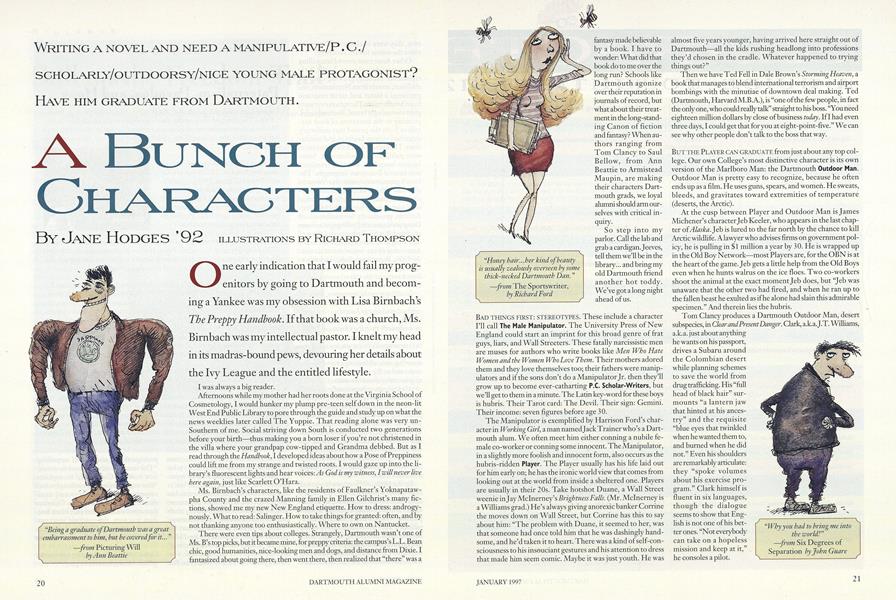
"Being a graduate of Dartmouth was a greatEmbarrassment to him, but he covered for it.from Picturing Will by Ann Beattie
"Honey hair... her kind of beautyis usually zealously overseen by somethick-necked Dartmouth Dan."from The Sportswriter, by Richard Ford
"Why you had to bring me intothe world!"from Six Degrees of Separation by John Guare
"Wrinkled woolen trousers andsports jacket."from The Dean's December, by Saul Bellow
"Remember last year'sgeek? The yellow-hairedhoy from Dartmouth?"from Geek Love, by Katharine Dunn
The terrorists named Bernaldefense minister "chiefly because ofhis Ivy League typing skills."from Tourist Season, by Carl Hiaasen
JANE HODGES lives in New York and is a reporter at Advertising Age. She recently completed an M.F.A. at Sarah Lawrence, buthasn't written fiction about her Dartmouth days yet because shedoesn't have a libel lawyer.